

What You Might Have Missed: January at Middle East Uncovered
Last month’s essential reads, all in one place.

This month, Iran dominated the headlines. Widespread protests shook the country, raising urgent questions about the future of the regime and the stability of the region. Our team analyzed how this moment emerged, what may come next, and how a potential regime shift could reshape Iran and its neighbors.
What drove this month’s biggest stories:
Nationwide protests erupted across Iran, with thousands taking to the streets in cities across the country.
What began as demonstrations over economic hardship escalated into open calls for regime change.
Iranian security forces responded with widespread violence; reports indicate thousands were killed, though an official toll has yet to be confirmed.
U.S. President Donald Trump publicly expressed support for the protesters, warning of potential action if the killings continued, as the United States moved additional military assets into the region.
Despite growing momentum for regime change, no clear or coordinated plan exists for a post-regime transition, raising concerns that collapse without preparation could lead to instability or chaos.
Top Read Stories
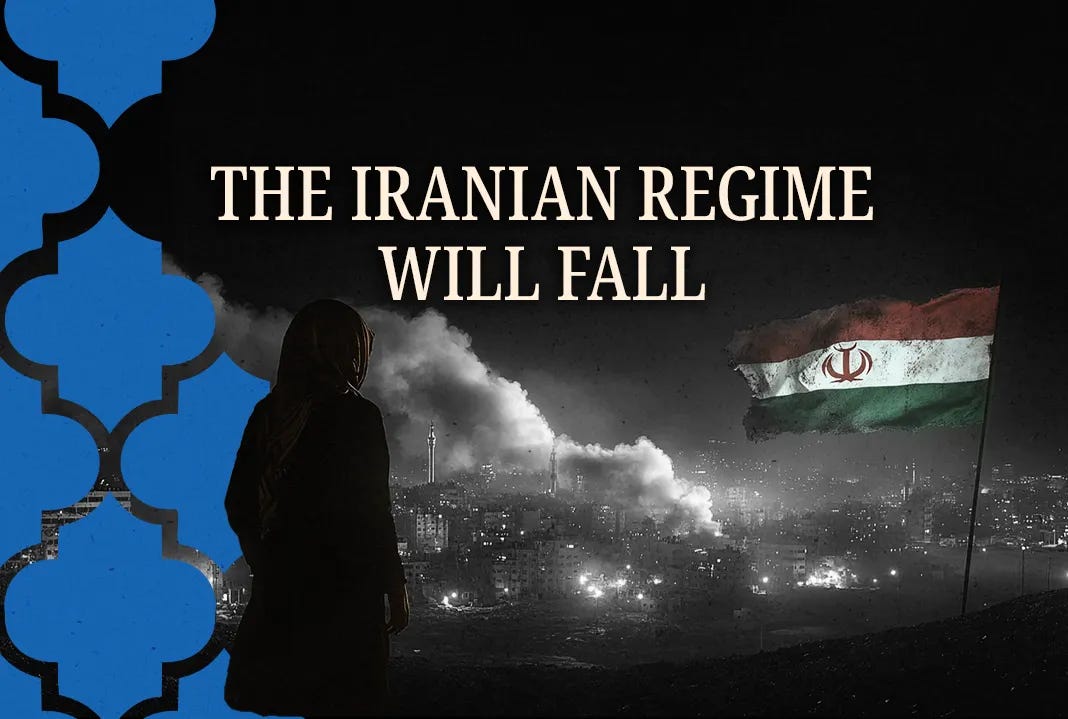
The Iranian Regime Will Fall
The Islamic Republic may endure protests for now, but treating it as a permanent fixture of the regional order ignores mounting evidence of irreversible decline. By Faisal Saeed al-Mutar for The Argument
“The Iranian regime will fall. Whether this happens soon or further down the line remains uncertain, but the overall trajectory is becoming increasingly clear. Authoritarian systems rarely unravel because of a single protest or economic shock. They fail because they accumulate opposition faster than they can contain it and wear out the narratives that once sustained their legitimacy. The Islamic Republic of Iran is now well into that stage. Regimes do not survive indefinitely once legitimacy erodes across multiple fronts.”

Iran’s Berlin Wall Moment and the Dangerous Silence About the Day After
Iran’s uprising has reached an irreversible moment—but no serious plan exists for the day after regime collapse. Without preparation, a revolution could give way to chaos. By Ammar Abdulhamid for The Argument
“Left to its own internal dynamics, Iran now faces two plausible futures. Either the regime reasserts control through mass violence, or it collapses under the weight of sustained nationwide revolt. Both paths are bloody. Only one offers the possibility of something better—and only if the world acts with foresight.
Power vacuums in deeply polarized societies do not produce democracy by default. They produce armed factions, institutional collapse, regional interference, and prolonged civil war.”

Oil, Power, and the Collapse of the Caracas-Tehran Alliance
As Venezuela recalibrates its strategic direction following the capture of Nicolás Maduro, Iran risks losing one of its most important footholds outside the Middle East. By Juan Miguel Matheus for the Argument
“For Israel, Iran is not a distant actor operating at the margins of the Western Hemisphere. It is part of a global architecture that combines financial resources, illicit routes, and political alliances to sustain power projection across regions. From Jerusalem’s perspective, the weakening of the Caracas–Tehran axis is read as an indirect gain in a much broader contest. The convergence between U.S. and Israeli interests reinforces the conclusion that the operation in Venezuela is not an isolated episode but rather an element of a larger geopolitical strategy.”

The Palestinian Question in a Post-Islamic Republic Middle East
Iran’s unraveling threatens to strip Palestinian militancy of its most powerful patron—forcing a reckoning between armed “resistance” and political survival in a newly reordered Middle East. By Hamza Howidy for The Argument
“The question is no longer just “Will the regime fall?” but rather: If the financial and ideological umbilical cord to Tehran is cut, does the Palestinian cause survive, or is it forced into a radical, perhaps painful, transformation?
The financial logic of the so-called “Axis of Resistance” rests on Iran’s shadow fleet: hundreds of illicit tankers laundering oil revenues to bankroll regional proxies. As that fleet is seized or immobilized amid the turbulence of 2026, Palestinian militant budgets would shrink dramatically. Filling that gap would require turning to the Arab Quartet—Saudi Arabia, the UAE, Egypt, and Jordan—whose support, unlike Tehran’s no-strings-attached funding for militancy, comes with strict conditions: the full integration of all armed factions into a reformed Palestinian Authority and the permanent dismantling of the tunnel economy.”

The CIA Didn’t Create the Islamic Republic
What Bernie Sanders, Glenn Greenwald, and Tucker Carlson get wrong about regime change and its consequences. By Faisal Saeed al-Mutar for Mythbusters
“Iran did not move from democracy to theocracy because of a single covert operation. What unfolded between Mosaddeq’s rise in the early 1950s and Ayatollah Khomeini’s return in 1979 was a far longer process marked by weak institutions, unresolved political tensions, and repeated failures by Iran’s own elites—liberal, royalist, leftist, and clerical alike—to build a system resilient enough to endure crisis.
Mosaddeq governed a political system that was weak long before foreign intelligence services intervened. Political crisis followed economic strain. The Islamic Revolution did not overthrow a functioning democracy; it replaced a system that had lost the confidence of nearly every constituency.”
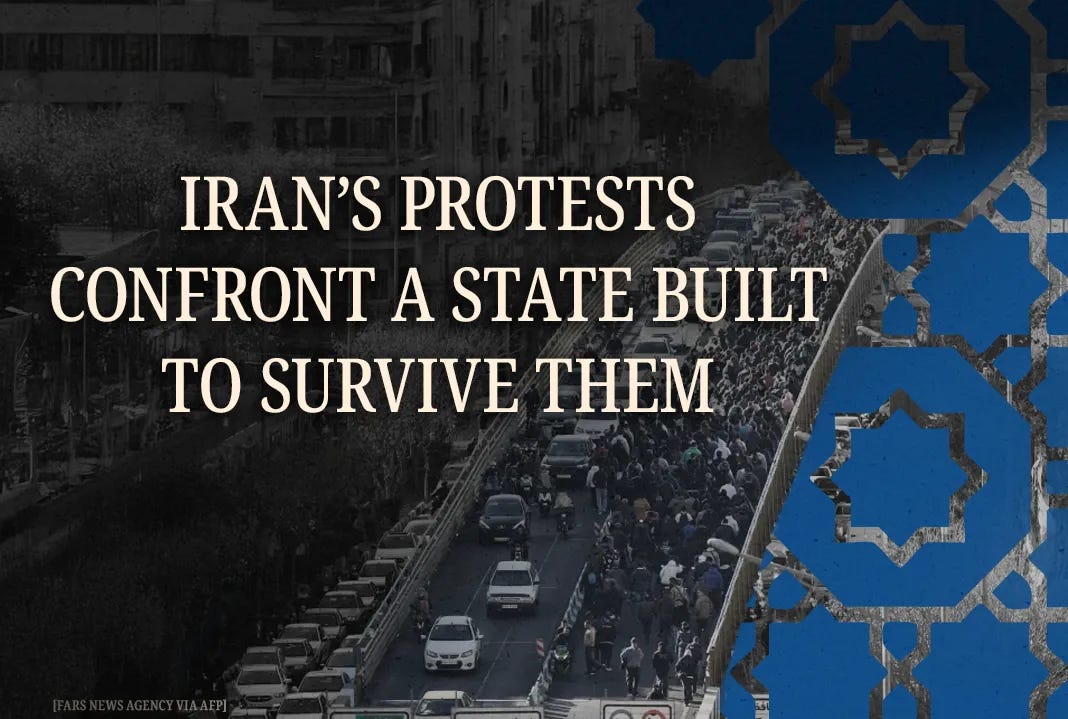
Iran’s Protests Confront a State Built to Survive Them
Public outrage has outpaced the regime ideologically, but not institutionally. The Islamic Republic endures because its security architecture is designed to absorb mass dissent without ceding power. By Iram Ramzan and Faisal Saeed Al Mutar for The Argument
“To understand why moments like this repeatedly stall, we need to stop focusing on protest dynamics and instead examine the structure of the state. Over four decades, Iran has transformed itself from a revolutionary regime into a mature security state. It no longer relies primarily on ideology or popular consent. It relies on institutionalized coercion.
At the center of this system lies a dense and overlapping network of coercive institutions. The Islamic Revolutionary Guard Corps, the Ministry of Intelligence, the Basij, militarized police forces, and thousands of security offices are embedded across Iran’s bureaucracy, economy, universities, and neighborhoods.”
Also In January
Why the “Concentration Camp” Label Fails in Gaza How Gazan suffering is described influences how the conflict is interpreted—and where the blame lies.
When Gulf Allies Fall Out A public dispute over Yemen has exposed deepening rifts between Saudi Arabia and the UAE, raising questions about Gulf cohesion and regional stability at a moment of widespread turmoil.
Iraqi Kurdistan Is Officially Open for Business After years of bureaucratic stagnation, practical reforms lowered the cost of entrepreneurship in the Kurdistan Region of Iraq, opening the formal economy to thousands.
The Vanishing Christians No One Wants to Talk About Across the Middle East, ancient Christian communities are shrinking—and fast. From Syria to Iraq and Gaza, Christianity is retreating from the lands where it first took root.
Lebanon’s Return to Soviet Economics The country’s leadership is using the Financial Gap Law to override contracts, seize savings, and normalize state supremacy over private property rights.
The West’s Betrayal of the Kurds The US has abandoned its Kurdish allies—who were battling enemies that no other nation wanted to face—leaving civilians exposed and ISIS extremists free to regroup.
The Politics Behind Attacks on Chinese Nationals in Afghanistan As ISIS-K claims responsibility for a recent suicide bombing in Kabul, rivalries among the Taliban, Pakistan, and others are reshaping Afghanistan’s security landscape.
January’s reporting followed a region entering a decisive phase. Alliances are shifting, and the consequences will extend far beyond Iran.
Stay tuned for February’s coverage and share Middle East Uncovered with someone who should be reading it.
Middle East Uncovered is powered by Ideas Beyond Borders. The views expressed in Middle East Uncovered are those of the authors and do not necessarily reflect the views of Ideas Beyond Borders.