Why the "Concentration Camp" Label Fails in Gaza
How Gazan suffering is described influences how the conflict is interpreted—and where the blame lies. Hyperbolic and inaccurate labels fail to describe a far more complex reality.
Gaza has been a canvas for competing metaphors for decades. Depending on the observer, it is described as a beautiful Mediterranean enclave, an “open-air prison,” or—most controversially—the “world’s largest concentration camp.” This phrase has been used by sociologists, historians, and political activists to describe the Strip’s long-standing isolation. It was first applied to Gaza by Israeli historian Baruch Kimmerling in 2003, and the rhetoric intensified following the 2007 blockade.
But does Gaza actually meet the technical criteria of a concentration camp, or is the term being deployed as a rhetorical weapon rather than a descriptive fact?
To answer this, one must begin with the standard definition of the term. A concentration camp is “a place where large numbers of people are deliberately imprisoned or confined in a relatively small area, usually without a trial or individual indictment, under the authority of an executive or military order rather than a judicial process.” Central to this definition is the concept of total physical custody. In a camp, the relationship is binary: there is the “guard,” and there is the “inmate.”
The primary reason Gaza fails to meet this definition lies in its internal governance. In a concentration camp, the guard exercises direct, continuous physical control over every aspect of the inmate’s life. Gaza, however, had its own internal de facto government under Hamas. It maintained its own police force, civil service, and judicial system. Gaza’s residents were not “inmates” under the direct physical custody of the Israeli state; they were citizens of a territory governed by a local administration that exercised sovereign functions—collecting taxes, enforcing laws, and managing infrastructure—entirely independent of the blockading power.
Critics often point to the theory of “effective control” to bridge this gap. They argue that because Israel controlled Gaza’s airspace, maritime borders, and tax clearances, it remained an occupying power with total responsibility. This interpretation stretches the legal definition of occupation beyond its intended bounds. Under the Hague Conventions, occupation requires a state to exercise “actual authority” over a territory. Since the 2005 disengagement, Israel did not have the power to enforce municipal laws or manage the daily civil lives of Gazans. One cannot logically be a “camp guard” if one does not stand inside the camp, and one cannot be an “inmate” if one is governed and policed by one’s own national authorities.
A second, more common metaphor is that of the “open-air prison.” The logic here is that a prison does not require a guard in every cell; it only needs a warden who controls the exit. Yet this analogy collapses when one looks at a map. Gaza shares a border not only with Israel, but also with Egypt via the Rafah crossing.
Following Hamas’s takeover in 2007, Egypt also strictly regulated movement for its own national security reasons. If a “prison” has two different wardens from two different countries who do not coordinate their management, it ceases to be a prison and becomes a territory under a dual security blockade. To call Gaza a prison is to ignore Egyptian sovereignty and the fact that travel was, in fact, possible. While difficult, the process of registering for travel via Egypt for education or tourism reflected border bureaucracy, not penal incarceration. In an actual prison, one does not apply for a permit to take a summer vacation or pursue a degree abroad.
The “prison” and “camp” labels also ignore the existence of a functioning private sector and civil infrastructure. In a detention facility, the state provides rations, and inmates own no property. Yet according to the Palestine Monetary Authority’s 2018 report, Gaza had 96 bank branches serving roughly 850,000 accounts. It even had a stock exchange—the Palestine Exchange—where Gazan companies such as Paltel Telecommunications were traded. The Palestinian Central Bureau of Statistics documented that, despite severe constraints, Gaza’s private sector in 2019 included more than 70,000 registered businesses across manufacturing, services, and agriculture.
This economic activity coexisted with severe hardship. United Nations data from 2020 showed Gaza’s unemployment rate had reached 45 percent—among the highest in the world—with youth unemployment exceeding 60 percent. The World Bank reported that 65 percent of the population lived below the poverty line, and approximately 70 percent relied on humanitarian assistance from UNRWA for basic services. The WHO reported regular stockouts of essential medicines, and fishing zones were restricted to between three and six nautical miles rather than the 20 stipulated in the Oslo Accords. But while the blockade severely restricted the flow of goods, the internal distribution and management of resources remained in the hands of Gazan authorities and private actors. A warden provides for inmates; a state blockades an enemy territory. The latter is a tragic reality of war, but it is not a system of imprisonment. The existence of a market-based economy and independent social institutions—however constrained—is incompatible with the definition of a camp.
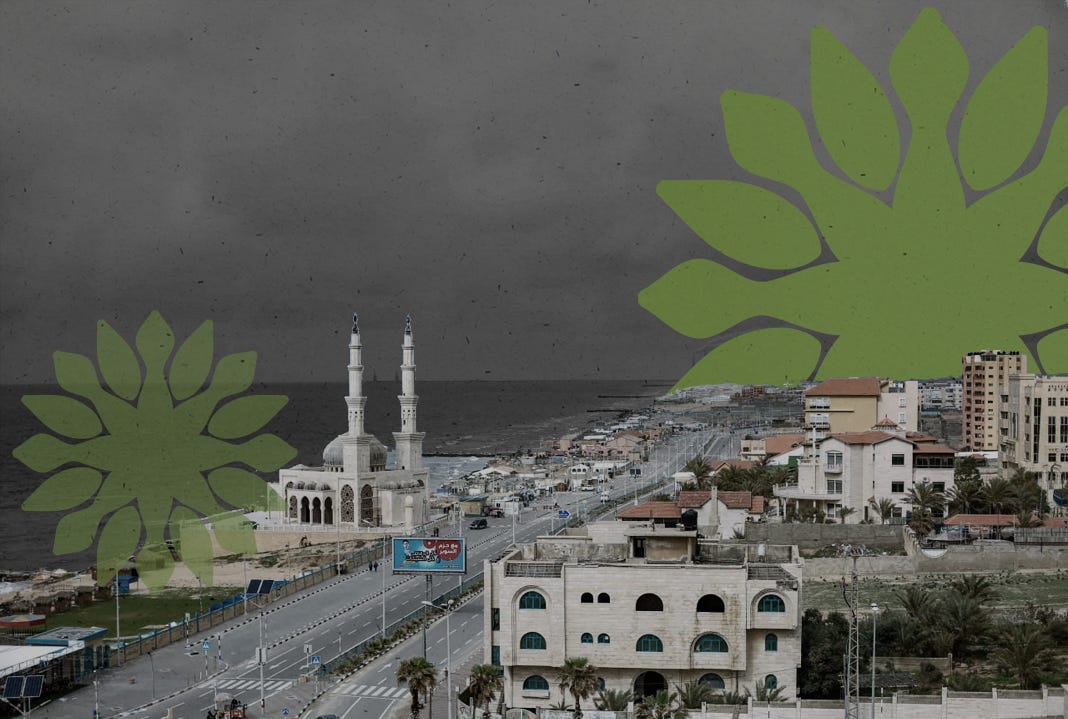
After October 7, many videos circulated on social media showing parts of Gaza that resembled a Mediterranean resort: pristine beaches, the sparkling restaurants along Al-Rasheed Street, and the upscale malls of the Rimal district. These images confused many observers, juxtaposing claims of a “concentration camp” or “open-air prison” with scenes that appeared almost Beverly Hills–like.
The explanation lies in Gaza’s internal class divide. The existence of luxury does not negate the blockade, but it does undermine the camp or prison metaphor. In real prisons or concentration camps, suffering is flattened and equalized; no one dines at a seaside bistro while others survive on rations.
In Gaza, however, these villas and high-end restaurants catered largely to the Hamas elite and their inner circle. According to multiple investigations, senior Hamas officials were collectively estimated to be worth between $1 and $5 billion, with wealth derived from taxes on tunnel smuggling, control of fuel and construction materials, and skimming from international aid. In 2014, it was widely documented that Hamas imposed a 25 percent tax on all goods entering through tunnels and controlled the distribution of building materials, creating vast opportunities for enrichment.
This internal stratification further undermines the prison narrative. The fact that a ruling class could live in luxury while simultaneously constructing a multi-billion-dollar underground tunnel network—estimated by Israeli military sources in 2021 to have cost roughly $1 billion and to have used 6,000 tons of concrete that could have built 86 schools or 19 hospitals, according to COGAT calculations—demonstrates that Hamas functioned as a sovereign actor making political and financial choices. If the supposed “inmates” are building the tunnels, running the police, and dining in luxury villas, then the prison metaphor ceases to describe reality and instead becomes a rhetorical mask. It obscures a complex, stratified society in which an internal government controlled resources and chose to prioritize military objectives over civilian welfare.
The question of whether Gaza was a “concentration camp” or an “open-air prison” carries profound implications for how responsibility, agency, and potential solutions to the Israeli-Palestinian conflict are understood.
When a problem is misdiagnosed, the proposed solutions are inevitably misguided. If Gaza were truly a concentration camp, the solution would be simple: open the gates, and the crisis would disappear. This framing ignores the reality that Gaza’s humanitarian catastrophe emerged from a complex interaction of external blockade, internal governance failures, resource allocation choices by Hamas, Egyptian security policy, and the broader regional conflict.
Accurate language also matters for accountability. The prison metaphor places all responsibility on Israel as the “warden,” overlooking Egyptian policy decisions and—more significantly—absolving Hamas of responsibility for governance, resource allocation, and the prioritization of military infrastructure over civilian needs. From 2010 to 2020, Hamas systematically diverted concrete, fuel, and other dual-use materials toward military tunnels rather than civilian reconstruction, even as housing, water systems, and the power grid deteriorated.
Precision is equally important for international law and humanitarian intervention. The Fourth Geneva Convention imposes specific obligations on occupying powers—obligations Israel has argued it did not bear after 2005 precisely because it no longer exercised the level of control that constitutes occupation. Whether one accepts this legal interpretation or not, conflating blockade with concentration camp obscures the actual legal frameworks governing state behavior and undermines efforts to alleviate civilian suffering.
Finally, rhetorical precision matters for the possibility of political solutions. Metaphors that strip away Palestinian agency—portraying Gazans solely as passive victims rather than a population living under a de facto government that made consequential choices—paradoxically disempower the very people they aim to defend. Any sustainable solution must account for internal Palestinian governance, not only external restrictions.
The suffering of Gaza’s civilian population is real and extensively documented. But understanding that suffering accurately—as the result of a blockade imposed by two states on a territory governed by a third political entity that made its own resource allocation decisions—is essential for crafting policies that might actually improve lives rather than merely score rhetorical points.
The goal should not be to win a war of metaphors, but to describe reality with enough precision to change it.
Middle East Uncovered is powered by Ideas Beyond Borders. The views expressed in Middle East Uncovered are those of the authors and do not necessarily reflect the views of Ideas Beyond Borders.


This entire piece was essentially a debate over semantics and a complete waste of time. Gaza has been under military blockade for almost 20 years now (which is an act of war under international law) and in the past 2 years, Israeli forces have intentionally murdered tens of thousands of women and children while denying food and medicine to the entire enclave. It is hard to come up with a single phrase or word that accurately captures the depths of Israel’s crimes but I don’t think concentration camp is as far off as the author would like to believe. However, here are a few more that might apply: genocide, ethnic cleansing, slaughter, and massacre. The semantics are irrelevant. What matters here is substance and substantively, Israel is guilty of serious war crimes of the sort that have no statute of limitations. It must be held to account one day. It’s long list of crimes prove there will never be peace in the Middle East until it is wiped off the map. Instead of wasting our time with silly debates over vocabulary, we would all be better served using our energy to try and formulate a plan to deal with the existential threat posed by the baby killing sociopaths who rule Israel and their arsenal of nuclear weapons.