


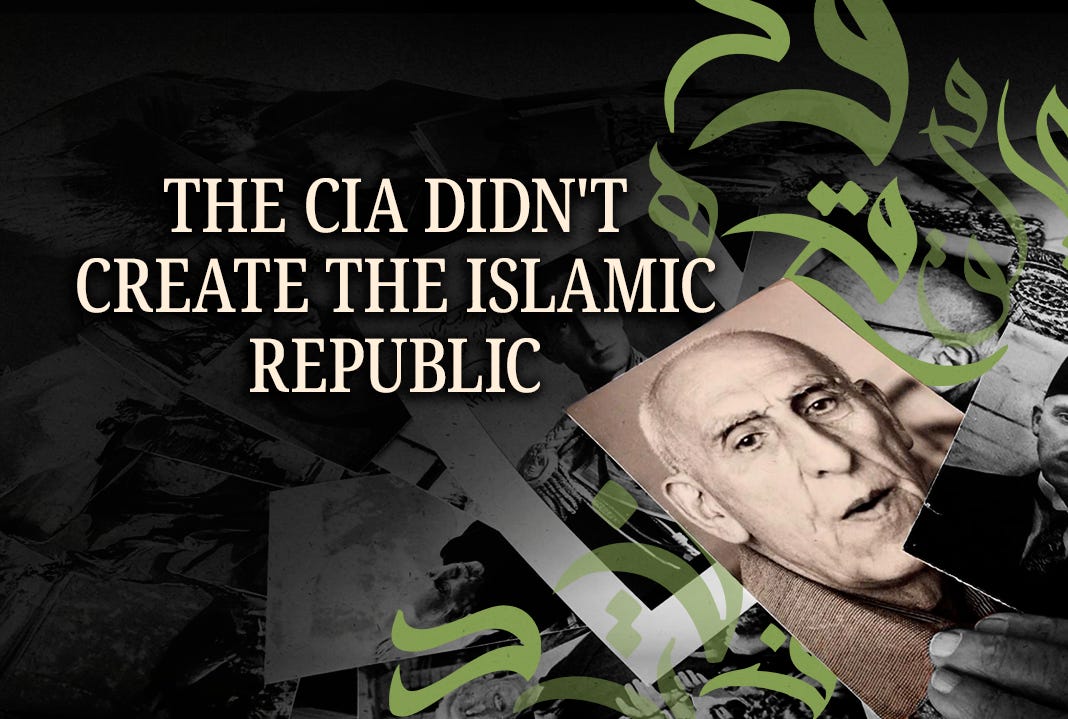
In much of the popular telling, modern Iranian history follows a simple arc. Iran had a democracy. In 1953, the CIA and British intelligence overthrew it by removing Prime Minister Mohammad Mosaddeq. The Shah returned, ruled as a Western-backed autocrat, and a quarter-century later the Islamic Republic emerged as the delayed consequence of that original sin.
This story is compelling. It offers moral clarity, a clear villain, and a straight line from foreign intervention to theocratic rule. But it is also incomplete. The habit of compressing this history into a morality tale—foreign intervention destroys democracy, which later returns as religious extremism—is emotionally satisfying but analytically false. Iran’s modern tragedy is not that its politics were hijacked once. It is that they never stabilized at all.
Iran did not move from democracy to theocracy because of a single covert operation. What unfolded between Mosaddeq’s rise in the early 1950s and Ayatollah Khomeini’s return in 1979 was a far longer process marked by weak institutions, unresolved political tensions, and repeated failures by Iran’s own elites—liberal, royalist, leftist, and clerical alike—to build a system resilient enough to endure crisis.
Understanding that history requires first understanding why Mosaddeq occupies such a central place in Iran’s political memory.
Mosaddeq came to office in 1951 through constitutional means, backed by a broad nationalist coalition demanding Iranian control over its oil. For many Iranians, he embodied dignity, legality, and independence. The Anglo-Iranian Oil Company was a represented foreign domination to many, and nationalization united liberals, professionals, parts of the clergy, and the urban middle class behind a shared cause. After his removal, Mosaddeq became something more than a politician: a symbol of a democratic path not taken, invoked by later generations across the political spectrum.
Mosaddeq governed a political system that was weak long before foreign intelligence services intervened. Parties were shallow, parliament was feckless, the monarchy retained significant constitutional power, and street mobilization often substituted for durable institutions. Britain’s response to oil nationalization—legal challenges, tanker interdictions, and diplomatic isolation—severely damaged Iran’s economy. Oil revenues collapsed, inflation rose, and the state struggled to pay its employees. Political crisis followed economic strain.
Under mounting pressure, Mosaddeq narrowed rather than broadened his coalition. He sought emergency powers, attempted to bring the armed forces under his direct authority, and dissolved parliament through a referendum marred by boycotts, intimidation, and implausible margins. By mid-1953, Iran no longer had a functioning legislature. A leader committed to constitutionalism was governing largely by decree.
Support fractured. Sections of the middle class drifted away. Senior military officers grew hostile. Clerical allies recoiled, worried about disorder and the growing influence of the communist Tudeh Party. Ayatollah Abul-Qasim Kashani, once a key partner in the nationalist movement, openly broke with Mosaddeq. These developments were not the product of foreign manipulation alone—they reflected a domestic political breakdown.
Foreign intelligence services did intervene. Britain and the United States authorized a covert effort to remove Mosaddeq, and that fact is not in dispute. What is often overstated is how decisive that intervention proved to be. The initial attempt failed. Mosaddeq rejected the Shah’s dismissal decree, arrested its couriers, and the Shah fled the country. Both Washington and London believed the operation had unraveled.
What followed succeeded not because foreigners controlled events, but because Iranians took charge. Large crowds filled the streets. Clerics mobilized openly. Military units switched sides. State authority shifted rapidly. Mosaddeq surrendered. Contemporary U.S. embassy and CIA cables describe the speed and scale of these developments as unexpected, driven less by foreign direction than by loyalty to the monarchy, fear of instability, and exhaustion with political deadlock.
Mosaddeq was a tragic figure, but not a mythic one. He devoted his life to constitutional politics, yet under strain, he weakened the very institutions meant to sustain it. His removal was shaped by foreign interference, yes, but it was accelerated by domestic divisions that had already hollowed out the system.
The return of Mohammad Reza Shah in 1953 did not immediately produce the authoritarian state later associated with the 1970s. The Shah came back cautious and constrained. For several years, Iran retained political parties, parliamentary life, and a degree of pluralism unusual in the region. This period contained genuine possibilities.
Those possibilities were gradually squandered.
Rather than restoring constitutional balance, the monarchy steadily centralized power, first in the name of stability and later out of ambition. Liberal forces failed to reconstruct durable organizations. The left fragmented and radicalized. Clerical networks, increasingly excluded from formal politics, expanded their influence through mosques, charities, and informal authority structures.
The system hardened without maturing.
The Shah’s White Revolution reshaped Iranian society. Literacy increased, infrastructure expanded, and women entered education and the workforce in unprecedented numbers. These changes were real and significant. But they were not matched by meaningful political representation. Parliament lost credibility, courts lacked independence, and dissent was managed by security services rather than processed through politics.
Modernization without representation breeds expectations it cannot satisfy. A younger, educated society encountered progress without voice and order without legitimacy. By the late 1970s, Iran had no trusted mechanism to negotiate conflict. When crisis came, it could only be resolved in the streets.
The Islamic Revolution did not overthrow a functioning democracy; it replaced a system that had lost the confidence of nearly every constituency. Liberals lacked organization, the left lacked trust, nationalists lacked unity, and the monarchy lacked credibility. Only the clergy possessed nationwide networks, disciplined leadership, and a moral language that resonated across classes.
They did not seize a stable order. They stepped into a vacuum.
From Mosaddeq to Khomeini, Iran’s trajectory was not a straight descent from democracy into dictatorship triggered by a single foreign plot. It was a prolonged failure to institutionalize governance, manage compromise, and ground legitimacy beyond personalities. Foreign interference mattered, and it left lasting damage. But it did not determine everything that followed. Domestic actors mattered more—and none succeeded in building a political system strong enough to endure repeated crises.
Reducing this history to the CIA or foreign interference may be emotionally satisfying, but it badly distorts and oversimplifies reality. External interference mattered, yet it did not erase Iranian agency or determine the outcome. What failed, again and again, were domestic institutions and political actors unable—or unwilling—to build a system capable of surviving pressure, defeat, and compromise. The Islamic Republic was not imposed from abroad; it emerged from a vacuum created at home. Treating foreign powers as the sole authors of Iran’s fate turns structural failure into conspiracy, and prevents any serious reckoning with how revolutions are actually born.
Middle East Uncovered is powered by Ideas Beyond Borders. The views expressed in Middle East Uncovered are those of the authors and do not necessarily reflect the views of Ideas Beyond Borders.
Fantastic article. Converges with several points I made in a similar article I wrote last year. However your perspective and moral clarity shines a fresh light on the subject for me.
The 1953 coup against Prime Minister Mohammad Mossadegh was a pivotal moment in Iran’s modern history—one of the key events that set the stage for the 1979 Revolution. By toppling a democratically elected government, it shut the door on gradual, lawful reform and sent a clear signal that peaceful change could be undone by force. This fueled deep disillusionment and pushed future opposition toward more radical, revolutionary routes. In the aftermath, the Shah tightened his grip on power, dismantling political parties, ending free elections, and replacing participation with repression. Over the next 25 years, frustrations built up without any legal outlet, eventually exploding into revolution. The coup also shattered public trust in the West, especially the U.S. and Britain, reinforcing the belief that their support for democracy only held when it served their interests. This helped legitimize anti-Western rhetoric and allowed religious leaders to present themselves as an “independent” alternative. Crucially, it weakened secular, nationalist, and democratic forces while leaving the clergy largely untouched. So when the monarchy fell in 1979, organized democratic leadership was missing, and the revolution ended up in the hands of the religious establishment. In many ways, the revolution wasn’t a sudden break, but the result of a trajectory set in motion in 1953, when democracy was derailed, and the country was forced down a far more destructive path.