


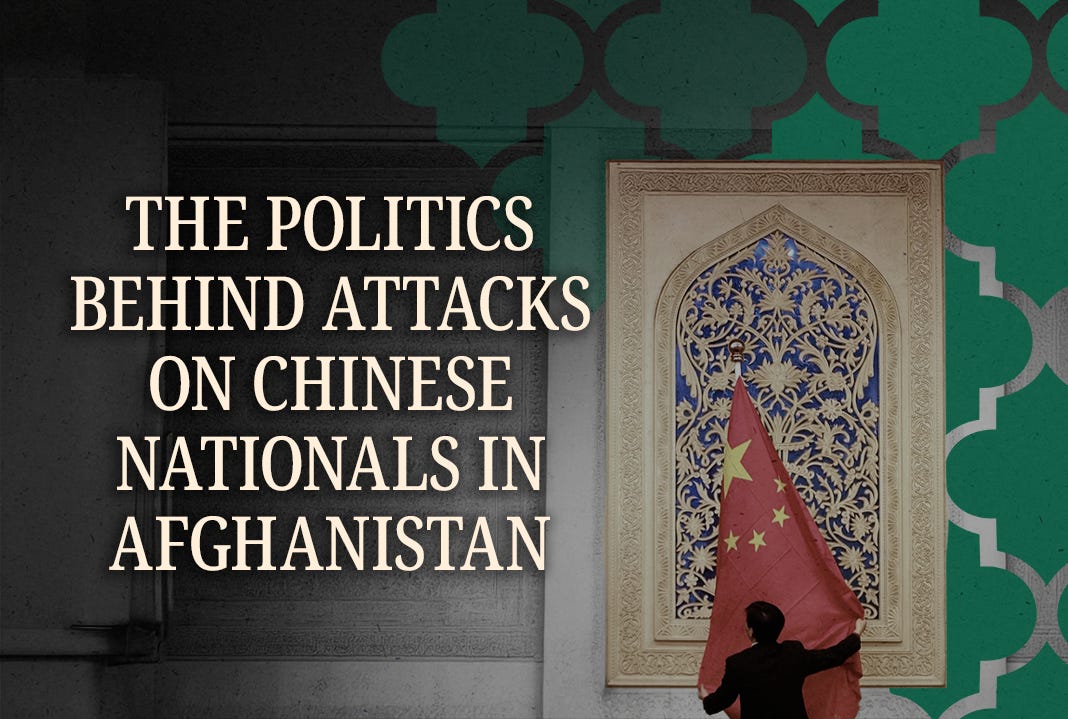
During the afternoon rush hour in Kabul’s busy downtown, an explosion shook the city. Around 3 p.m. local time, a suicide attacker detonated his vest inside a crowded Chinese restaurant, near the kitchen, where several Chinese nationals and Afghans were eating lunch. The restaurant was co-owned by a Chinese Muslim, his wife, and an Afghan partner. One Chinese national and six Afghans were killed in the blast, and up to 20 others were taken to emergency rooms.
Ahmad Shoaib, a Uyghur Muslim businessman, was inside the restaurant at the time of the bombing. In a statement to Tolo News, he said, “I was exploring the possibility of opening a minerals trading company in Afghanistan and was holding a meeting at the restaurant when the bomb exploded. I fell unconscious.” Shoaib is not the only Chinese national seeking business opportunities in Taliban-run Afghanistan. In recent years, several Muslim Chinese businessmen have expressed interest in investing there. Still, the environment remains fraught with challenges.
In the aftermath of the blast, the Islamic State–Khorasan Province (ISIS-K) released a photo of the alleged attacker and claimed responsibility. The group justified the attack by citing China’s treatment of Uyghur Muslims. Ironically, a Uyghur Muslim was among those killed, raising questions about ISIS-K’s stated motivations and the broader purpose behind such attacks.
To understand the context, it is necessary to examine ISIS-K itself. Founded in 2015, ISIS-K is the Afghanistan-based branch of the Islamic State and has become the Taliban’s most persistent armed challenger. The group promotes a transnational jihadist ideology that rejects diplomacy, borders, and economic engagement. Unlike the Taliban’s nationalist project, ISIS-K focuses on high-profile attacks designed to generate fear, attract attention, and undermine rivals. Its recent targeting of Chinese nationals serves multiple purposes: citing Beijing’s treatment of Uyghurs while simultaneously embarrassing the Taliban, undermining their claims of security, and discouraging foreign investment. By striking Chinese interests in cities like Kabul, ISIS-K seeks to expose the limits of Taliban control and destabilize Afghanistan’s post-2021 order.
The January 19 attack was one in a series. On December 12, 2022, gunmen and bombers attacked the Longan Hotel in Kabul, a site frequented by Chinese nationals. On January 22, 2025, Taliban authorities reported that a Chinese national working for a mining company was killed in Takhar province while traveling with an interpreter, who survived. An Islamic State affiliate claimed responsibility. Later, on December 2, 2025, Tajik authorities reported two attacks along the Afghanistan–Tajikistan border in late November that killed three Chinese nationals and wounded others. Those incidents reportedly involved drones for the first time in the region.
Despite ISIS-K claiming responsibility for most of these attacks, the situation remains complex. Some analysts argue that other regional actors may also be involved. Ghaos Janbaz, a former Afghan diplomat and Central Asia political analyst, told Middle East Uncovered that it is important to consider who benefits most. “First of all, I reject claims that this is the Taliban’s doing, contrary to some commentary,” he said. “One must ask which border the perpetrators used to enter the country. Did they come from Iran? Tajikistan? Uzbekistan? China? Or Pakistan?”
While cautioning against conspiracy theories, Janbaz outlined the complex dynamics among regional powers. He argues that China has both the capacity and a measured willingness to invest in large infrastructure projects in Afghanistan—some of which, he says, will “stay in place” long after the Taliban are gone. One example is Afghanistan’s potential integration into China’s Belt and Road Initiative, which faces significant challenges, particularly in the Wakhan Corridor. Janbaz calls such projects “essential” for Afghanistan and says they should be welcomed regardless of leadership, while stressing that this does not imply support for the Taliban regime.
“In politics today, you cannot have leverage or influence over a country without economic influence,” Janbaz said. He noted that as Western engagement in Afghanistan declines, China is increasingly filling the vacuum—though cautiously and slowly. After the Taliban seized Kabul in August 2021, China kept its embassy open and signaled pragmatic engagement, while stopping short of formal recognition.
In September 2021, Pakistan’s Inter-Services Intelligence chief, Lt. Gen. Faiz Hameed, visited Kabul, signaling early coordination among Pakistan, China, and the Taliban following the U.S. withdrawal. In January 2023, the Taliban announced a 25-year oil extraction deal in the Amu Darya basin with Xinjiang Central Asia Petroleum and Gas Co., widely described as the first major foreign investment since the takeover. The Taliban terminated the contract in June 2025, citing the company’s failure to meet investment benchmarks.
Janbaz argues that new dynamics have emerged since the Taliban returned to power, including the rise of Pashtun nationalism and identity politics inside Afghanistan and across its borders. Pashtuns form Afghanistan’s largest ethnic group and a significant minority in Pakistan. According to Janbaz, nationalist sentiment among Pashtuns is growing. Recently, the Taliban have displayed maps depicting a “Greater Afghanistan” that includes parts of Pakistan’s Khyber Pakhtunkhwa province, while senior Taliban officials have dismissed the legitimacy of the Durand Line (the Afghanistan–Pakistan border). These actions have drawn attention—and concern—from both Pashtun communities and Pakistani authorities.
As a result, Janbaz contends that China’s continued engagement in Afghanistan, combined with rising Pashtun nationalism, could provoke a Pakistani response. He notes that Pakistani officials have increasingly acknowledged their past support for the Taliban, drawing parallels to current mutual accusations between Islamabad and Kabul. According to Janbaz, long-standing covert relationships have given way to strategic rivalry, fundamentally altering regional alignments. While an open confrontation remains unlikely, underlying tensions pose serious risks.
Another major factor is Tehrik-e-Taliban Pakistan (TTP). Like the Afghan Taliban, the TTP is an extremist Islamist group seeking autonomy in parts of Pakistan’s Khyber Pakhtunkhwa region. Since the Taliban returned to power in Kabul, the TTP is widely believed to have found refuge in Afghanistan, using that space to coordinate attacks against Pakistan. Last year was Pakistan’s deadliest in decades, with dozens of suicide bombings and militant attacks across the western regions, particularly in Khyber Pakhtunkhwa and Balochistan, amid deteriorating Taliban–Pakistan relations. Islamabad accuses the Afghan Taliban of failing to confront the TTP and has clashed repeatedly with Taliban forces along the Durand Line. An airstrike in October 2025 reportedly targeted TTP leader Noor Wali Mehsud in Kabul, though he was later reported to have survived. Pakistan’s security, Janbaz argues, is directly threatened by the TTP’s sanctuary in Afghanistan.
At the same time, India has emerged as a major trading partner for Afghanistan. Following a trade facilitation agreement, India allowed Afghan exports to enter its market with reduced tariffs despite the Taliban takeover. In 2025, Taliban Foreign Minister Amir Khan Muttaqi visited India, a notable development given New Delhi’s Hindu nationalist government. These engagements revived air corridors and trade routes, allowing goods to move between the two countries at historically low costs. In November 2025, the Taliban announced it would stop processing customs duties on medicines imported from Pakistan, weakening Pakistan’s dominance in Afghanistan’s pharmaceutical market. Taliban officials said cheaper, higher-quality Indian medicines would increasingly replace Pakistani imports.
“Pakistan wants a subordinate Afghanistan as its neighbor,” Janbaz said. “Whether ruled by the Taliban or another group, they prefer an Afghanistan they can control.” He added that even during the previous republic, Pakistani officials often acted condescendingly toward Afghanistan, questioning why foreign countries maintained consulates in cities like Kandahar.
Janbaz argues that Pakistan’s initial enthusiasm after the Taliban takeover faded when the group turned against its former backers—a development he describes as “treasonous.” He believes the long and violent partnership between Pakistan and the Taliban is effectively over, replaced by resentment on both sides that could lead to direct confrontation. Still, he notes that Pakistan’s status as a nuclear-armed, industrial middle power gives it significant advantages, making all-out war unlikely.
What does this mean for the Chinese Muslims killed at the Longan Hotel and the Chinese restaurant in Kabul? According to Janbaz, Chinese nationals are caught in the broader struggle between the Taliban and Pakistan, much like Afghan civilians affected by Pakistani strikes inside Afghanistan. Both groups, he argues, are victims of failed policies and destructive identity politics that cause unnecessary suffering. Janbaz believes Pakistan will continue applying pressure until Pashtun nationalism and anti-Pakistan rhetoric from the Taliban subside—even if that means the Taliban collapse in the process. He also asserts that ISIS-K, whose backers remain unclear, cannot carry out large-scale attacks like the January 19 bombing without substantial external support, making it critical to identify who is directing these operations.
Janbaz does not believe China will withdraw from Afghanistan in the near term. Major projects, including the Mes Aynak copper mine and other gold and precious metals contracts, are likely to move forward, albeit more slowly. “China’s intelligence and security apparatus will take extra measures to protect Chinese nationals without taking direct action or establishing a military presence,” he said. This could involve pressuring the Taliban to tighten security in border regions and rural areas, while expanding China’s own intelligence capabilities.
The recent attack in Kabul is a reminder of the last two decades of conflict, shaped in large part by the Taliban’s own policies. By alienating much of the population, banning women from public life, and imposing sweeping restrictions on trade, dress, and daily behavior, the Taliban may be accelerating their own downfall. Whether the final blow comes from Pakistan, internal Taliban fractures, or another opposition force remains uncertain. What is clear, Janbaz says, is that Afghanistan is deeply divided, and unrest will return to the streets if the opportunity arises. Another civil war, he warns, is increasingly likely if the Taliban persist on their current path. As for China, its long-term goals of influencing Afghanistan are currently slowed by other regional actors who are not eager to back down from this power struggle.
Middle East Uncovered is powered by Ideas Beyond Borders. The views expressed in Middle East Uncovered are those of the authors and do not necessarily reflect the views of Ideas Beyond Borders.
Such a great piece, on topic few are writing about