


*Middle East Uncovered uses pseudonyms to protect sources inside Iran.
When Yasmin* watches footage from the current nationwide demonstrations in Iran, she is no longer in 2026. In her mind, it’s 2009 again, when she joined her compatriots in the streets of Tehran, swept up in a movement that demanded change.
Millions took to the streets to peacefully protest the official claims that Mahmoud Ahmadinejad had won the presidential election in a landslide.
Their slogan was simple: “Where is my vote?”
The state’s answer came quickly and violently. Fear spread faster than the crowds, with the smell of tear gas in the air and the sound of bullets cutting through revolutionary chants.
Yasmin, not her real name, recalls her encounter with the regime’s anti-riot police. “I call them dogs. They’re massive,” she says. “I think they’re chosen solely for this purpose. They’re all on bikes, armed head-to-toe, and the way they’re dressed makes them look like monsters. I shat my pants!”
She ran without stopping, narrowly avoiding arrest. The following day, she returned with a camera to document the violence, only to be stopped by the Basij, the regime’s paramilitary force. They confiscated her memory card and let her go with a warning.
Others were not as lucky. Thousands were arrested and over 30 killed.
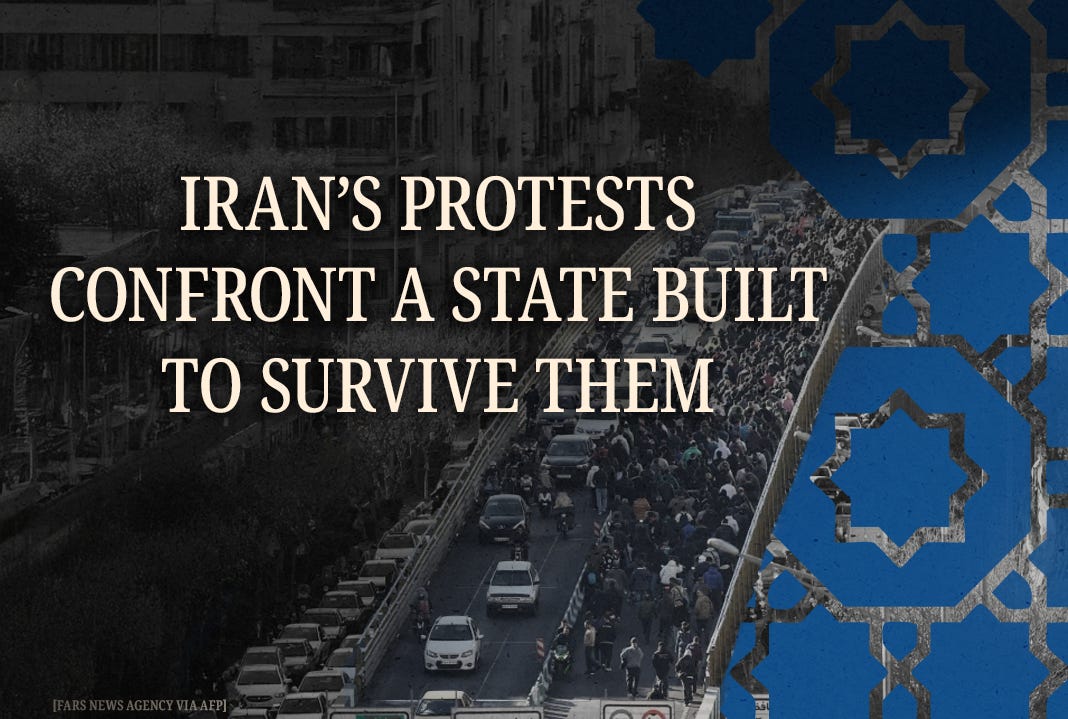
More than 15 years later, similar scenes are unfolding again. Cities and towns in 26 of Iran’s 31 provinces have been rocked by unrest.
The clerical establishment is weaker than it has been in years, reeling from a brief but punishing war with Israel in June and a deepening water crisis driven largely by state mismanagement. Last month, the Iranian rial collapsed to 1.45 million to the US dollar.
On December 28, shopkeepers and merchants in Tehran’s Grand Bazaar went on strike, with demonstrations spilling onto Jomhuri Street. The moment carried historical weight. It was the Bazaaris, a powerful class of conservative merchants and traders operating within Iran's traditional marketplaces, who bankrolled the 1979 revolution.
Within 72 hours, protests spread from Shiraz to Isfahan to Qom, including traditionally quieter regions.
Per capita incomes have fallen by roughly 20 percent. More than a third of Iranians now live below a poverty line fixed at just $400 a month. Many teachers earn less than $250. The line separating Iran’s professional middle class from blue-collar workers is rapidly eroding.
A retired teacher in the Kurdish region tells Middle East Uncovered that his pension, now worth about $200 a month, supports his family for only 10 days.
“Prices change daily, and many people have eliminated protein from their diet,” he says. “The regime claims it provides subsidies, but in reality, each person receives only three dollars per month.”
Unlike the Green Movement and earlier waves of protest, this uprising has quickly evolved into a direct challenge to clerical rule itself.
Chants of “Death to the dictator” now echo openly. So does “Javid Shah” (long live the king), a once-taboo reference to Prince Reza Pahlavi. In some cities, protesters wave the pre-revolutionary Iranian flag.
Pahlavi is popular among activists abroad but lacks both leadership capacity and broad support inside Iran. Still, the fact that such slogans are now shouted openly signals a deeper shift. Fear is eroding. People are calling not only for reform, but for a viable alternative.
Videos circulating online show protesters confronting security forces directly, calling them dishonorable, and urging them to defect.
At least 20 people, including three children, have been killed so far, according to human rights groups, though activists believe the true number is higher. Some 582 have been arrested. Security forces have opened fire with live ammunition, while arrests and intimidation widen.
Activists have shared videos of young men and women with bullet wounds. One protester in Tehran says she saw someone shot in the eye. The next day, at a Metro station, she watched security forces deploy tear gas without provocation.
President Masoud Pezeshkian, often described abroad as a “reformer,” has acknowledged protesters’ “legitimate demands” and called for economic relief. But the real power lies elsewhere.
Supreme Leader Ayatollah Ali Khamenei has remained defiant, dismissing protesters as “rioters” who should be “put in their place.” In a recorded address, the 86-year-old declared that the Islamic Republic “will not yield to the enemy,” responding to US President Donald Trump’s threat to intervene if protesters were killed.
Trump wrote on Truth Social: “If Iran shots [sic] and violently kills peaceful protesters, which is their custom, the United States of America will come to their rescue.”
Several Iranians say the statement gave them hope.
“The statement by President Trump has been one of the greatest sources of hope so far,” says the Kurdish teacher. “Democratic nations must provide support.”
Khamenei has accused foreign powers, including the US and Israel, of instigating unrest. Some argue the regime can still reform, pointing to uneven enforcement of the hijab law. But these gestures are tactical, not transformative.
To understand why moments like this repeatedly stall, we need to stop focusing on protest dynamics and instead examine the structure of the state. The Islamic Republic endures not because protesters lack courage, but because the system was built to survive exactly this kind of dissent.
Over four decades, Iran has transformed itself from a revolutionary regime into a mature security state. It no longer relies primarily on ideology or popular consent. It relies on institutionalized coercion.
At the center of this system lies a dense and overlapping network of coercive institutions. The Islamic Revolutionary Guard Corps, the Ministry of Intelligence, the Basij, militarized police forces, and thousands of security offices are embedded across Iran’s bureaucracy, economy, universities, and neighborhoods.
These institutions do not merely suppress protests when they erupt; they also continuously monitor society, isolate organizers early, splinter movements, and apply calibrated violence to prevent escalation. Saeid Golkar frames this as repression professionalized into everyday governance. Control is no longer exercised episodically, but as a permanent condition of rule.
This is why protests in Iran follow a grim and familiar pattern. Uprisings emerge suddenly, spread rapidly, radicalize rhetorically, and then stall. The regime absorbs the shock, tightens control, and reasserts dominance. Each cycle deepens public alienation while leaving the structure of power intact.
Iranian political scientist Mehran Kamrava explains why this structure is difficult to dismantle. The Islamic Republic is not a simple clerical dictatorship, but a hybrid system in which religious authority, republican institutions, patronage networks, and coercive power reinforce one another. Power does not flow straight from the Supreme Leader downward. Instead, authority circulates through competing institutions that interact and collide but ultimately submit to clerical arbitration under the doctrine of velayat-e faqih, or guardianship of the Islamist Jurist, asserting that Islamic jurists hold ultimate authority in the absence of the Twelfth Imam. This doctrine underpins Iran’s theocratic government.
The regime’s complex governance structures prevent opposition from identifying a single center of gravity. Remove a president and little changes. Kamrava’s broader point is that authority in Iran is deliberately diffused across institutions without ever becoming decentralized, making the system resilient to decapitation or sudden rupture.
Khamenei and the main founders of the revolution will be dead in the coming decade.
But given that the economy is largely controlled by the IRGC, “when the ideological folks are all dead, and you’re left with these pragmatic IRGC, the most likely outcome is that someone from the IRGC, or connected to them, takes over. In the next 10 years, that’s probably going to happen,” says Jonathan Hackett, a retired US Marine interrogator and author of Iran’s Shadow Weapons.
This is why the fantasy of reform from within persists yet repeatedly fails. The idea that pressure empowers moderates misunderstands the system entirely. Moderates are permitted to exist precisely because they cannot alter the foundations of power. When they overstep, they are neutralized. Every apparent opening, from elections to nuclear negotiations, has functioned as a tactical concession rather than a structural transformation. Even the Supreme Leader has acknowledged this logic, framing compromise as a strategic maneuver rather than genuine change.
Golkar’s analysis makes clear that this system is not only ideologically guarded but physically enforced. The regime’s coercive institutions are armed, ideologically vetted, and deeply embedded in everyday governance. They embody the state itself. Expecting them to fracture under pressure is wishful thinking.
This helps explain why even the most powerful uprisings of 2009, 2019, and 2022 failed to produce regime change. Protesters confronted a state that monopolized force, intelligence, coordination, and narrative control. Opposition, then and now, remained unorganized. Reformists, republicans, monarchists, ethnic movements, and labor groups were united in their rejection, but divided in their visions.
Opposition groups debate hypothetical futures while the regime governs with an iron fist in the present.
Today, this imbalance is reinforced internationally. Iran’s security services have refined internet control beyond shutdowns, relying on throttling, selective protocol blocking, and deep packet inspection that disrupts coordination while preserving outward connectivity. Surveillance and tracking technologies have become central tools of social control. At the same time, Iran’s cooperation with Russia and China has reduced its isolation and strengthened its resiliency. As Golkar noted, this marks a shift from reactive repression to anticipatory control, narrowing the historical window in which mass mobilization alone could overwhelm the state.
That said, Iranian society has moved far beyond the regime ideologically. Yet as Kamrava’s work reminds us, a system built on institutionalized authority and coercion can survive long after its moral claims have collapsed.
The Islamic Republic survives not because it is popular, nor because Iranians are passive, but because it has constructed a system explicitly designed to absorb dissent without yielding power. Until that system is confronted directly, until its coercive architecture is neutralized rather than merely challenged, protest will remain cyclical and performative.
Protest exposes the regime’s illegitimacy, but it does not dismantle the machinery that sustains it. Until opposition forces reckon seriously with the state’s coercive and institutional architecture—rather than mistaking moral rupture for political collapse—the cycle of uprising and repression will persist, and the Islamic Republic will continue to endure despite its profound loss of consent.
Until then, ordinary people will remain trapped between the urge to resist and the fear of the consequences.
In 2009, when 26-year-old Neda Agha-Soltan was shot dead, Yasmin stayed home out of fear.
“If I were in Iran now,” she says, “I would go out to the streets. What would I have to lose?”
In her voice lies the steely defiance the regime has never fully extinguished. But defiance, as history has shown, is not sufficient enough to bring the system down. For those who look to Iran’s streets as a barometer of imminent change, the lesson is this: protest reveals the regime’s illegitimacy, but only a serious reckoning with its coercive architecture can translate that dissent into meaningful political rupture.
Middle East Uncovered is powered by Ideas Beyond Borders. The views expressed in Middle East Uncovered are those of the authors and do not necessarily reflect the views of Ideas Beyond Borders.
This is a good article and helpful to us here in the West, as we are not well-informed on a lot of the details mentioned here. And thank you for the references mentioned. It’s clear that there are no simple answers. But there is no human institution on this earth that is impervious to breakdown, and there never has been. All human institutions require maintenance, including democracy, but extreme and repressive institutions require extreme maintenance. That means they are a drain on human and material resources and waste energy. These systems may seem hard to break, but systems do break down and the causes are often multifactorial. (What is harder to break down and probably never will be. is hope and the human spirit. Even fear-based systems never seem to be able to totally eradicate those and sometimes those things lead to creative solutions that we might not be able to imagine.) Sometimes “God holds a man or woman in readiness,” as someone once said, or, if you will, sometimes someone appears for whatever reason from inside or outside the system. Sometimes it’s a group effort, or both. Sometimes serendipity comes into play. Sometimes opportunities must be seized and always attention must be paid. One way or another totally repressive regimes do not last. Thank you for your contribution in this respect, and I would like more!!
Fantastic analysis thank you so much