


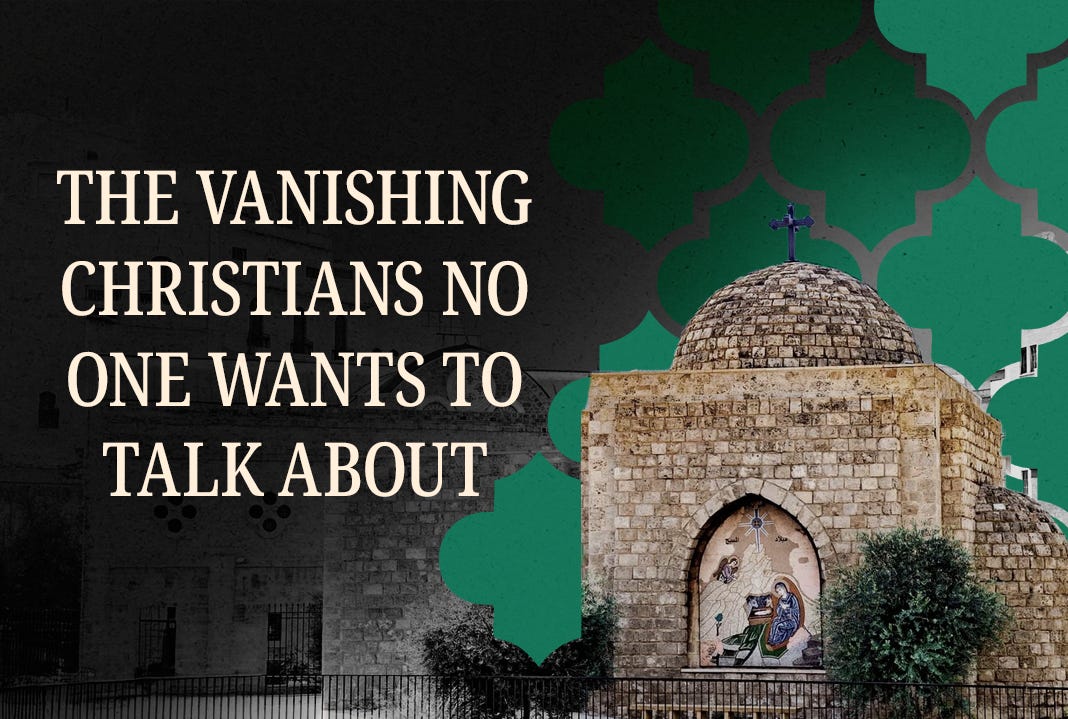
Many years ago, when I was trying to improve my Arabic speaking skills, I befriended a student called Firas.
A Christian from Syria, his family had fled the country for Sweden following the 2011 civil war. Firas came to the UK, but he never quite warmed up to Manchester—the constant rain probably didn’t help.
In addition to brushing up on our language skills (I helped Firas with his English), we’d also discuss politics in the Middle East.
In those days, there were regular protests filled with Syrians and non-Syrians alike, supporting the revolution and opposing Bashar al-Assad’s brutal regime.
Not Firas, though. He thought the demonstrators were extremists and that the government was better, particularly for people like him. We had many arguments about this. “How on earth can you support a dictator?” I would ask him.
Looking back now, I don’t think he was loyal to Assad, but rather fearful of who or what would replace him.
That fear is rooted in how deeply Christianity runs in Syria. The country is home to some of the oldest Christian communities in the world. In the village of Maaloula, southwest of Damascus, some residents still speak a version of Aramaic, the ancient language believed to have been spoken by Jesus.
In her book The Vanishing, a forensic account of the disappearance of Christianity in the Middle East, war correspondent Janine di Giovanni argues that minorities in the region saw authoritarianism as a grim but predictable shield against sectarian chaos.
“Their big concern was that more radical Islamist groups would rise, who would drive them out,” she told an interviewer. “I think it’s because they [would] rather support their authoritarian leaders whom they know, rather than have some unknown people in power who might persecute them more.”
Today, Syria offers a painful vindication of that fear. After Assad’s ousting just over a year ago, a Sunni Islamist–dominated government in Damascus has promised inclusion and protection for religious minorities. Yet reality has proved otherwise.
As well as attacks on the country’s Druze and Alawite minorities, in June, a suicide attack on Damascus’s Mar Elias Church killed at least 25 worshippers and injured over 60.
The interim government, led by Ahmed al-Sharaa (formerly known as Abu Mohammad al-Julani), has condemned attacks on minorities, but its authority remains weak. Armed factions, some loosely affiliated with the state, continue to operate with impunity, and sectarian violence hasn’t abated.
For Syrian Christians, public worship has become both an assertion of faith in the face of risk and carries a deep-seated sense of dread. Days before Christmas, hundreds returned to the courtyard of Mar Elias, lighting a neon Christmas tree adorned with photos of the dead.
Sadly, Syria is not an exception. Across the Middle East, Christianity is steadily disappearing from the very region where it was born. In the occupied West Bank, East Jerusalem, and Gaza, Christians now number fewer than 100,000 (50,000 according to some estimates), around one percent of the population. In Gaza, the dwindling Christian population has faced discrimination—women have previously reported harassment for refusing to veil, while Christian men who marry Muslim women have been targeted.
Iraq tells a similar story. Once central to biblical history—home to Abraham's birthplace and traditions placing the Garden of Eden in the south—Christian numbers continue to decline. There are around 150,000, down from one million 30 years ago.
Most Iraqi Christians are Chaldean Catholics or members of the Assyrian Church of the East, descendants of Aramaic-speaking communities who trace their roots to the first-century Church of the East. After decades of war, sanctions, and sectarian violence, they are now a shadow of their former presence.
All this once prompted the Archbishop of Erbil, in Iraqi Kurdistan, to accuse his British counterparts of failing to do enough in defense of the vanishing Christian community in Iraq.
During a visit to the UK at the time, the Archbishop Bashar Warda said his people now faced extinction after 1,400 years of persecution.
“Our tormentors confiscated our present while seeking to wipe out our history and destroy our future,” he said.
As di Giovanni documents in her book, the countries that first nurtured Christianity are now those where it is disappearing fastest. This erosion is often treated as inevitable, as collateral damage of conflict, rather than as a profound cultural and historical loss.
Beyond the Middle East, persecution persists under vastly different political systems. In Iran, the imprisonment of Christians has surged this year, with human rights groups reporting a sixfold increase. In Nigeria and across West Africa, Islamist violence has disproportionately affected Christian communities, a reality that recently prompted US President Donald Trump to authorize airstrikes against ISIS targets.
For Christians worldwide, Christmas is meant to be a season of celebration. Yet for many in the Middle East, it has become an act of courageous, steadfast faith.
This is something that my friend Firas knew intuitively. In times of uncertainty, minorities turn to survival. The tragedy is that, in the Middle East, survival itself is becoming harder to guarantee.
Middle East Uncovered is powered by Ideas Beyond Borders. The views expressed in Middle East Uncovered are those of the authors and do not necessarily reflect the views of Ideas Beyond Borders.

This article points out one of the most glaring lies of the Intifada.
While the vast majority of Muslims & supporters of Palestine cry "genocide" against "Palestinians" the "Palestinians" in Gaza, the West Bank and other locations has more increased 10 fold (https://english.wafa.ps/Pages/Details/157272#:~:text=The%20Israeli%20occupation%20has%20been,Gaza%20Strip%20for%202025) since 1948. Meanwhile the Christian population in all Middle East Muslim dominated countries has decreased by 90% . The declining number of Christians in the Middle East is primarily the result of Islamist intolerance/persecution.
If there is any group suffering from intolerance or genocide in the ME it is clearly the Christians and not the "Palestinians". Thanks you for highlighting the truth. I only wish that you had also been even more direct about the Islamist intolerance/persecution
It amounts to unintended ethnic cleansing by all means; Aleppo was one-third Christian as late as 1940 and is now less than 1%.