


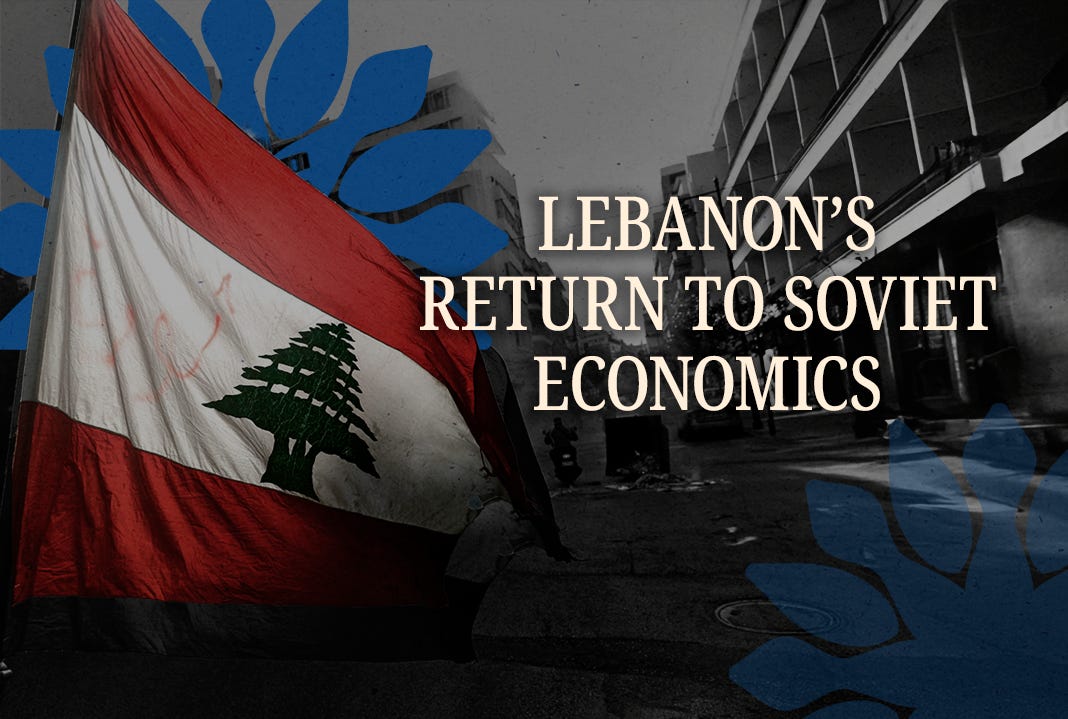
Financial tyranny rarely announces itself with tanks or decrees. It arrives through laws, committees, and press conferences, speaking the language of necessity and stability. In Lebanon today, it has identifiable political leadership. President Joseph Aoun and Prime Minister Nawaf Salam stand at the center of a project that recasts state failure as a burden imposed on citizens.
The Financial Gap Law represents a decisive break with liberal governance.
The recently approved draft legislation is purportedly designed to resolve the country's deep banking crisis by distributing massive losses (around $80 billion) between the state, central bank, banks, and depositors, aiming to return frozen funds through structured repayment plans, bond conversions, asset-backed securities, and audits.
In practice, it declares that private property exists conditionally and assigns state-created losses to citizens who lack power, access, or decision-making authority, securing compliance by exploiting economic vulnerability.
The purpose of an accountable, just government is to protect citizens’ rights and property. When it violates them, it becomes tyrannical. The seizure of private property without consent erodes legitimate authority and undermines the rule of law. Lebanon’s current leadership has embraced that outcome.
The president and the prime minister preside over a state that exhausted public funds through decades of mismanagement. They inherited a failing system and chose to preserve it rather than hold anyone accountable.
This approach is blatant financial authoritarianism.
The law targets deposits of $100,000 or more. That threshold carries no economic logic and is purely political, dividing society into those whose losses matter and those whose losses can be swept under the rug. People who worked abroad for decades now face the depletion of their life savings with executive approval.
Nurses, doctors, engineers, contractors, entrepreneurs, and workers sent money home believing the law protected ownership. The government now legitimizes a framework that strips them of that protection retroactively and treats their savings as expendable.
Financial tyranny always begins with retroactivity. Rules change after trust has been extended, and authorities rewrite the terms once they secure power.
The law also erases distinctions essential to any market-driven economy. It treats current business accounts and high-interest savings accounts as identical. Businesses have used current accounts to operate—to pay wages, rent, and suppliers. These accounts earned nothing and carried no speculative upside.
Savings accounts that earned extreme interest reflected different incentives and carried different risks. But the law ignores this entirely and imposes losses indiscriminately. That choice reflects corrupt politics rather than liberal governance.
Under classical liberal economic theory, the government exists to enforce contracts and protect property. The Lebanese executive endorses a law that does the opposite. It nullifies contracts and reallocates property by decree, converting executive power into an instrument of what essentially amounts to state-sanctioned burglary.
This law affects more than personal finances and weakens the separation between political power and economic activity, signaling that businesses, depositors, and citizens are to bear the cost while the political class remains untouched.
The president and the prime minister present themselves as managers of an unavoidable crisis, but that claim does not withstand scrutiny. Both are responsible: they approved financially illiterate policies, defended the system, and delayed reform until sweeping economic failure became unavoidable.
Financial repression has never stabilized an economy, as history has repeatedly demonstrated. It drives capital out, pushes activity into informal markets, erodes trust, and leads governments to rely on greater coercion. The result is a self-reinforcing cycle of failure and government overreach.
The private sector is already under heavy strain from informal capital controls, currency instability, and regulatory paralysis. The Financial Gap Law adds another layer to these constraints.
This move should be firmly rejected. Political authority exists to protect liberty and property, not to override them. When governments reverse that relationship, dark times lie ahead. Lebanon, once described as the “Switzerland of the East,” now risks a far more unstable trajectory.
The law also sets a precedent and signals how future crises will be handled. That expectation undermines any prospect of Lebanon’s economic recovery. Capital does not return where ownership is uncertain, entrepreneurs do not invest where rules are rewritten, and growth does not occur under sustained financial pressure.
Lebanon once claimed a liberal economic identity defined by openness, entrepreneurship, and a robust banking sector. The current government is abandoning that legacy. Financial authoritarianism does not require ideology—only opportunity. The current ruling class has that opportunity and is seizing it through lawfare.
The Financial Gap Law warrants rejection because it formalizes coercion and consolidates unaccountable power. It shifts the burden of state failure onto citizens while shielding those responsible.
Tyranny often hides behind procedure, but it becomes harder to defend once clearly identified. Lebanon’s crisis has many causes—and its financial authoritarianism now has identifiable authors.
Middle East Uncovered is powered by Ideas Beyond Borders. The views expressed in Middle East Uncovered are those of the authors and do not necessarily reflect the views of Ideas Beyond Borders.
