


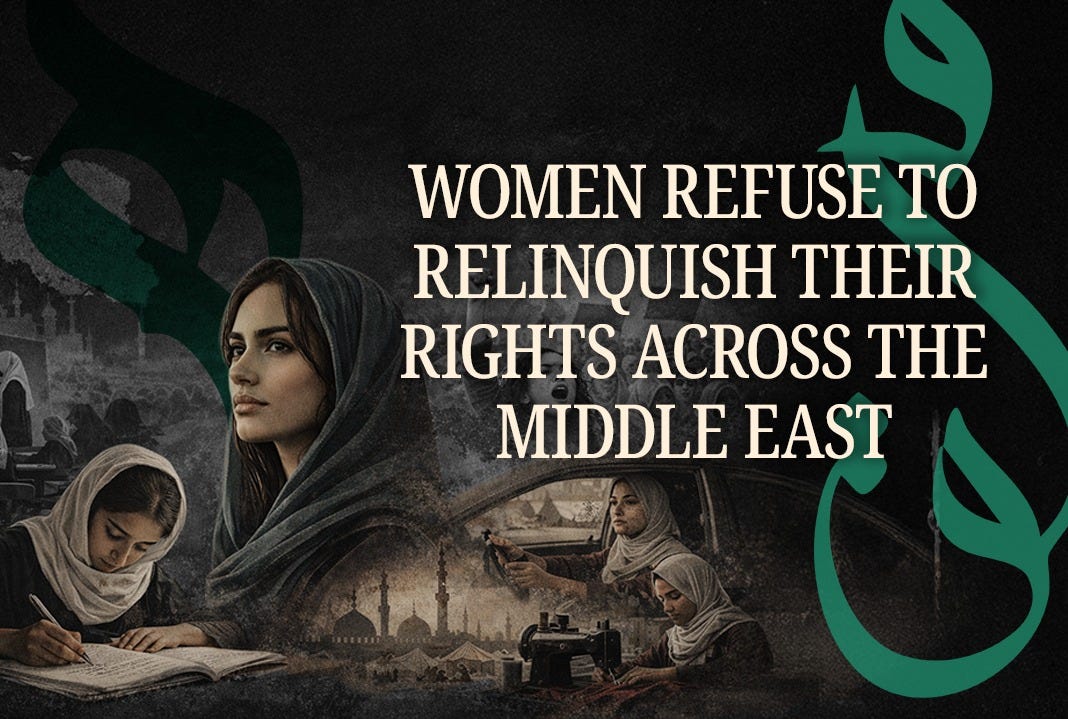
In the Middle East, International Women’s Week can feel unrelentingly bleak. Headlines spotlight surging rates of sexual violence and dissect discriminatory laws that layer fresh restrictions on female freedoms.
In recent years, funding cuts have gutted support networks and exacerbated the risks faced by women’s rights actors operating in an increasingly hostile environment. Just last week, Iraqi women’s rights activist Yanar Mohammed was shot dead outside her home in Baghdad by an unidentified gunman. Rights groups decried the “chilling pattern of targeted killings” faced by activists in Iraq.
Now, the US-Israeli strikes on Iran threaten to intensify a crisis that has already seen a rollback in women’s rights across the region. The disproportionate impact of war on women and children is well documented, and the UN Secretary General has called for an immediate cessation of hostilities.
However, this catalogue of decline obscures another truth unfolding simultaneously. From the Gulf, where education has spurred advances in civil liberties, to Iran, where female protesters risk reprisals to speak out, women across the region are shaping their own futures in vastly different contexts.
Even in Afghanistan, where the Taliban’s new criminal code has entrenched gender apartheid, women refuse to disappear. Studying in secret and working online, they continue to work, learn, and organize, defying a regime that’s set on erasing them from public life.
These are the stories that inspire us at Ideas Beyond Borders, where we support hundreds of women and girls advancing education, entrepreneurship, and civic participation in some of the region’s most challenging environments. From underground classrooms in Afghanistan and businesses built under repressive conditions to refugee camps in Iraq where Yazidi women rebuild lives shattered by ISIS, this resistance takes many forms.
As authoritarian and patriarchal values gain momentum across the globe, women and girls are creating openings of opportunity that bypass institutional sexism and lay the foundations for freedom in the Middle East.
It’s in these stories—of fathers who refuse to see their daughters’ ambitions erased, teachers risking their safety to keep girls learning, and entrepreneurs who refuse to be intimidated by tradition—that the future of the region rests.
Our ambition is to reinforce this support system so that the forces seeking to censor and oppress fail to dampen female potential, leaving women and girls free to realize their power.
Today, the Middle East is at a tipping point, inching closer to gender equality even as the forces against it intensify. In her statement on International Women’s Day, UN Women Executive Director Sima Bahous described the stark contradiction facing women and girls: “Stronger laws exist on domestic violence. More girls are in school than ever before. Women’s movements are more connected, more visible, and more crucial than ever before.”
Yet this progress exists alongside a powerful backlash. “Violence is rising, including online. Backlash is organized and well-resourced. Rights are being reversed in real time and at unprecedented speed. Impunity is spreading, in homes, online, and in conflicts,” Bahous warned.
Worldwide, women still have just 64 percent of the legal rights of men. As the war in Iran spreads, those rights come under increased pressure, putting the safety, security, and livelihoods of all civilians, particularly women, at risk. Yet even as conflict creates new uncertainties, women across the region are creating and pursuing opportunities for progress.
‘Afghan Women Tend to Find a Way’: Inside the Secret Classrooms Defying the Taliban’s Ban on Girls’ Education
KABUL, Afghanistan — Scattered across Afghanistan, where girls’ education has been severely restricted, a clandestine network of women educators refuses to surrender the future of their country’s girls.
Since the Taliban’s return to power in August 2021, which brought a systematic dismantling of girls’ education beyond the sixth grade, some teachers have continued to operate underground schools.
“We started small, just a few students in a safe house,” said Amina, a teacher at the forefront of these secret networks. “Now, even with the risk, we are operating in multiple provinces. The number of students keeps growing because there is no other option. If we stop, these girls will have nothing.”
The World Moved On. She Stayed to Defend Yazidi Women.
KURDISTAN, Iraq — Taban Shoresh never spoke about surviving genocide in Iraq. Growing up in the UK as a refugee, she tried to be “as British as possible” and avoid her painful past.
Shoresh was four years old when Iraqi soldiers came to her family home in Kurdistan. It was the late 1980s, and then-Iraqi president Saddam Hussein had launched the so-called Anfal campaign, which oversaw the mass extermination of Kurds in northern Iraq amid the ongoing Iran-Iraq War.
Realizing that her lived experience could offer vital insight, Shoresh quit her job at an asset management firm in London and flew to Iraq for the first time since her family fled in the 1980s. “If I can prevent one person from going through what I went through, I’m happy with that,” she said.
In Iraq, Mosul’s Women Find Freedom in Female-Only Transport
MOSUL, Iraq — The clang of construction rings loud throughout Mosul, where homes, cafes, and historic monuments are still emerging from the rubble. Nine years after Iraqi security forces declared victory over ISIS, Iraq’s second-largest city is still forging a new identity as battle-scarred buildings give way to fresh facades, leaving the bitter years of occupation behind.
Many residents remained in displacement, unable to see a future there. Hakam Hesham, 25, was among a handful of local entrepreneurs brave enough to try. In 2023, he launched Lygo, a taxi service for women, becoming the first Iraqi-led service of its kind to both employ and cater to female customers.
Initially staffed by female drivers, the company has revolutionized travel in the conservative city. “If a woman doesn’t have a car, or one of her male relatives doesn’t, she cannot go anywhere,” Hesham said.
She Wanted to Be a Doctor. Now She Fights to Keep Afghan Kids Learning
KANDAHAR, Afghanistan — At just 21, Rohila never imagined she would become a teacher. Her dream was to study medicine. Instead, she now stands before classrooms of Afghan children, trying to keep their curiosity alive in a country where education has been gutted, and teachers are disappearing.
“Why shouldn’t learning be fun?” she says of her philosophy. She builds lessons around games, cartoons, and what children see online. “These kids are sensitive. You have to meet them where they are.”
Yet even the most committed teachers cannot escape the reality of Taliban rule. Schools are under constant scrutiny. Curricula are stripped of subjects deemed “un-Islamic.” And qualified teaching staff, particularly women, are being forced out.
Twenty-Five Years After Resolution 1325
Twenty-five years after a landmark United Nations resolution set out to give women a seat at the table, the backward slide in women’s rights is accelerating. Goals that were once difficult now seem impossible as campaigners confront renewed barriers to equality in many parts of the world.
In the Middle East, a question mark hangs over the future of women and girls as military spending increases and support networks vanish.
Hailed as a turning point when it was adopted unanimously by the UN Security Council on October 31, 2000, Resolution 1325 recognizes the disproportionate impact of conflict on women and girls and reaffirms their role in peacebuilding, conflict resolution, and post-conflict reconstruction.
Now it’s coming under fire amid a global ideological backlash that is dismissing gender as a dirty word and threatening decades of hard-won progress.
The Woman Behind Palestine’s Pioneering Brewery
WEST BANK, Palestine — At 4am, while the world around her sleeps, Madees Khoury is wide awake and brewing beer in the hills of the occupied West Bank. “I’m still in my pajamas, but I’m in my zone! It’s fun!” she laughs. “I get my hands dirty, and I work. I love it!”
Khoury is not just doing any job. She’s the only female brewer in the Middle East. And from the Palestinian village of Taybeh, she is making beer under occupation, against the grain of tradition—far from the easiest place to run a business.
“I grew up here, since the age of nine, watching my family build the business and work really hard,” the 39-year-old tells me from the brewery over a Zoom call.
The Vanishing Coverage of Women’s Lives is a Policy Risk
In 2023, I remember sitting with a teenage girl in a motel room in Jordan who was on the run from her father after he tried to force her into marriage. The law offered her no protection; the police sided with her father, a common reality in Jordan and many other countries. Without journalism willing to document her experience, her story—and the system that failed her—would have gone unheard.
As global crises deepen, women and girls sit at the center of conflict, repression, migration, and authoritarianism. Yet the journalism that documents their lives is disappearing.
This truth is unfolding today in Iran, where women are leading one of the bravest movements of our time, risking prison and death for bodily autonomy and basic freedom. Their protests are journalism in themselves: public testimony against a system built on fear and silence. Yet the reporting needed to preserve this moment remains scarce, underfunded, and treated as optional.
Fathers in Afghanistan Refuse to Surrender Their Daughters’ Dreams
KABUL, Afghanistan — The rush of joy when Sayed held his baby daughter for the first time was fleeting. At 20, he was a first-time father, anxious to give the tiny, precious human in his arms the best chances in life. But looking down at his little girl, he felt her happiness had an inevitable expiration date.
“After the initial joy, I felt hopeless,” he said. “In the future, she cannot pursue her studies like girls in other countries, cannot make a good life for herself.”
His concerns echo those of countless fathers across Afghanistan who feel powerless to intervene as their daughters, wives, and sisters watch their dreams dissolve. Women who once led full, productive lives are now stuck at home, hope ebbing under a regime that grows increasingly hardline.
Forgotten Women Defying the Odds
KURDISTAN, Iraq — There’s an eerie quiet on the streets of Essyan Camp. One of the largest refugee camps in the Kurdistan Region of Iraq, this was once a hub of activity, with aid and development agencies from across the world offering support and services to thousands of internally displaced people, many of them Yazidis forced from their homes by ISIS in 2014.
Today, the atmosphere is different. Some people have moved on, emigrating to Europe or returning home to Sinjar and other areas that were overrun by ISIS at the height of their caliphate. Yet the camp remains one of the largest in the region, with families afraid to return to areas with limited infrastructure and a volatile security situation, offering little hope for the future.
The Lotus Flower is among a handful of organizations continuing to provide services to refugees and IDPs in camps and host communities across Kurdistan. Set up by former child genocide survivor Taban Shoresh, they support women and girls affected by conflict and provide the tools they need to rebuild their lives.
The Criminalization of Afghan Women
KABUL, Afghanistan — As Senior Director of Right to Learn Afghanistan, I have spoken with girls inside the country who instinctively lower their voices when they utter the word “future”—not out of shyness, but because they have learned that dreaming of one might draw attention they cannot afford.
With the introduction of the Taliban’s new Criminal Courts Procedure Code, even staying within the confines of the law offers no protection.
The code assigns punishment by social class, denies defendants basic procedural safeguards, and grants judges sweeping discretion to criminalize ordinary behavior. It’s not a system meant to resolve crimes, but one designed to discipline a population—especially women—through the constant threat of arbitrary punishment.
International Women’s Week is a reminder that progress rarely moves in a straight line. Yet across the Middle East, women are continuing to push forward—building classrooms, businesses, and movements that refuse to accept a future dictated by those who would seek to strip them of their agency.
Middle East Uncovered is powered by Ideas Beyond Borders. The views expressed in Middle East Uncovered are those of the authors and do not necessarily reflect the views of Ideas Beyond Borders.