


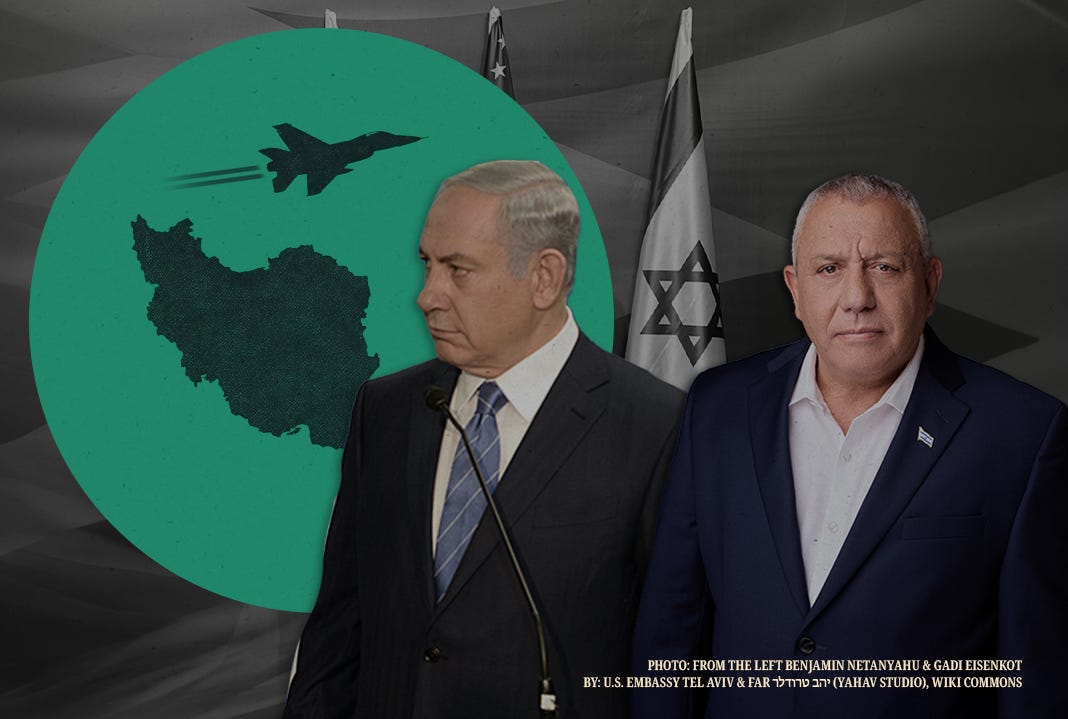
As predicted, Israel’s elections produced no clear winner. All the major parties failed to secure the required 61 seats needed to form a government. Benjamin Netanyahu’s bloc secured 53 seats in the 120-member Knesset, while the opposition bloc led by Gadi Eisenkot won 48.
The result leaves open the possibility of a national unity government led by Netanyahu if he can persuade someone like Eisenkot to stand by him.
But a change of leadership may change little in the way of Israel’s approach to Iran, where the war is widely viewed as a matter of Israel’s existential survival.
If recent reports are to be believed, there may be strikes on Iran soon after the US midterm elections.
“Iran occupies a unique place in Netanyahu’s strategic worldview, not as a temporary political issue but as a long-term security challenge,” says Ahmed Khuzaie, a Bahrain-based analyst. “As a result, any assessment of future Israeli military action should begin with political continuity rather than electoral outcomes.”
He adds that the prospect of further Israeli strikes should be taken seriously if Netanyahu remains in office.
“This is not because elections create an incentive for war, but because a stable leadership provides greater freedom of action,” he says. “A government preoccupied with coalition bargaining or political uncertainty is typically more cautious in taking major military decisions.”
By contrast, says Khuzaie, a stable Netanyahu-led government could be more inclined to maintain pressure on Iran if Israeli decision-makers conclude that Tehran is rebuilding its military capabilities, extending its regional influence, or establishing strategic advantages that could become harder to challenge later.
“The more important question, therefore, is not whether the election changes Israel’s policy towards Iran, but whether it removes constraints on the execution of that policy,” says Khuzaie.
Richard Pater of the Britain Israel Communications and Research Center (BICOM)—an independent British think tank—believes a national unity government has considerable appeal among the Israeli public, even if the parties involved might struggle to agree to it.
The potential grouping of the three main center-right leaders—Avigdor Lieberman, Eisenkot and Naftali Bennett—represents an alternative to Netanyahu’s existing political arrangements.
Yet Pater suggested that the prospect of a wider coalition could take on a different significance if the government’s overriding objective became confronting Iran.
“I think, ironically, this could help the thesis of the unity government,” he says. “It makes sense if you’re going for a war and you’ve kind of identified the enemy.”
Pater points to what he described as a two-year window while Donald Trump remains US President, in which Israeli leaders could seek to strike Iran and eliminate what they regard as the Iranian threat.
A broader coalition could give any decision to resume military action greater political legitimacy and make it easier for the government to sustain public and parliamentary support. Rather than necessarily moderating Netanyahu’s approach, a unity government could give him more legitimacy.
Pater also suggests that Eisenkot’s participation in a government could make it easier for Netanyahu to take difficult security decisions, with a former Israel Defense Forces (IDF) chief of staff involved in shaping them and sharing responsibility.
Netanyahu has made no secret of his mission to eliminate the Iranian threat. He has spent the past three decades telling the world that Tehran is on the brink of creating a nuclear bomb
“Netanyahu has often stated this is his life’s mission. And so obviously he’s going to be even more determined to do so,” says Pater.
An Israeli government that includes figures outside Netanyahu’s existing coalition might change how decisions are made, but perhaps not the end goal.
Eisenkot himself is no less hawkish. Once part of Netanyahu’s emergency war cabinet after the October 7 attacks, he recently praised the joint US-Israeli operation against Iran.
“Trump’s decision to strike Iran together with Israel exceeded anything one could have imagined,” he told the New York Post. “That military campaign and the operation were courageous.”
He also warned that the question of what follows the campaign was critical, arguing that Iran continues to seek nuclear weapons capability and wants to become “another North Korea.”
Eisenkot has proposed a US-backed regional security alliance involving Israel and Arab countries, dubbing it a “Middle Eastern NATO.” His position suggests that, even under a different prime minister, Israel could continue to pursue a strategy aimed at containing Iran through military pressure and regional partnerships.
Zizette Darkazally, an associate fellow at Chatham House in London, offers a more explicit interpretation of the stakes for Netanyahu.
“It doesn’t look good if Netanyahu stays in power. He needs war; it’s his lifeline,” she says, adding: “If Netanyahu stays, the likelihood of war is high.”
Under Eisenkot’s leadership, only “the management of it would be different,” she adds.
Pater believes any future operation would also need to take account of the lessons of the previous strikes on Iran, particularly the need for Israel and the United States to agree on their objectives in advance.
“One is setting objectives in coordination with the US in advance and an agreement, because it seems to be that last time America and Israel were not necessarily on the same page. And they didn’t fulfill the full objectives,” he says.
His point highlights a central uncertainty. Even if Israeli leaders agree that Iran is a threat, they may differ with Washington over the aims, duration, and limits of any renewed bombing campaign. A broader Israeli coalition would not, by itself, resolve those questions.
In Tehran, the expectation is that there will be another attack soon, regardless of the outcome of Israel’s election.
Iran has shown little willingness to accept the concessions demanded by the Trump administration, while its leaders have continued to signal that diplomacy remains possible under conditions they consider acceptable.
In comments to Al Jazeera in September, Iranian Foreign Minister Abbas Araghchi said Tehran was not planning to meet US officials, although he described recent American efforts towards “broader dialogue” as positive. He said Iran had reviewed a letter from US Vice President JD Vance and would decide whether any negotiations should be direct or indirect once Washington agreed to Iran’s conditions.
Araghchi also floated a proposal to reopen the Strait of Hormuz within a week if the US lifted its blockade of Iranian ports, released frozen Iranian assets, and waived sanctions on Iranian oil sales, among other conditions. The proposal was rejected.
Qatar, which has acted as a mediator between Tehran and Washington, has continued its diplomatic efforts. A Qatari delegation arrived in Tehran for talks last week.
Yet the diplomatic contacts have not removed the risk of renewed fighting. Trump is reportedly weighing further attacks, potentially after the upcoming US midterm elections, and American and Israeli officials have drawn up specific plans for strikes.
Hamidreza Azizi, a senior Iran analyst at the International Crisis Group, told the New York Times: “They have been expecting a new round of war already for a few weeks, and they’ve been preparing accordingly.”
The US midterms add another layer of uncertainty. Democrats appear positioned to make gains and potentially take control of the House of Representatives. The scale of those gains, and the Senate outcome, could affect Trump’s political room to maneuver.
However, a Democratic victory would not automatically end US support for Israel or prevent the administration from authorizing further strikes.
If Trump wants to secure a diplomatic agreement, the coming weeks may offer an opportunity to do so. If negotiations remain stalled, however, the possibility of military action could persist regardless of the election’s implications for Congress.
For Iran, the stakes are also economic. Annual inflation reached 88.7 percent this month, adding to the pressure on households already affected by sanctions and the conflict.
Parliamentary speaker Mohammed Bagher Ghalibaf has said that Supreme Leader Mojtaba Khamenei wants people to be able to afford basic goods, while also making clear that the welfare of “the armed forces and the fighters at the front” remains a priority.
The combination of economic strain, military preparations, and tentative diplomatic contacts leaves Tehran facing difficult choices. Accepting Washington’s conditions could carry high political and strategic costs; refusing them could leave Iran exposed to another round of attacks.
On Saturday, Khamenei (who has still not been seen in public since being injured in US-Israeli airstrikes on February 28) warned the US against launching fresh attacks.
“If the enemies once again launch military or terrorist attacks, it is the armed forces of the Islamic Republic and the Iranian nation that will determine the time and conditions for ending them,” said a statement attributed to Khamenei posted on his Telegram channel.
Israel’s election offers little reassurance that the conflict with Iran is nearing an end. A unity government could give Netanyahu broader backing for renewed strikes, while a successor may share his view of the Islamic Republic as an existential threat.
Whoever takes office will have to decide whether Israel’s military campaign has achieved its objectives. Or whether, as Iran fears, another round of fighting is only a matter of time.
You might also be interested in:
What’s at Stake for Palestinians in Israel’s Election

Israelis will go to the polls on October 27, in what may be one of the most consequential elections in the country’s history.
Middle East Uncovered is powered by Ideas Beyond Borders. The views expressed in Middle East Uncovered are those of the authors and do not necessarily reflect the views of Ideas Beyond Borders.