


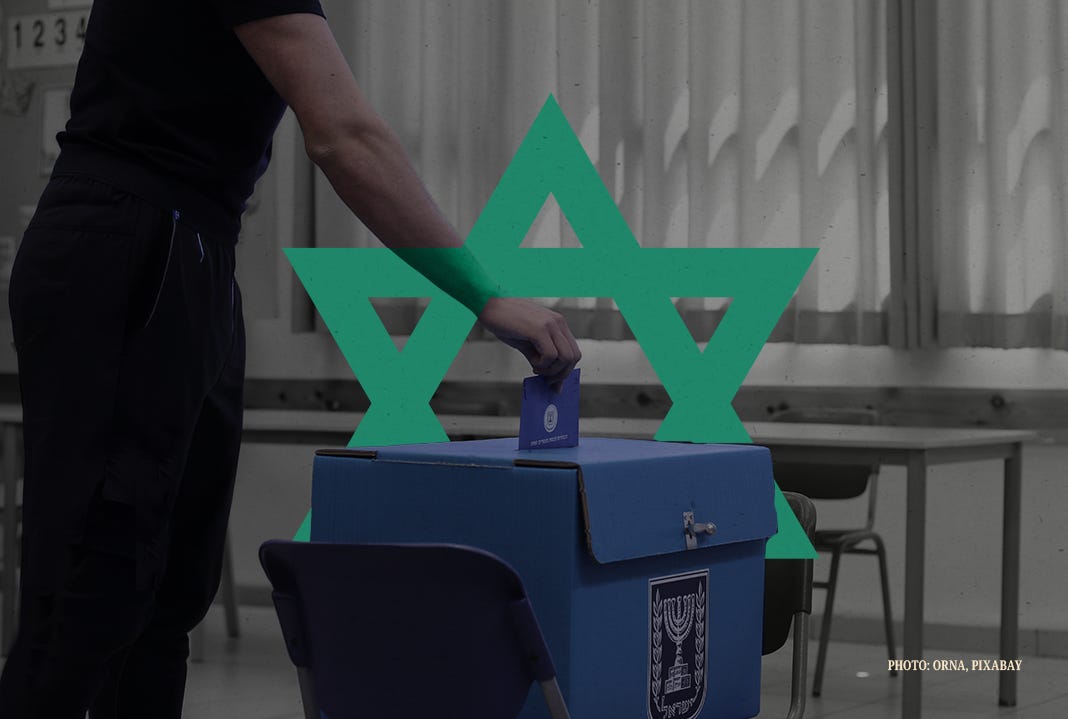
Israelis went to the polls on Tuesday in extraordinary numbers. Turnout reached a reported 77.7 percent, the highest in a quarter-century. After four years of political upheaval, mass demonstrations, the Hamas-led invasion and massacres of October 7, wars on several fronts, and a succession of national traumas, many hoped the election would finally provide some resolution. Instead, the result has left Israel facing another predicament. Neither of the two principal political blocs has an obvious path to power.
The political picture remains unsettled, and developments in the coming days may render present calculations obsolete. Nevertheless, the broad outlines of the result are becoming clear. Benjamin Netanyahu has suffered a significant parliamentary defeat. Although Likud remains the largest party, his outgoing coalition is projected to fall from 68 seats to 53, well short of the 61 required for a majority. His opponents, taken together, have the numbers to replace him. Whether they can agree to govern together is another matter.
Several opposition leaders have ruled out governing with Arab parties, leaving Netanyahu in the peculiar position of having lost his parliamentary majority without necessarily having lost an opportunity to retain power. For those who voted in the hope of bringing his long premiership to an end, hope and despair have become difficult to separate.
Much of this predicament can be traced to perhaps the most consequential development of the election: the remarkable mobilization of Israel’s Arab citizens. In Nazareth, turnout rose from 48 percent in 2022 to more than 72 percent. In Umm al-Fahm, it increased from 38 percent to nearly 76 percent, while in the Bedouin city of Rahat it climbed from 61 to 82 percent.
Several factors drove this surge, with many rooted in the everyday concerns of Arab communities rather than Palestinian nationalism. Organized crime and gun violence have devastated towns and neighborhoods, with successive governments failing to contain the crisis. Inadequate public services, housing shortages and poor infrastructure have contributed to a longstanding sense of neglect.
The war in Gaza and Israeli policies in the West Bank provided further reasons to oppose the government. So too did the conduct of ministers such as Itamar Ben-Gvir and Bezalel Smotrich, whose rhetoric and policies are openly hostile to the Arab minority. The effect appears to have been the opposite of what such antagonism might have been expected to produce. Rather than retreating from the political system, Arab voters turned out in numbers sufficient to help deprive the government of its majority. The methods of Ben-Gvir and Smotrich, whatever their intended purpose, appear to have backfired.
The Arab vote, however, should not be mistaken for the expression of a single political movement. The parties representing Arab citizens differ substantially in their ideological traditions, priorities and attitudes towards cooperation with Jewish parties. Mansour Abbas’s Islamist Ra’am has over recent years pursued a pragmatic course, concentrating on budgets, policing and improvements in Arab communities. His decision to parnter with Yoav Segalovitz, a Zionist politician and former senior police commander, was a striking illustration of this approach.
Balad, by contrast, is rooted in Palestinian nationalism, while Hadash emerged from the communist movement. Both are antizionist and have historically resisted formal participation in Zionist-led governments. These differences have considerable practical importance. A parliamentary majority that includes the Arab parties may exist on paper, but converting it into a functioning government requires agreements between politicians whose disagreements extend well beyond the usual disputes over economic or social policy.
Israel has encountered this problem before. Between 2019 and 2021, four successive elections demonstrated that a majority opposed to Netanyahu was not necessarily a majority capable of replacing him. In 2021, Naftali Bennett and Yair Lapid eventually assembled an unlikely coalition that included Abbas’s Ra’am, the first independent Arab party to formally enter an Israeli government. The arrangement survived for approximately a year before collapsing amid internal disputes and defections from both Arab and Jewish members. It established an important precedent for Jewish-Arab political cooperation, while exposing the fragility of a government held together largely by opposition to Netanyahu.
Recreating such an arrangement today would be considerably more difficult. October 7 and the wars that followed have transformed the political atmosphere. Bennett and Avigdor Liberman have rejected governing with Arab parties, while Yair Golan’s Democrats support their participation. Gadi Eisenkot has taken a more conditional position to the participation of any party, setting out requirements concerning recognition of Israel’s Jewish and democratic character, acceptance of the principles of its Declaration of Independence, national service, and an unequivocal commitment to the demilitarization of Gaza and the replacement of Hamas.
These demands reflect concerns that cannot be explained simply as a reluctance among Jewish politicians to share power with Arab representatives. For much of the Jewish electorate, the question of Hamas is inseparable from the experience of October 7. The massacres and the subsequent wars have given rise to questions of security and political loyalty that were less pronounced during the negotiations of 2021.
Much of the discussion since the election has therefore focused on whether Bennett, Liberman and other Jewish opposition leaders might reconsider their objections to Arab participation. Less attention has been given to the concessions that Arab parties themselves might be prepared to make. Any durable agreement would require not only a willingness among Jewish politicians to accept Arab partners, but also sufficient common ground on Hamas and national security to make cooperation credible to the wider electorate.
Netanyahu, for his part, has declared somewhat of a victory. Likud remains the largest party, and his existing coalition has won more seats than the Jewish opposition parties combined. He will seek a mandate from President Isaac Herzog to form a government, although the president is not required to give the first opportunity to the leader of the largest party. Without additional partners, Netanyahu cannot reach 61 seats. One possibility would be a national unity government involving Eisenkot’s Yashar, perhaps under an agreement to rotate the premiership.
There is an obvious difficulty with such an arrangement. In 2020, Eisenkot’s former partner Benny Gantz entered a unity government with Netanyahu under an agreement that was supposed to make him prime minister. The government collapsed after failing to pass a state budget, bringing about the dissolution of the Knesset before Gantz could take office. The episode remains fresh in the memories of Netanyahu’s political opponents. Eisenkot would be asked to trust a prime minister whose previous partner never received the position he had been promised.
For Eisenkot, the decision would also carry a deeply personal significance. His youngest son, Gal, a 25-year-old reservist, was killed fighting in Gaza in December 2023. Two of his nephews also died during the war. Eisenkot has repeatedly held Netanyahu responsible for the failures that preceded October 7, and the demand for accountability became a central part of his campaign. Entering a government led by Netanyahu would mean helping preserve the premiership of the man whose removal he has argued is necessary for Israel’s recovery.
Netanyahu’s opponents have spent years arguing that his continued leadership threatens Israeli democracy, deepens its divisions, and prevents the country from confronting the failures of October 7. Yet they may now prove incapable of acting on those convictions because the compromises required are politically unpalatable. The Arab parties face decisions of their own. Their voters have helped deprive Netanyahu of his majority, but translating those votes into political influence may require cooperation with politicians whose positions on fundamental questions of national identity, the Palestinians and security they oppose.
The electorate, taken as a whole, wants several mutually incompatible things and has voted accordingly. It has now produced a parliament that faithfully represents this incoherence, crystallized in the form of 120 MKs, no 61 of whom can agree on anything at all.
Much may change in the coming weeks. Old rivalries may be reconsidered between the opposition and Netanyahu, new alliances explored between Jews and Arabs, both of which means campaign promises will be sufficiently abandoned. Meaning every politician involved faces the same uncomfortable calculation: if negotiations fail and the country returns to another election, they will have to explain to their voters why the principles they insisted were non-negotiable suddenly became moveable. Few politicians relish having to ask voters for a renewed mandate after demonstrating how little their previous promises were worth.
Middle East Uncovered is powered by Ideas Beyond Borders. The views expressed in Middle East Uncovered are those of the authors and do not necessarily reflect the views of Ideas Beyond Borders.

Right now it feels like nobody in Israel across the political spectrum feels physically safe and nobody trusts the other “camps” enough to take any real risks to break the ongoing impasse. People need a basic sense of safety and many want vengeance for both real and perceived wrongs by the IDF, Hamas, etc. Until enough people commit to a vision of accountability and human dignity for all Israelis I’m not sure how you break that impasse. Perhaps a starting point would be for each side to lay out what steps it needs to see to start building trust in the other side and-if that happens-what next steps would build in that trust, etc.? Could the opposition and Arab parties commit to such a pathway as a means to create a governing bloc that can actually implement real changes within Israel? I don’t know. As an American I admittedly don’t have to risk anything. I’m simply trying to add something constructive to the conversation. All I can say confidently is if Israel keeps lurching further to the right and Palestinians don’t renounce Hamas I don’t see how you avoid deepening violence. I have faith that collectively you can create a viable path forward. I keep praying for all of you and if I see chances to constructively contribute to change I will.
There is a way out: a minority government led by Eisenkot. The Arab parties (or Raam only) will vote for it but not participate in the government or the coalition. Such government will suffer from fierce incitment from the right, but it can still govern and even hold out 4 years - once the government is voted in, is very difficult to take it down. The Arab parties may agree because the alternative is worse; the new government will commit to handle the crime problem in the Arab towns.