


The mourners came out in full force. Clad in black despite the unforgiving summer heat, they joined an 80-kilometer procession through Tehran, weeping and chanting either “revenge” or “bayad barkhast”—“we must rise.”
It was July 6, and hundreds of thousands of Iranians attended the week-long state funeral procession for former supreme leader Ayatollah Ali Khamenei.
The casket was taken across various cities in Iran, even crossing the border into Iraq, where it was carried through the holiest Shia shrines.
Three days later, he was finally laid to rest in his birthplace of Mashhad.
Emotions were certainly running high. Some mourners unfurled a banner reading: “We will kill Trump.”
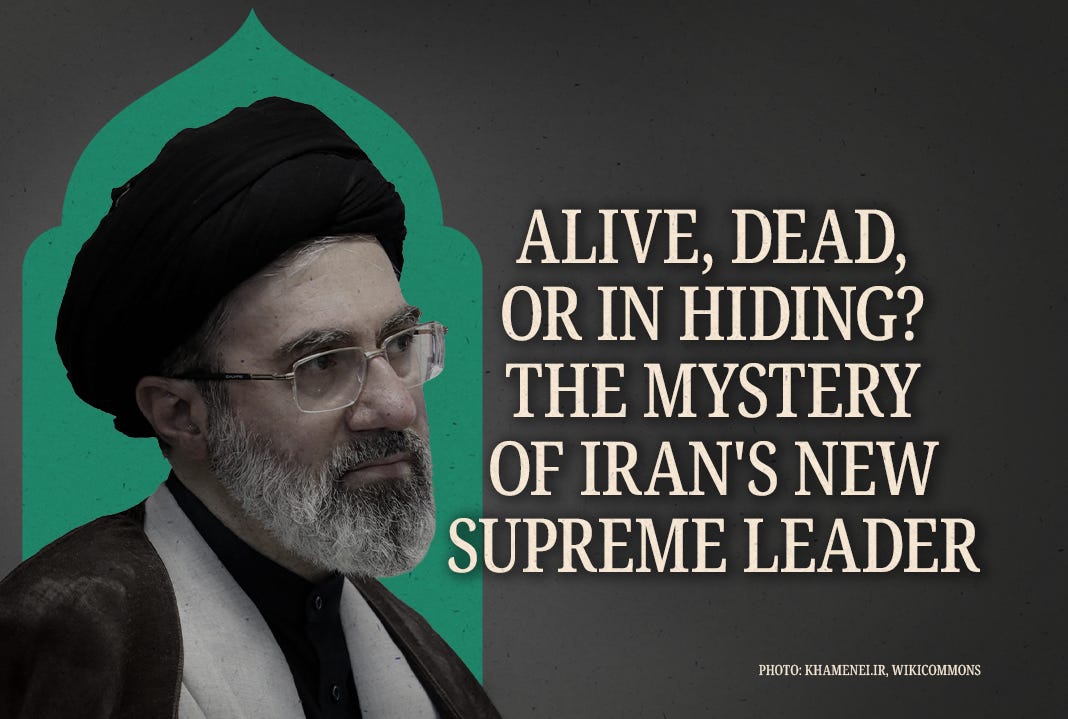
But one figure’s absence was notably conspicuous—Mojtaba Khamenei.
The 56-year-old succeeded his father as Iran’s new Supreme Leader. Yet, since assuming the country’s highest office, he has not been seen in public since the Israeli air strike on February 28 that reportedly wounded him and killed Ali Khamenei.
His absence has fueled intense speculation inside and outside Iran. While some rumors have suggested he was merely injured, others have gone further, claiming he may have died.
The funeral ceremonies were carefully choreographed to project continuity. Foreign delegations attended, seemingly pointed Quranic verses were recited throughout the proceedings, and senior officials were present, including President Masoud Pezeshkian, Foreign Minister Abbas Araghchi, and Parliament Speaker Mohammad Bagher Ghalibaf.
Hassan Khomeini, grandson of the founder of the Islamic Republic, attended alongside other family members.
Three of Ali Khamenei’s sons—Mostafa, Masoud and Meysam—appeared repeatedly throughout the funeral ceremonies, appearing to be physically well.
Only Mojtaba was missing. Instead, a cardboard cutout was placed to pay tribute in his stead. A statement on Tasnim News Agency, affiliated with the Islamic Revolutionary Guard Corps (IRGC), said that Khamenei may lead a memorial ceremony for his father on July 23.
“I don’t even know the last time in global history where we’ve had a head of global state who has been absent throughout his time,” says historian Dr. Arash Azizi, author of What Iranians Want: Women, Life, Freedom.
“It’s not like where, once in a while, you don’t see a president for a few months because they’re sick. This is something much more radical.
“This is a head of state who has not even issued a five-second voice note. This is added to the fact that even before he was Supreme Leader, there were very few things that have ever come out of this guy in his life.”
Khamenei’s first message to the nation, on March 12, was delivered not personally but read aloud by a news anchor. In the speech, he vowed to “avenge the blood of our martyrs” and to keep the Strait of Hormuz closed.
Since that address, Iran’s state media has released no new images or recordings of Khamenei.
Earlier this year, a video of regime supporters cheering a cardboard cutout of Mojtaba Khamenei went viral, leading some people to mock him as the “cardboard ayatollah” and question whether he is even alive.
Asked if Khamenei could be dead, Azizi said it was “not impossible,” before adding:
“But I find it quite unlikely. I think it stretches incredulity. I also think Israel and the US have excellent intelligence in Iran. If they were sure Mojtaba is dead, they would declare it publicly.”
Azizi says he wouldn’t be surprised if this status quo continued not just for months, but even years.
According to a report by The New York Times, Iranian security officials blocked Mojtaba from attending his father’s burial because they feared Israel could either assassinate him or track him back to his secure location. The report cited two unnamed members of the IRGC and a person involved in planning the funeral.
If accurate, the decision highlights the extraordinary security environment surrounding Iran’s new leader. Since the opening strikes of the conflict, Israel has demonstrated an unprecedented ability to target senior Iranian military and political figures deep inside the country.
Jonathan Hackett—a US Marine Corps veteran specializing in counterintelligence and the author of Iran’s Shadow Weapons: Covert Action, Intelligence Operations, and Unconventional Warfare—concurs with Azizi’s assessment.
But, he adds, Israel and the US “may calculate that keeping his status ambiguous publicly may be beneficial for them as well.”
He continues:
“The IRGC is gaining by having kept Mojtaba incommunicado. This allows the real power players like [Ahmad] Vahidi, Ghalibaf… to carve out their own power bases within the IRGC absent any public interference from the new, untested Supreme Leader.”
Khamenei’s fate is important to monitor “because the way his status is described will help us understand how the dynamics inside the IRGC and clerical elite are playing out privately,” says Hackett.
Insiders have sought to counter the more dramatic rumors. One source familiar with the matter said Mojtaba was in good health and that reports of serious injuries had been exaggerated. Mojtaba, the source continued, sustained some injuries to his feet and some facial scarring during the conflict, but was recovering well.
The funeral itself also revealed growing political tensions.
Despite the carefully managed ceremonies, several senior officials encountered open hostility from hardline mourners. Pezeshkian, Araghchi, and Ghalibaf were heckled by some attendees over negotiations with the US. In one incident, Araghchi was reportedly confronted by protesters who shouted insults and threw stones at him.
This, Hackett says, demonstrates that the clerical establishment retains influence over the IRGC. He points to several “more extreme religious figures” who openly described Qalibaf’s negotiations with the United States as a “soft coup.”
The guest list itself was also noteworthy. The most significant attendee was former president Mahmoud Ahmadinejad, whose appearance came after months of widespread media speculation over his alleged links to Mossad, Israel’s intelligence agency—claims that he has denied.
Ahmad Vahidi, the newly appointed IRGC commander, was seen publicly for the first time since the war began. Vahidi had himself been the subject of persistent rumors that he had been killed in Israeli airstrikes.
If Khamenei is alive and active, he would almost certainly rank high on Israel’s target list, which would explain why Iran’s leadership has prioritized security above all else.
Yet the longer he remains out of public view, the more questions are likely to grow. In the absence of official images or appearances, speculation has filled the vacuum, leaving observers to debate whether his invisibility reflects genuine security concerns, health issues, or a deliberate political strategy.
“Mjotaba’s absence could actually be used to fit him into the hidden imam narrative that is deeply woven into Shi’a Islamic thought,” says Hackett.
Within Twelver Shi’a belief, the 12th imam is still alive, although he is said to have gone into occultation after disappearing in 941 AD. The Mahdi, or “Hidden Imam,” will supposedly reappear at the end of time to restore justice and peace on earth before the Day of Judgment.
This connection, says Hackett, could serve as a useful tool for propagandists of the Islamic Republic in order to keep Mojtaba’s hidden status as a sign of legitimacy rather than weakness.
As for who is running Iran on a day-to-day basis, Azizi believes it is not Khamenei but rather Ghalibaf and his team at the national security council. This could lead to major changes in Iran.
“Ghalibaf might very well take the regime in a different direction, and the most likely direction he’d go in is a pragmatic one,” says Azizi. “It’s one in which Iran makes deals with the United States to help lift sanctions, tries to become a more normal country, and becomes less of a revolutionary one.”
But Ghalibaf, he says, will face resistance from the hardliners and parts of the deep state.
For now, we remain in limbo. Over 100 days after Ali Khamenei’s death, Iran has a new Supreme Leader but has yet to publicly introduce him. It continues to raise questions that neither official statements nor public ceremonies have managed to answer.
What is the truth behind Mojtaba’s lack of appearance, and will we finally get a glimpse of him? We may find out later this week.
Middle East Uncovered is powered by Ideas Beyond Borders. The views expressed in Middle East Uncovered are those of the authors and do not necessarily reflect the views of Ideas Beyond Borders.
Strong signal that he doesn't exist is the start of IRGC attacks on ships right after that they saw he didn't show up for the funeral. It seems IRGC is convinced he's not there so they started the attacks to sabotage the negotiations.
Moreover,it's much needed for the Islamic Republic that he show up, otherwise the internal conflicts will get more intense. So if he was alive they would somehow provide some proof.
What's going on this week that you expect him to show up?