


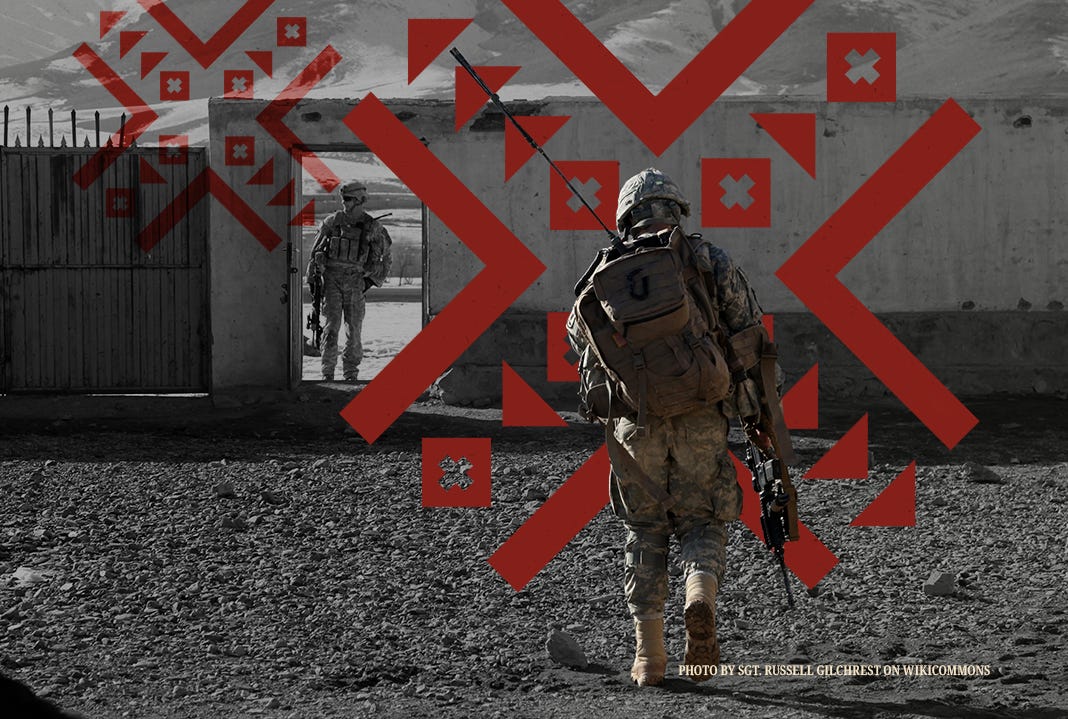
I was fifteen the morning the towers fell, watching from a small television screen in rural Australia late at night, confused and terrified as a second plane careened through the towering skyscraper live on air. I had no way of knowing then that a country I knew next to nothing about that day would go on to define most of my adult life and career.
But here is what the anniversary coverage rarely sheds light on: Afghans did not fly those planes; they were not the ones directly responsible for that horrific terrorist plot, and yet they are the ones still paying the price.
Let’s not forget that nearly all the hijackers, including the ultimate financier, were Saudi nationals. Bin Laden was not even hiding in Afghanistan when American forces found him in 2011. He lived covertly across the border in Pakistan, within walking distance from the country’s military academy. The offense Afghanistan committed in the invasion was that its leadership, the Taliban, was harboring a guest it couldn’t control.
The Afghan people have been paying for that failure for twenty-five years.
Today, I still try to go back to Afghanistan. Not as often as I once did, and not for the long stretches I used to, as objective reporting there has become increasingly dangerous under Taliban rule. But in 2021, I was there when the beautiful, bleeding nation fell once again, watching the Taliban ride motorcycles into Mazar-i-Sharif as bank lines swelled outside shuttered storefronts.
I wince when I remember watching as the women marched defiantly in the streets weeks later. Some wanted desperately to leave; others told me they would never give up on their country. Their home, the only home they knew. I wonder what happened to these women… if they found a way out, or if they are now banished to a sea-blue burqa in the basement.
That is the part of this anniversary few of us dare to grapple with: the war didn’t end in August 2021. It just stopped being American.
This year, for the first time since the towers fell, Afghanistan does not appear by name in either of the country’s core national security documents—not the National Security Strategy, not the National Defense Strategy. A nation that ingested two decades, thousands of American lives, and more than two trillion dollars has gone, in the space of five years, from a central concern of U.S. foreign policy to little more than a footnote folded into a larger debate.
I’ve asked officials in Washington about it. The answer I keep getting, more or less, is that there’s an “ongoing process” to figure out what America’s Afghanistan policy even is anymore. Others are more obtuse, telling me off the record that the country, and the maniacal end to the conflict, are moments most leaders would rather not think about.
Still, six years on, Afghanistan sits uncomfortably in the back of our collective memory. The country, meanwhile, hasn’t gone quiet.
This summer, in the mountains of Badakhshan, a resistance faction claimed its most serious clashes with the Taliban since the takeover—dozens of fighters were killed, positions seized and lost, and the first stretch of fighting that analysts are willing to call something closer to an insurgency than scattered raids occurred. It probably won’t unseat the Taliban. It doesn’t have the money or the outside backing for that yet. Nevertheless, it reminds us that nothing about that country’s story ended when the last American aircraft lifted off the runway at Kabul airport. It just stopped being covered.
When I visited Kabul’s EMERGENCY hospital for the war-wounded, weeks after the Taliban’s return in 2021, I met a boy named Abdul—thin, wide-eyed, maybe fourteen by my guess. A landmine had taken both his legs in Logar province just days before, planted most likely by the former regime now back in power. Abdul wasn’t alive for September 11, 2001. Had no stake in the towers, no memory of that Tuesday at all. He was still paying for it twenty years on.
I think, too, about a twenty-year-old named Halimsah, whom I met inside the grounds of the Blue Mosque in Mazar-i-Sharif two days before that city fell to the Taliban five years ago. It was a Friday, his only day off, and he was sitting quietly with friends among the white doves, trying to hold onto something ordinary while the ground shifted underneath the country.
He’d come to Mazar to study economics after violence chased him out of his home in Badakhshan province—the same province now, half a decade later, hosting the most serious armed resistance the Taliban has faced since it retook power.
“There is too much war,” he told me in broken English. “I just want to go to the university, and now I don’t know.”
Then, when I asked what he knew about September 11 and Osama bin Laden, he glared back at me like I’d spoken a foreign language.
“I don’t know,” he said. “Who is that?”
I paused. That was the whole war, condensed into one confused stare. An entire generation of Afghans has now grown up knowing only the after—after the invasion, after the surge, after the withdrawal, after the second collapse—with no memory of the event that supposedly started all of it, and no real say in why it happened to their country at all.
Remembering the towers, the lives lost, the way the country came together that week—that grief is real and it deserves its place in every anniversary written about this day. However, twenty-five years out, there’s another question worth sitting with too: what did we do in the two decades of war that followed, and what do we still owe a country we occupied for an entire generation?
Afghan women gained access to classrooms and workplaces they’d been locked out of for years, and many of them fought—genuinely fought, in the street, with their bodies—to keep that access after the Taliban returned. Some of them are still fighting for it, quietly, in ways that don’t make headlines anymore because no American soldier is standing next to them.
Those of us old enough remember that morning all too well—the crumbling towers, the ash-lathered bodies, the missing posters and the flags on every porch—we are worse at acknowledging what happened in the two decades after, and even worse at facing what happens to a country once we stop talking about it.
The chapter on Afghanistan didn’t close in August 2021 even though the United States and its allies walked, or more accurately, chaotically flew away. Forty-million people still live with the effects of a war they did not ask for, in a country that has slipped from the news cycle and from the lips of our political leaders. Twenty-five years later, that silence leaves a haunting legacy. Are we ever going to care again about Afghanistan?
What I Experienced Inside Afghanistan As It Fell

This essay is republished from Maternal Dispatches With Hollie McKay. McKay is a distinguished foreign policy expert, war crimes investigator, and bestselling author renowned for her work, particularly the book "Only Cry for the Living: Memos from Inside the ISIS Battlefield."
Middle East Uncovered is powered by Ideas Beyond Borders. The views expressed in Middle East Uncovered are those of the authors and do not necessarily reflect the views of Ideas Beyond Borders.

This is an important question because what we left behind after September 11 was not simply a war, but an entire strategic mindset.
Twenty-five years of counterterrorism demonstrated that military power can disrupt networks, remove leaders, and reshape battlefields, but it cannot by itself resolve the political, institutional, and social conditions that allow conflict to reproduce itself.
From the field, one lesson became particularly clear to me: when strategy focuses primarily on defeating the visible enemy, it can miss the environment that continuously generates new forms of resistance.
Afghanistan was one of the clearest examples. Tactical victories could coexist with strategic deterioration because the battlefield was only one part of the system. Governance, legitimacy, institutions, local incentives, regional power competition, and the population’s perception of the future all mattered.
Perhaps the most important question after 9/11, therefore, is not simply what we defeated, but what we failed to understand.
If the next twenty-five years are to be different, security policy must move beyond the cycle of threat, intervention, retaliation, and reconstruction. It must ask what conditions produce durable political order—and whether the people living inside those systems have a meaningful role in creating it.
The ultimate measure of strategy is not how long we can fight.
It is whether we eventually create conditions in which fighting is no longer necessary.
Wahidullah Noorzai — ANCOP Strategy | NIDA