


This essay is republished from Maternal Dispatches With Hollie McKay. McKay is a distinguished foreign policy expert, war crimes investigator, and bestselling author renowned for her work, particularly the book "Only Cry for the Living: Memos from Inside the ISIS Battlefield."
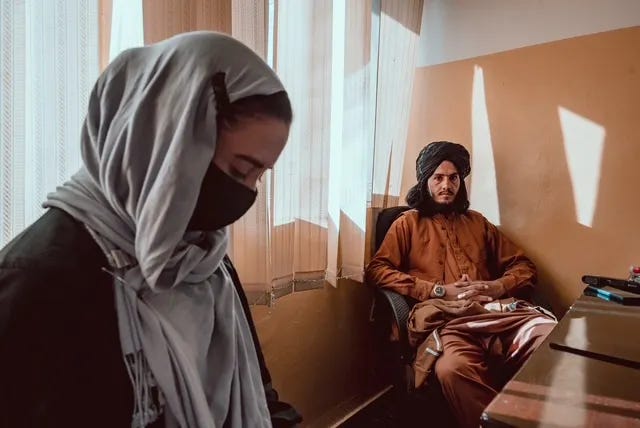
MAZAR-E-SHARIF, Afghanistan, August 2021— On August 14, 2021, I wake before my alarm on a Saturday morning, a sobbing mess, hungover with anxiety. The body, I quickly learn, never lies. My photographer, Jake Simkin, and I meander through the oddly empty Afghan city of Mazar-e-Sharif. The city’s dynamism has been stripped into shuttered stalls as hundreds line up outside the banks, a last-ditch bid to withdraw whatever cash they can to head somewhere else.
There is no longer a way out for us. A rare breeze wafts through the typically static air, carrying something ominous. Frightened families stuff themselves and their belongings into tiny, intricately colored rickshaws, retreating into the city center as their homes on the periphery come under threat. Under a scorching sun, shops are closed, and cars and construction equipment lie abandoned.
Around midday, Jake and I jump into a cab and drive toward what we presume to be the sandbagged front lines, where Afghan and resistance forces are putting up the fight of their lives. There are no signs of fighting.
“I’m scared,” the cab driver unexpectedly croaks. “I don’t want to go any further.”
Our interpreter, Hami, still on his Nokia flip phone, turns to us in the backseat.
“The Taliban has just broken through the first of the three front lines,” he blurts out with a bizarre smile, either out of secret pleasure or to appease my unease. “We are surrounded.”
I return to my hotel room, making call after call. I lie and tell my worried parents I am not near Mazar, which they hear on the news is on the verge of Taliban control. Still, every Afghan government and military official I speak to tells me the city will not fall, at least not for many more days.
The clock ticks, each second stretched thin, refusing to move fast enough toward whatever comes next. We venture out for Afghan street kebabs. After all, it is a Saturday night. Upon leaving our hotel, we are met by pitch-black skies and barren streets illuminated only by a faint crescent moon. We eat quickly, pulling hunks of fatty beef and liver off long metal skewers, noting that the kebab café down a dozen crooked steps is silent, empty, and unusual. Our favorite basement kebab café has never been silent before.
“That Spidey sense,” Jake utters, his voice trailing off.
We forgo our food, throw some money on the table, and head toward the hotel as quickly as possible. In the stifling summer night air, gunfire crackles. My fast walk becomes a run as motorbikes roar closer and closer behind. With my fingers gripping the back of Jake’s shirt, I thrust my body through the blast-proof doors of the ornate, towering hotel overlooking Mazar-e-Sharif.
Everything I think I know about war disappears from my graveyard of memories. I don’t know anything. I do not know what will come. I text a friend in Southern California.
“It’s falling,” I write, my hands shaking as I hurry to the roof in time to watch the Taliban swarm what was supposed to be the bulwark of resistance below. “It’s fallen.”
When I ask him if I will make it out, seeking any semblance of reassurance from a world far away, he says he does not know.
The Taliban’s celebratory gunfire intensifies. Jake and I move away from the glass windows. As a precaution, the hotel staff asks that we avoid taking pictures out of caution that our phones and cameras might be mistaken for weapons. These young staffers bring me warm green tea and assure me I am safe, despite their pinched faces and listless eyes. They’re lying. They don’t know. Nevertheless, I trust these staffers whose names I do not know, in a place where it is hard to find trust.
A message flashes across my phone announcing the cancellation of my flight back to Kabul, scheduled for two days later. The vibration on my phone will not stop. Media outlets are looking for stories. I am now the story, and I do not want to be the story. In this confusing moment, it feels as though the outside world knows more about what is happening in the clouded streets below than I do. I’m trapped inside an isolated, burning bubble. Far away in Australia, my father leaves another voicemail. In the wake of news reports stating Mazar has fallen, he nervously asks again where I am.
Subconsciously wishing I could return to the infantile state of having someone else take care of me, I curl into a fetal position on the wooden floor. It is the color of walnuts, and I fixate on whether I will crack walnuts at Christmas. I always crack walnuts at Christmas. Will I be able to this Christmas? Just for a moment, I am a child who wants someone else, someone older and stronger, to take her out of this unforeseen mess. We are never too old to miss our parents. How had I not comprehended that the city would fall so quickly? I should have known better than to be here. Why was I even here?
I came to Afghanistan again to forget the American life with Uber, air-conditioning, and Sprite Zero, the cozy American life that did not feel like mine, the life once stuffed with celebrities and Hollywood heavyweights and Malibu soirees, Oscars, Grammys, cigar bars with Wall Street powerplayers and egos that could not be deflated. I returned for the forgotten. The small voices. To not forget the small voices. Is anybody there? Could anybody hear them? The ones wrapped in war after war after war? That is why I am here. Some say you should travel only to return home and find your center again. Home, at this point of my life, doesn’t really exist. It is here, in the core of bedlam, that I feel most like myself.
Just like that, in an ordinary moment, the extraordinary city inside a country I had come to love plunges into a medieval, concrete morass I no longer recognize. The takeover is complete, but the earth continues. I snap my eyes open. I’m still on the glass-encased rooftop, and the Taliban is still below. I bounce up and onto wobbly feet.
In a calm and collected manner, Jake and I creep back down to the seventh floor. We lock the blast-proof door behind us. And we wait.
Listen to our conversation with Hollie McKay below:

Middle East Uncovered is powered by Ideas Beyond Borders. The views expressed in Middle East Uncovered are those of the authors and do not necessarily reflect the views of Ideas Beyond Borders.

Thank you for sharing this deeply moving and troubling memory.
Quite an interesting write up that makes one visualise your experience,not many have been in a war zone and watch how low man can go and society can collapse