


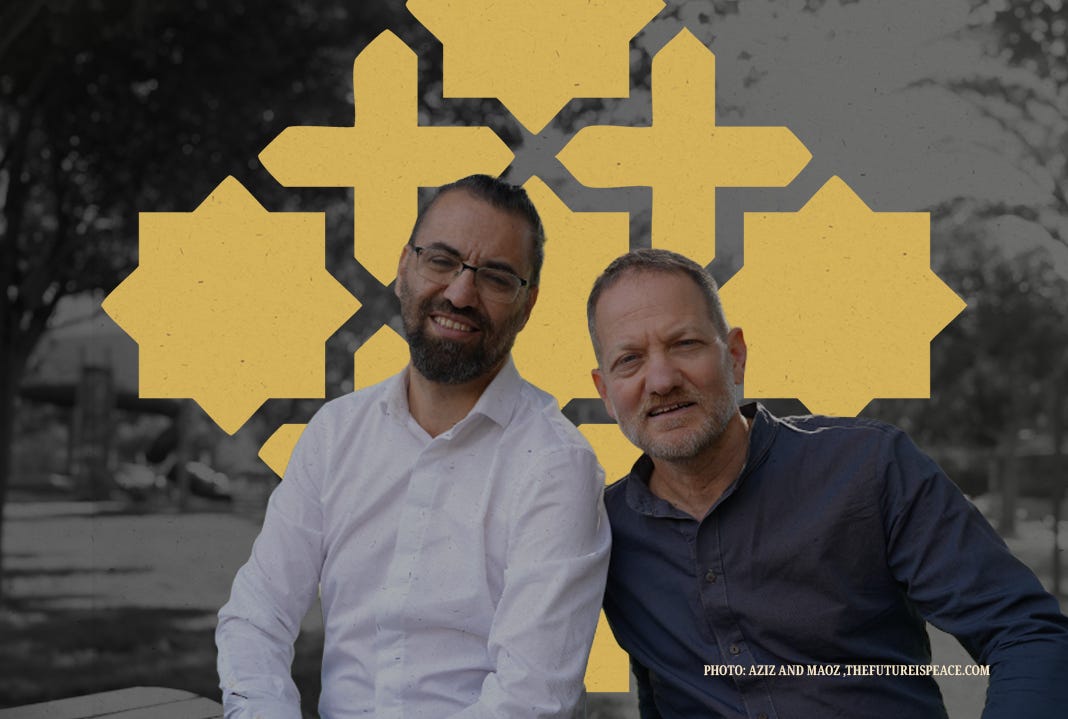
When Maoz Inon’s father texted him on the morning of October 7 to say he was sheltering in his safe room, he wasn’t worried at first.
Inon’s elderly parents, Bilha and Yakovi, lived in Netiv HaAsara, just 100 meters from the Gaza Strip. For the past 20 years, the “steady soundtrack of rockets, sirens, and gunfire had been the reality for Israelis and Palestinians living close to the border.”
Later that day, Inon learned that Hamas fighters had shot his parents and burned their home to the ground. It would take their children 14 days to identify the remains among the ashes.
“We tried to find comfort in knowing that they were together when they died, but we were plunged into a bottomless abyss of sorrow and pain, drowning in our own tears and deafened by our own wails,” Inon writes.
Despite his anguish, Inon made an extraordinary pledge in the aftermath—he would seek neither revenge nor retribution, but peace and healing.
“I will always be sad,” Inon tells Middle East Uncovered. “Every day I’m missing my parents. I miss my childhood friends. But I cannot let this sorrow or loss control or predict my future.”
That message is at the heart of The Future is Peace: A Shared Journey Across the Holy Land, a new book he co-authored with Palestinian activist Aziz Abu Sarah.
“We are inspiring so many people around the world. There’s a demand for peace,” says Inon. “We do see the impact of our work on the ground, and it’s amazing.”
Throughout September, the friends toured different cities and towns across the UK, culminating in a visit to Manchester, where they spoke virtually before a live audience. Inon speaks to Middle East Uncovered from his home in Binyamina, northern Israel, and Abu Sarah speaks from the US; he splits his time between there and Jerusalem.
Inon, soon to be 51, and Abu Sarah, 46, met briefly many years ago—they both worked in the travel and tourism industry. But the pair reconnected when Abu Sarah messaged Inon to offer his condolences after October 7.
His words, says Inon, “were more than a message of condolence; they shone a light into the darkness.”
The book takes the reader along on their eight-day journey across the ancient land that simultaneously binds and divides their people. Not only do they learn about each other’s personal histories, but they grapple with difficult questions.
Abu Sarah and Inon have worked extensively since the October 7 attacks and the subsequent war in Gaza. They have met popes Francis and Leo, and in January this year, they became the first Israeli and Palestinian to run with the Olympic torch in Verona, Italy.
“Feeling compassion doesn’t banish sorrow, and having empathy for others doesn’t mean you can’t also be angry. These emotions all coexist together,” writes Abu Sarah. “Anger is like nuclear energy—you can use it to create light, or to sow destruction.”
Like Inon, Abu Sarah knows all too well what it feels like to mourn a loved one.
He grew up in Eizariyya (the biblical town of Bethany), east of Jerusalem, during the First Intifada. His 18-year-old brother Tayseer was arrested by the Israeli military and accused of throwing rocks at soldiers.
In the book, Abu Sarah recalls the moment it all happened. It was in the holy month of Ramadan; the family had gone back to sleep after having their pre-dawn suhoor meal, when “soldiers with machine guns stormed into the room,” he writes. “My whole body was shaking with fear. Then they grabbed Tayseer and dragged him out. They didn’t even let him change out of his pajamas or put on a pair of shoes. My mom was crying, begging the soldiers not to take him.”
Tayseer’s interrogators beat and tortured him until he was forced to confess. He was then sent to an Israeli military prison for nine months.
A few months after being released, Tayseer was rushed to the hospital, where he died from injuries to his internal organs.
“That kind of loss completely breaks a family,” says Abu Sarah. “It changes the dynamics of everything. It was a house of mourning for a very long time.”
Tayseer was nine years his senior, the archetypal big brother who looked after Abu Sarah. “He was the one who walked me to school, who marched up to the headmaster to stand up for me when I was being bullied by a kid in my class,” Abu Sarah writes.
He coped by becoming a youth activist in the Fatah party, which rules the occupied West Bank, writing “angry” articles for its weekly magazine, much to his parents’ displeasure.
But things changed when he enrolled at an ulpan (a Hebrew-language school), where he started having more meaningful interactions with Israelis.
“I started realizing the power of us working together, instead of thinking in terms of us vs. them,” he says. “That’s what brought me to peace-making.”
Perhaps due to his own experiences, Abu Sarah tries not to judge each person’s response to trauma and how it can manifest.
He recalls a conversation with a man in London whose entire family was killed in Gaza during the war.
“I asked him if he met the pilot who killed his family, would he do something to him? And he said no,” says Abu Sarah. “I was like, wow, you wouldn’t? This is recent pain. He said, ‘No, I can’t, I can’t get myself to hurt another person, even the person who killed my family.’ People deal with trauma differently. But trauma makes it harder for people to become more supportive of peacemaking, often because many of them don’t see the vision anymore.”
The longer we leave it, he says, the more difficult it will become.
“If you have another generation growing up with this trauma without any intervention, then assuming the next generation is going to be better than us in solving this conflict is absolute idiocy,” he says.
Abu Sarah and Inon’s recent tour coincided with an announcement by the UK government to sanction illegal Israeli settlements in the occupied West Bank.
Foreign Secretary Ed Miliband defended the decision, saying the UK could not remain “silent or passive” over the issue. Miliband said the prospect of a two-state solution is “being destroyed” by Israeli settlements in the illegally occupied territory.
These peacemakers welcomed the move.
“This is what we’ve been asking for a long time. I think that, honestly, this is a minimum,” says Abu Sarah. “Different governments in Europe have been talking about the two-state solution as they allowed the destruction of that solution with zero consequences. It makes no sense.”
He believes the sanctions could go further, by holding to account IDF soldiers who give the settlers the green light for their violent actions.
However, he is also scathing towards the Palestinian Authority and its leader, Mahmoud Abbas. Abu Sarah believes the British government should push for new leadership, which is “beyond a failure,” he says. “Europe has a lot to do with this; they are the biggest supporters of the Palestinian Authority. And they’ve got to start pushing this government for real elections. They talked about one in November but still don’t know any details.” The last election was in December 2005.
In the UK, many in the Jewish community believe the sanctions could lead to more hatred and division.
The number of antisemitic incidents recorded across the UK since the start of the year is up by a fifth compared to last year, according to figures from the Community Security Trust (CST), an organization that provides security support to the Jewish community.
But Inon believes the policy clearly distinguishes between the Israeli public and the actions of its government.
“I would encourage diaspora Jews to differentiate themselves from the far-right extremist [Israeli government], to differentiate themselves from those who claim to be acting in the name of God and in the name of Judaism,” he says. “I think it’s about time that the Israeli government will be accountable for breaking international law.”
Some of what Maoz and Aziz will say will no doubt cause controversy. Indeed, they often get some pushback from their respective communities, which is “normal,” says Abu Sarah. “I try to focus less on those people, and focus more on the many people who are actually supportive.”
Inon agrees, adding: “My parents always told me to say what’s in my heart and what I believe. I’m not a politician, I don’t need to be popular.”
Three years on from the October 7 attacks, a devastating war in Gaza, and continued settler violence in the West Bank, it would be easy to dismiss peacebuilding as a lost cause. Inon and Abu Sarah refuse to.
Citing major milestones like the tearing down of the Berlin Wall, the Good Friday Agreement, and Egyptian leader Anwar Sadat becoming the first Arab leader to visit Israel in 1977, Inon says:
“Before the turning point of history, no one will believe it will happen. Two weeks before those historical events happened, no one believed it would happen. So it means we are only weeks away from the tipping point between the Israelis and Palestinians. Each one of us can do one thing today, tomorrow, and the day after to bring this tipping point into reality.”
To order the book, visit https://thefutureispeace.com.
A Shabbat in Bahrain

Attending a Shabbat service isn’t how I typically spend my Saturday mornings. But at 8:30 a.m., I find myself seated inside a synagogue tucked into the heart of Manama, the capital of Bahrain. A young man stands at the lectern, reciting a Hebrew psalm in a gentle, rhythmic cadence. He’s dressed in a neon-green sports shirt, swaying slightly as he chants.
Middle East Uncovered is powered by Ideas Beyond Borders. The views expressed in Middle East Uncovered are those of the authors and do not necessarily reflect the views of Ideas Beyond Borders.