


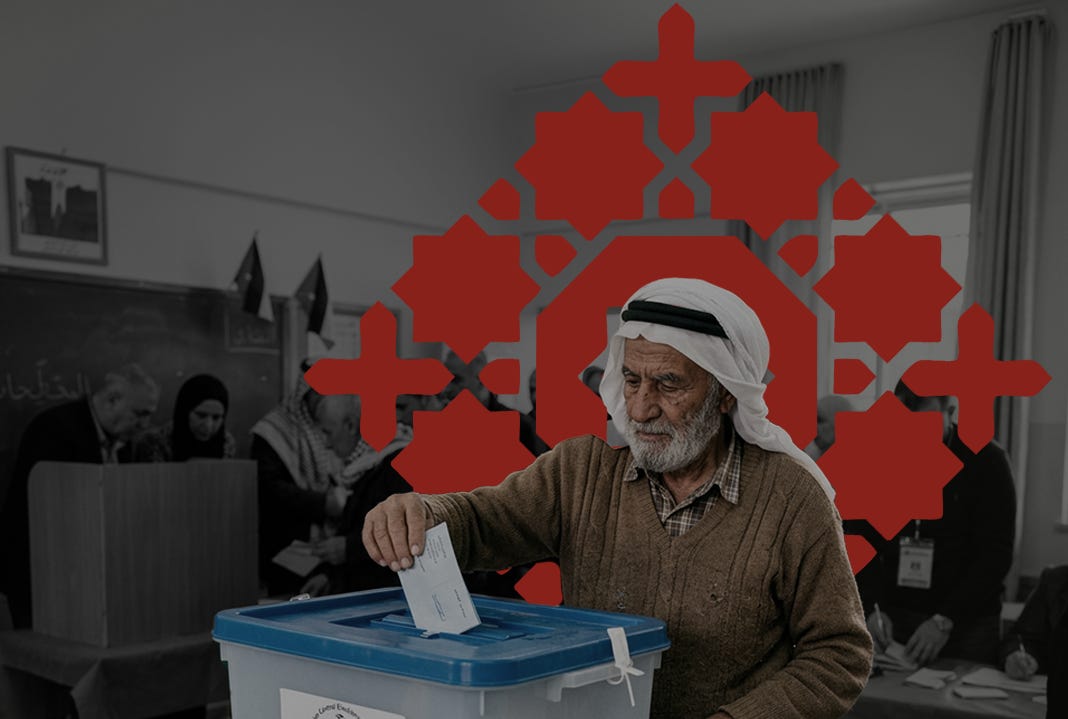
In January 2006, Palestinians went to the polls to elect a new parliament. This was the first legislative election since 1996, and none have happened since.
In 1996, Fatah had emerged victorious, winning 50 out of the 88 available seats. Hamas, meanwhile, had boycotted that election, rejecting the Oslo peace framework that had established the Palestinian Authority (PA), which was supposed to be a temporary and transitional body that would eventually be dissolved with the establishment of a Palestinian state.
Following Yasser Arafat’s death in November 2004, a presidential election was held in January 2005. Once again, Hamas did not field a candidate. This allowed Fatah’s Mahmoud Abbas to win easily.
By 2006, however, Hamas was ready to participate and compete against Fatah for political influence—even if it still was not fully signed up to the peace framework.
At the time, Fatah had serious weaknesses that Hamas sought to exploit. After a decade in power, many Palestinians associated it with nepotism, jobs-for-loyalists, misuse of public money, and an entrenched political elite.
Meanwhile, for ordinary Palestinians, there were problems with large scale unemployment (which was at 23.5% in 2005). The Median monthly household income had fallen from $500 in 2000 to $349 by 2005.
To make matters worse, parts of Gaza and the West Bank were experiencing kidnappings, armed clashes, militia activity, and a general sense that the PA under Fatah was unable to impose order.
Clearly, there was an appetite for a different political direction.
Hamas answered the call.
Hamas’ entry to electoral politics was not under their own name. Rather, they ran under the seemingly more innocuous-sounding banner of “Change and Reform” (al-Taghyīr wa-l-Iṣlāḥ).
The campaign focused on the internal situation for Palestinians—emphasizing fighting corruption, restoring order, and alleviating poverty—rather than resistance or jihad against Israel.
Hamas candidate Muhammad Abu Tir was quoted in The Guardian in January 2006 as saying:
“We will reform this system, we have to be rid of the corruption... Our first priority is not Israel but Palestine.”
Yet, although they emphasized other issues first and foremost, they still remained ideologically committed to Islamism.
In their platform for the election, they said:
“True Islam with its civilized achievements and political, economic, social, and legal aspects is our frame of reference and our way of life.”
And they also remained committed to Islamic ownership of all of the land from the river to the sea:
“Historic Palestine is part of the Arab and Islamic land and its ownership by the Palestinian people is a right that does not diminish over time.”
Under this platform, “Change and Reform” won the legislative election with 44.45% of the vote, winning 74 of the now 132 available seats. Fatah received 41.43% of the vote and won 45 seats.
The consequences of this were disastrous, both immediately and in the longer term.
In March 2006, Hamas leader Ismail Haniyeh became the new prime minister and formed a new government, creating an uneasy situation in which the presidency and government were controlled by rival movements.
The Middle East Quartet—the United States, European Union, United Nations, and Russia—demanded that the new government recognize Israel and accept the political agreements previously signed by the Palestinian Authority. Hamas refused these conditions. Major donors consequently suspended direct financial assistance to the Hamas-led government, while Israel stopped transferring tax revenues that it collected on behalf of the Palestinian Authority.
Meanwhile, tensions between Hamas and Fatah increasingly descended into violence, with armed clashes becoming common by late 2006.
Saudi Arabia attempted to broker some kind of compromise via direct negotiations held between the two factions in February 2007, leading Hamas and Fatah to form a national unity government. It lasted barely three months.
In June, the conflict erupted into open warfare in Gaza. Hamas forces attacked Fatah-controlled security installations and, within days, overwhelmed their rivals and seized control of the Strip. The fighting left more than 160 Palestinians dead and led to Fatah’s expulsion from Gaza.
Hamas alone now ruled Gaza, and used this opportunity to develop an architecture of jihad in the enclave—building up a rocket arsenal, developing weapons-manufacturing capabilities, constructing extensive tunnel networks, and building the security apparatus necessary to maintain its rule.
No doubt, some Palestinians who had voted for Hamas in 2006 would have been happy with this. For them, armed jihad against Israel was the goal, and voting for Hamas was their best hope to achieve this.
For others, the promises of “Change and Reform” left a bitter taste in their mouths.
In the long run, especially after the start of the war in 2023, support for Hamas in Gaza collapsed. By October 2024, a poll by AWRAD revealed that only 3% of Gazans named Hamas as the group they trusted most to lead Gaza.
This is a particularly revealing statistic, as the people in Gaza actually had to live with the consequences of Hamas’ policies. Meanwhile, in the West Bank—which has not had to live with these consequences—23% named Hamas a the group they most trusted. That is a huge gap.
There is a new Palestinian legislative election scheduled for the 28th of November this year. Whether that election will go ahead remains to be seen. Elections were also scheduled in 2021, only to be postponed before voting could begin. And there are still enormous practical questions over how a credible election could be conducted in the devastated Gaza Strip.
For the moment, however, preparations are proceeding. Hamas has indicated that it intends to participate, although nominations do not formally open until late September.
Twenty years is a long time to live with the consequences of a single election. An entire generation of Palestinians has grown up without the opportunity to choose its representatives, while Gazans have experienced firsthand what Hamas rule has meant.
If November’s election goes ahead, Palestinians will finally have the chance to pass judgment on what followed 2006 and decide whether they want something different. The result will reflect the views of voters who have lived with its consequences for two decades.
Middle East Uncovered is powered by Ideas Beyond Borders. The views expressed in Middle East Uncovered are those of the authors and do not necessarily reflect the views of Ideas Beyond Borders.

Excellent article on a very important subject.
The November elections to the Palestinian parliament are part of a much larger mosaic, in which the October Knesset elections and the likely Palestinian presidential election in 2027 are also important pieces.
If Netanyahu remains in power, the situation will be more predictable, but negative for the Palestinian elections and especially for Marwan Barghouti, who is sometimes called the Palestinian Mandela. At the moment, he is the most popular politician in both Gaza and the West Bank, supports Fatah-Hamas unity, and supports a two-state solution.
But if Gadi Eisenkot forms the next government in Israel, the situation may become less predictable, but it may also open up possibilities even for Barghouti’s release, despite his five life sentences.
This could happen if a Barghouti-aligned coalition takes control of parliament in the November elections, and Palestinians elect him president in early 2027. Then the sacred mantra for any Israeli politician - “Israel’s security” - could become compatible with releasing Barghouti.
Although all of this looks very unlikely right now, with energetic action by the United States, the EU, and countries in the region, the Palestinian people may finally have some hope.
After all, not long ago no one could have imagined that former militant al-Sharaa would be trying to build a peaceful Syria, or that Armenia and Azerbaijan would initial a peace agreement and move toward normalization.
Is it really going to make a difference when they are enveloped by a steel cordon whose creator’s only objective is to drive the inhabitants into the sea?!