


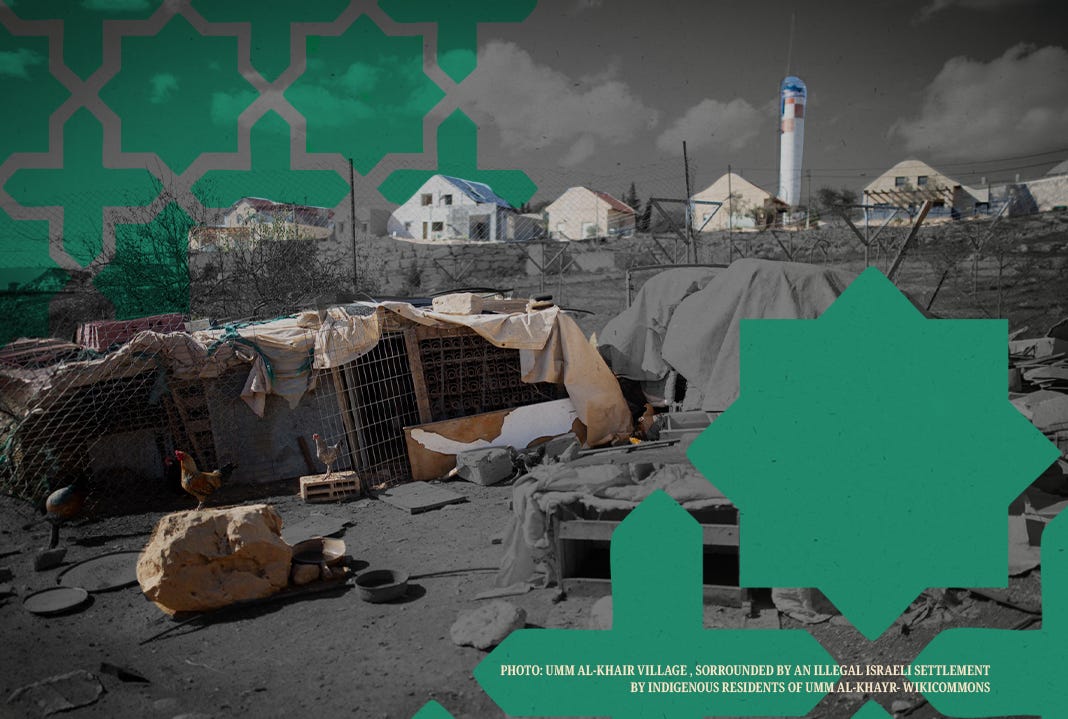
From the village of Umm al-Khair in the occupied West Bank, Jonathan Wittenberg, a senior rabbi of Masorti Judaism, is in a prime location to witness the results of the violence carried out by extremist settlers:
“The village is under siege. Mere meters from the home in which I stand, the army has declared ‘a military zone’,” he writes on his Substack. “This means that families who’ve lived here for decades can’t enter parts of their own land, can’t reach their livestock (except 5 minutes a day to feed them) or even access their toilet. Yet the settlers hang out on that very land with impunity, and mock… Here is a whole row of new settler homes, built in one single night and connected to the grid, with all modern facilities. The Palestinian families don’t have that.”
Wittenberg’s post was in response to the United Kingdom’s (UK) Government’s decision to sanction illegal settlements in the West Bank. His intervention is significant because it illustrates that criticism of settlement expansions is not confined to Palestinian or international voices; it is also coming from within conservative Jewish communities.
The sanctions will ban settlement goods and target companies and individuals that provide services for settlement expansion, following a period in which violent settlers forcibly evicted more than 2,200 Palestinians from their homes in the first half of 2026.
Prime Minister Andy Burnham said:
“For too long, we have been hesitant to act, fearful of being accused of being anti-Israel. Today we are announcing carefully judged, targeted steps that are not aimed at the Israeli people, but at the unacceptable policies of the current Israeli government.”
Over the next six to nine months, the UK will introduce “a new comprehensive sanctions regime.”
Foreign Secretary Ed Miliband said the move marked the “beginning of a new approach” to the Israeli-Palestinian conflict, which “not only calls out injustice and suffering, but acts.”
Miliband said this position, in line with a 2024 advisory opinion from the International Court of Justice, should be reflected in the UK’s “economic relationship” with the occupied West Bank.
Until now, Britain has largely dealt with settlement expansion through diplomacy and public criticism. The new measures add economic consequences.
The sanctions do not necessarily represent a rejection of Israel itself. Rather, they demonstrate a growing willingness among Western governments to distinguish between support for Israel’s security and opposition to policies pursued in the occupied territories.
While some have dismissed these measures as “symbolic” and cynically timed with the upcoming parliamentary by-election in Holborn and Saint Pancras—forced by the sudden resignation of former prime minister Keir Starmer—others point to France and Canada, which have followed suit with their own import bans.
The fact that other European states are moving in the same direction suggests that the issue is shifting from individual national criticism to a broader international response.
Nine additional countries have promised to “introduce national and/or support European restrictions on trade in goods with settlements.”
A recent poll revealed that the majority of the British public overwhelmingly supports the trade restrictions, as Labour takes a tougher stance against Israeli settlement expansion in the West Bank.
The sanctions and resulting countermeasures have brought UK-Israel relations to their lowest point since the creation of the Jewish state.
Israel has reacted with fury. Gideon Saar, the foreign minister, lashed out at Miliband, saying his speech was based on “outrageous lies.”
Saar promptly ordered the closing of the British Consulate in Jerusalem, and evicted British officials from an international center coordinating support for Gaza in southern Israel.
Israel’s retaliation also shows how consequential it regards the shift in British policy.
And the potential consequences of the sanctions extend beyond the Israeli government and settlement businesses.
Interviews with Palestinian workers in the West Bank highlight the real dilemma they face by opposing settlements, while also being concerned about the impact this could have on their livelihoods.
Can these policies achieve their political objective while minimizing unintended economic costs for the very population they are trying to protect?
Opinion remains divided, even among Britain’s Jews. While Ephraim Mirvis, the UK’s spiritual leader of mainstream Orthodox Jews, described the sanctions as a “dark day for British Jews,” warning that they could embolden people who “use hatred as a weapon against Jews,” those from the progressive wing of the community have backed the recent measures.
“What is happening in the West Bank is Chillul HaShem, a violation of God’s name of the worst order,” said Wittenberg. “We cannot stay silent. This is terrible for Palestinian people who want to get on with their lives in peace. It is terrible for Israel.”
Criticism is no longer coming exclusively from foreign governments or international organizations. Former senior Israeli officials themselves argue that the country’s current policies are damaging their country’s interests and require external pressure.
Ehud Olmert, Israel’s prime minister from 2006-2009, has denounced extremist settlers and their backers as a “group of murderous criminal terrorists” seeking to ethnically cleanse Palestinians.
He said the perpetrators frequently receive “active assistance” from the army, law enforcement, and members of the Israeli government, such as ultranationalist ministers Itamar Ben Gvir and Bezalel Smotrich.
Michael Ben Yair, Israel’s attorney-general from 1993-96, said that while he did not “relish” these actions being taken against his country, the sanctions were a “necessary move” for a two-state solution:
“...What we are witnessing today, under [Benjamin] Netanyahu’s leadership, has crossed a threshold that was previously unimaginable. Extremist Jewish settlers run amok against Palestinians while the Israeli security forces stand idly by,” he wrote in an article for the Financial Times.
“I wish for the day when the citizens of Israel will wake up and tell their government they no longer want to occupy millions of people against their will,” says Ben Yair. “But in its absence, those of us who see the true danger of this situation look to our allies in the international community to act for us.”
Perhaps more significant than Britain’s decision is Washington’s response, which was less predictable than usual.
For decades, US-Israeli relations have been central to Israel’s ability to resist diplomatic pressure from other Western states. Experts warned prior to the announcement that the US would punish Britain if it moved forward with the sanctions.
But when Burnham called the US president to inform him of the decisions, Trump “did not push back or ask Mr Burnham to change course,” according to the American news outlet Axios and the Times of Israel.
Mike Huckabee, US ambassador to Israel and a Christian Zionist, went on to accuse Miliband (who is Jewish) and the British government of “Jew hate.”
But Marco Rubio, the US secretary of state, refused to condemn the UK’s action, saying that the US and UK shared the same goals over violence in the West Bank.
Some analysts have linked this to growing tensions between Trump and Netanyahu. In recent weeks, the US president has grown frustrated with the Israeli Prime Minister over the war with Iran.
On their own, the sanctions may have limited, practical effect. Taken together with similar measures being considered or introduced by other Western states, however, the sanctions point to a wider change in Israel’s international standing.
If Israel does not act to address the expansion of illegal settlements, it risks becoming increasingly isolated and, eventually, a pariah on the global stage. When even Israel’s allies are raising concerns and taking action, the government should see that as a warning and move quickly to address the policies driving them away.
Ending Settler Violence Is in Israel's Interest

Across the West Bank, Palestinian communities are facing a steady rise in attacks by Israeli settlers. Homes have been torched, agricultural land destroyed, and residents beaten or driven from their villages. The violence has become a source of growing concern not only for those living through it, but also for neighboring states watching the consequence…
Middle East Uncovered is powered by Ideas Beyond Borders. The views expressed in Middle East Uncovered are those of the authors and do not necessarily reflect the views of Ideas Beyond Borders.
Britain is not an ally of Israel. And as a british palestinian wrote in substack these sanctions will effect mostly to palestinians because in Judea-Samaria they are the working in these firms. So their salaries will be fewer or they will loose their job.
And Europe is not the world, Israel nowadays build a lot of new busieness relation with Asia, Suth-America.
And many violent jews are under arrest, but the news in the west never write about it, as not write the 5 times more palestinian violence in Judea-Samaria
Let's see how this foreign policy shifts after the elections, and how these Bold policies over jewish settlers will be effective on ground.