


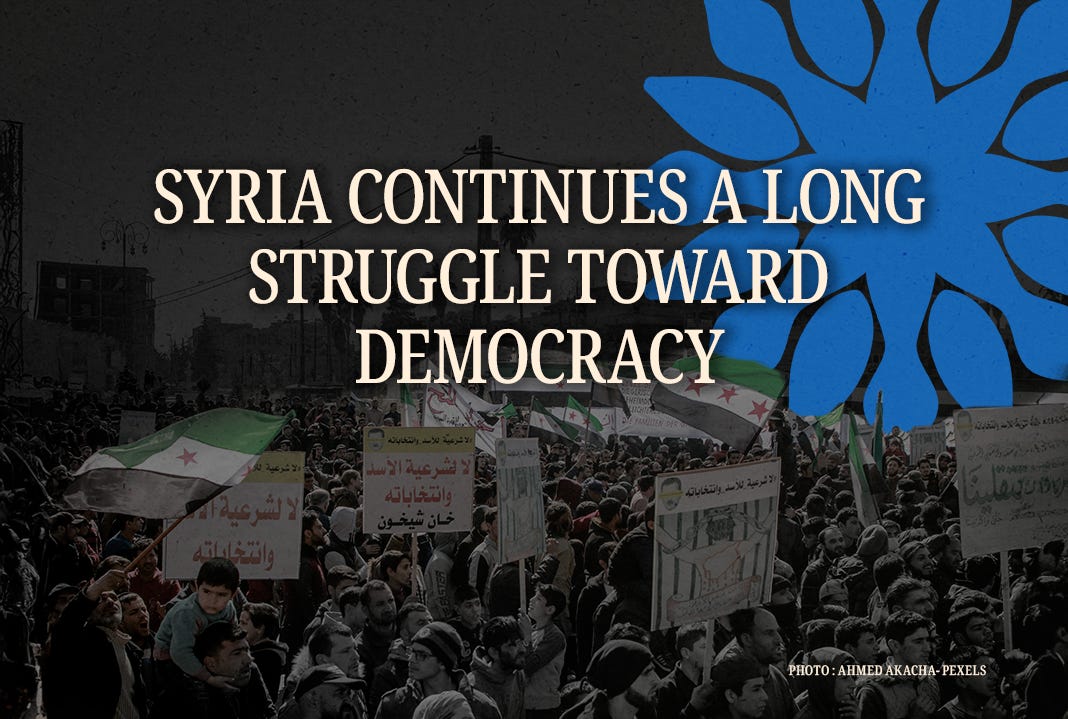
The question being asked about Syria today—in diaspora living rooms, opposition circles, Western policy briefings, and homes across Syria itself—is whether there is still any chance for democracy. The tone in which it is asked usually implies the answer: “Probably not.” The new leadership replicates the authoritarian reflexes of the regime it replaced. Institutions are hollowed out or captured. Minorities are marginalized. The Islamist project consolidates discreetly while the pragmatic façade holds. What exactly is there to be optimistic about?
The pessimism is not irrational. But the question itself is subtly wrong—not in its urgency, but in its premise. It treats democracy as a destination that Syria either reaches or forfeits, a binary condition measured against which the verdict is clear, and the pessimists win easily. What that framing misses is the difference between democracy as an endpoint and democratization as a process—the long, non-linear, frequently ugly accumulation of experiences, failures, negotiations, and institutional habits that eventually make democracy possible. No society that has democracy today arrived at it ready. The question worth asking about Syria is not whether it has arrived, but whether it has begun—and more precisely, how long it has actually been trying, and what that history tells us about what is happening now.
Syria’s democratic project did not begin with the fall of Assad, the 2011 revolution, or even independence in 1946. It began in 1918 with the establishment of the Arab Kingdom and the convening of the General Syrian Congress, which, in 1920, produced the first democratic constitution in the Arab world: an elected parliament, guaranteed civil liberties, and a framework for self-governance. The French mandate extinguished that experiment within months, partitioned the territory, and imposed external sovereignty. But it did not end the democratic impulse, nor did it manufacture the pathologies that would eventually destroy it. Elections continued under the mandate. Syrians governed significant aspects of their own affairs, formed governments, and negotiated within representative structures. The factionalism, regionalism, and elite dysfunction that would later produce the coup carousel were already visible in that period—not as products of French interference, but as indigenous features of Syrian political culture expressing themselves even within the constrained space the mandate allowed.
The French, for their part, attempted to manage Syria’s diversity by creating separate administrative units for Alawites, Druze, and others. Whatever the self-serving motivations behind that approach, it reflected a recognition that diversity was real and required institutional management. Syrians rejected it in favor of unity—a legitimate and courageous political choice. But unity was asserted rather than constructed. The mechanisms, culture, and institutional framework that genuine unity requires were never built. Syria was not, after all, an ancient unified nation dismembered by colonial powers. It was a modern political project, born from the Arab revolt against the Ottomans, whose borders and composition were themselves contested and contingent. Insisting on unity without doing the work of constructing it was a choice—and it was Syria’s own.
Independence brought about the most direct democratic experiment: elections, parties, a parliament, and a press. It also brought more than two dozen coups and coup attempts in two decades. Each one divided the liberal and democratic elite not along principled lines but along factional lines, based on who supported this general, opposed that faction, and whose communal network aligned with which officer corps. The parties that claimed democratic legitimacy participated in, enabled, or acquiesced to military interventions whenever those interventions served their immediate interests. Institutions were treated as instruments rather than constraints. There is a tendency in some Western academic circles to attribute this coup cycle primarily to CIA manipulation, a case built largely on Miles Copeland’s self-dramatizing and internally contradictory recollections. The State Department’s own contemporaneous assessment of the 1949 coup found “no evidence” of outside participation and attributed it to internal military grievances. Patrick Seale’s enduring account locates the drivers where the evidence actually points: domestic factionalism, weak institutions, and inter-Arab rivalry. External actors mattered, but they did not invent Syria’s instability. The coups were Syria’s own work. So was the democracy they destroyed.
What the Ba’ath replaced that democracy with was not simply authoritarianism but a specific kind of social engineering—land redistribution, nationalization, the expansion of the public sector, the elevation of previously marginalized constituencies—all pursued simultaneously with modernization and development, but with regime consolidation always as the primary concern. When development served consolidation, it was pursued. When it conflicted with it, consolidation won. Bashar Al-Assad then completed the logic: by the end of his dynasty’s rule, the regime was consuming everything—democratic possibility, development, modernization, and the country’s basic physical and human infrastructure alike. The institutions that survived were not merely weak; they had been deliberately designed to serve control rather than public function, which means rebuilding them is not a technical problem of capacity but a political problem of purpose.
That history is the context for the current moment. Syria is not beginning to democratize. It is continuing a century-long struggle to democratize, under the worst conditions that struggle has yet faced. The pathologies that destroyed the post-independence experiment are not new diagnoses. They are the same pathologies, wearing new clothes, operating through new actors, in a landscape of institutional ruin that makes their management harder than ever.
The current governance picture is, by any honest measure, deeply discouraging. Ministries are staffed by loyalists reporting through informal networks. Politburo branches operate as parallel provincial authorities with more real power than officially appointed governors. Unions and chambers of commerce have been placed under direct state control. The constitutional framework concentrates all meaningful authority in a single executive with no independent judicial check. The replacement of Alawite Ba’athist loyalists with Sunni Islamist loyalists replicates the sectarian logic of the previous system under a new ideological banner. The deep state is being rebuilt with different personnel and the same underlying architecture.
And yet the deficit is not total. Civil society is thin but stirring. Activists from the Damascus Spring era are again attempting to carve out space for cultural and political expression, aided by a new generation of conscientious youth. The Bab Touma protests, the cross-communal response to the alcohol restrictions, the meager turnout at the Islamist counter-mobilization—none of these are signs of democratic health, but rather of democratic instinct: the reflexive pushback of a population that has not entirely surrendered its sense of what it is owed, and the equally significant signal that authorities, however reluctantly, can be made to retreat. The space for genuine politics in Syria is limited, but it is not zero. The difference between limited and zero is everything.
Democratization, understood historically, is the accumulation of conditions, habits, and experiences that eventually make democratic governance sustainable. It includes the formation and dissolution of political coalitions, however imperfect, and the negotiation of communal boundaries, however painful. It requires developing the expectation that power has limits and can be contested. And the experience of failure—the learning that only comes from having tried something, watched it go wrong, and been forced to reckon with why.
By these measures, Syria is engaged in democratization not for the first time, but in a new and particularly difficult chapter of a long attempt. The alcohol controversy produced a public pushback and a government retreat. The Kurdish autonomy negotiation produced an outcome nobody wanted, and both sides had to live with—which is, in fact, what democratic accommodation almost always looks like from the inside. This is what practicing democratic governance looks like. And practice, accumulated over time, is the only known path to anything better.
Those who care about the outcome for Syria must engage with these ideas honestly—or retreat into the fantasy of reconstruction, the despair of permanent impossibility, or the comfort of watching from a distance while setting temperatures they will never have to live in.
No society that eventually developed democratic governance did so from a position of readiness. What made the difference, where it was made, was not the arrival of the right conditions but the persistence of the attempt under wrong ones. Britain, France, and the United States all arrived at their current democratic arrangements through processes that were violent, exclusionary, and non-linear, and none of them has finished the work. Rwanda built a functioning post-genocide state not by waiting for readiness but by doing specific, hard things under difficult circumstances. South Korea’s democracy emerged from military dictatorship and student massacres. Japan’s was imposed by occupation and took decades to internalize. The endpoint looks “clean” because we know where it ended. The process was anything but.
Syria has had genuine democratic beginnings. Each was interrupted, captured, or destroyed before it could come to fruition. The current moment is not a fresh start. It is the latest attempt, made by a society that carries the full weight of everything that failed before, in conditions of fragmentation and institutional ruin that make it harder than ever. That is not a reason for despair, but for clarity about what is actually being attempted, what has failed before and why, and what it actually requires to work within real constraints.
Liberty is not a goddess to be worshipped but a necessity—like water, like bread. The march toward it does not culminate in transcendence. It culminates, if it culminates at all, in the acceptance of the mundane: the daily, unglamorous work of governing a society that has chosen, imperfectly and provisionally, to govern itself. Syria is not ready for democracy, but it is engaged in democratization. Those are not the same thing, and the difference between them is not failure. It is time, and practice, and the willingness to keep working in a space that is limited but genuine, for as long as that space exists and wherever it can be found.
Middle East Uncovered is powered by Ideas Beyond Borders. The views expressed in Middle East Uncovered are those of the authors and do not necessarily reflect the views of Ideas Beyond Borders.
This article is brilliant, and your point about focusing on democratization as process rather than democracy as end-point is extremely well taken. That is an attitude which can advance a country rather than saying, "Not everyone wants democracy," and "Democracy cannot be imposed." (=so forget about it). Natan Sharansky had a similar idea about the need to build up things like civic organizations, judicial independence, free press etc before attempting a full-scale democracy. Thank you also for pointing out the jagged paths and untoward conditions of current democracies, including the American one which is still in the process of solving problems. Your approach is both realistic and hopeful. Finally, thanks for making it clear that the West (e.g. the CIA) is not responsible for every failure in other countries. All of these points make your article a breath of fresh air, which we ALL need right now, and I hope your ideas will inspire us all to greater things.