


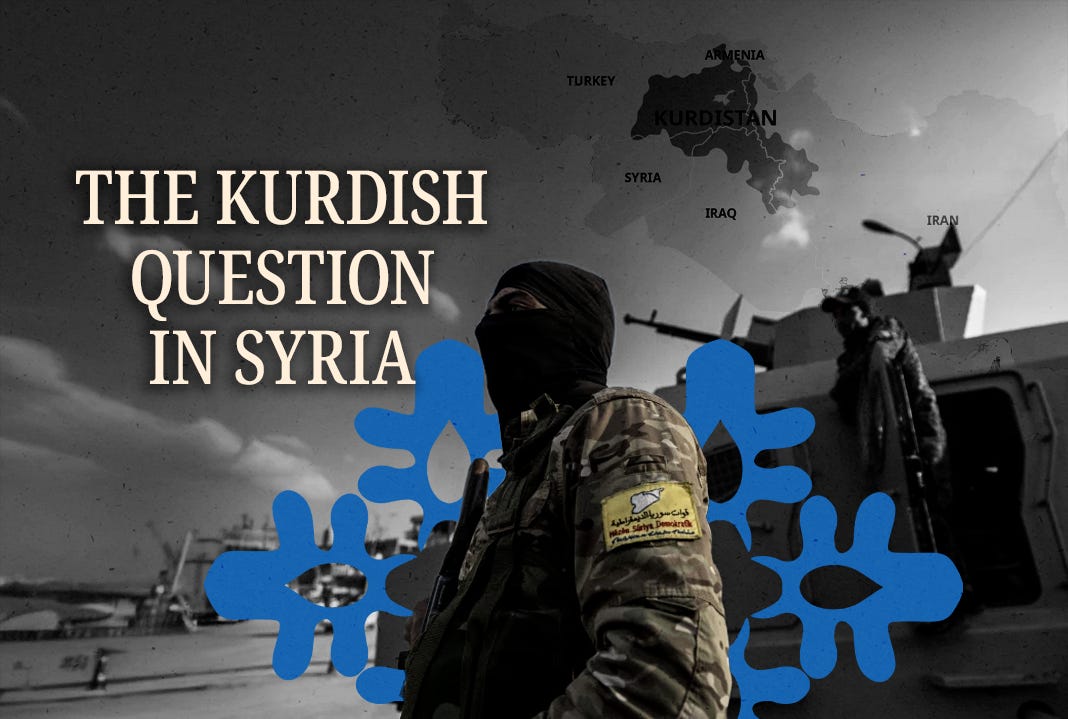
Few peoples in the Middle East carry grievances as deep and legitimate as the Kurds. More than a century ago, they were denied a state of their own when the post–World War I order was drawn. That historical injustice is real, and it continues to shape Kurdish politics, identity, and expectations.
But moral entitlement, even when reinforced by international law, is not a viable strategy.
Rights do not implement themselves. They are realized—or squandered—through concrete balances of power, hostile conditions, and regional constraints. To ignore this is to mistake moral claims for political possibility. In Syria today, that mistake has carried severe costs—and demonstrated how justified demands can be undermined by the means chosen to pursue them.
Yet something remarkable has also happened, quietly and without triumphalism: Syrian Kurds have obtained what they struggled for over decades.
They just may not recognize it yet. The confrontation between the Syrian transitional government and the Syrian Democratic Forces (SDF) has frequently been reduced to a set of binaries: Kurds versus Damascus, autonomy versus centralization, and liberation versus repression.
Reality is less comforting and more complex.
The SDF came to control large parts of northeastern Syria during the war against ISIS. But nearly a third of that territory is traditionally Arab, including major population centers and tribal regions such as Deir ez-Zor, Raqqa, Tabqah, Shaddadi, and much of the Euphrates Valley.
In those areas, SDF rule was widely perceived not as liberation but as external domination. This alone made any claim to sweeping territorial autonomy politically toxic inside Syria and diplomatically indefensible abroad.
This is compounded by the ideological legacy of the PKK (Kurdistan Workers’ Party), which includes documented practices of child recruitment, repression of rival Kurdish parties, and systematic marginalization of Arab local governance.
None of this negates Kurdish suffering, but it does mean this was never a morality play with clean hands on one side and villains on the other. Syria’s future cannot be built on selective innocence.
President Ahmed al-Sharaa captured the contradiction in a recent interview when he addressed SDF leader Mazloum Abdi directly:
You demand autonomy and self-administration. Where have you practiced it? You control a territory spanning three provinces, larger than Lebanon several times over. Have you governed it locally? Have you given Deir ez-Zor its rights? When decisions about Sheikh Maqsoud come from Qandil, what exactly is “self-rule”?
It exposed a structural problem: a movement demanding decentralization while practicing centralization; invoking local sovereignty while outsourcing strategic authority; calling for autonomy while denying it to Arab regions under its control.
In many of these areas, Arabs were never allowed to run their own local affairs. Instead, symbols of authority were imported from outside: portraits of PKK leader Abdullah Öcalan appeared across towns and public institutions. One personality cult was quietly replaced by another. The iconography of Hafez al-Assad gave way to that of Öcalan, imposed in communities that had no say in either and little attachment to both.
These were not cosmetic flaws; they went to the heart of why Kurdish maximalism failed to win durable local and international support.
Al-Sharaa also revealed that the SDF had been formally invited to participate in the National Dialogue, the drafting of the Constitutional Declaration, and the formation of parliament and the transitional government, and declined all three.
These processes took place under regional and international observation and received external endorsement. In that context, claims of systematic exclusion lose much of their force.
The outcome reflected a strategic decision to remain outside emerging institutions rather than engage them, and to seek bargaining power directly instead of building it through participation.
This posture reflected not resistance, but a deliberate acceptance of political marginality.
Days later, al-Sharaa signed a presidential decree that fundamentally altered the Kurdish question in Syria:
restoring Syrian citizenship to Kurds stripped of it after the 1962 census and to their descendants;
legalizing Kurdish-language education in Kurdish-majority areas;
guaranteeing cultural and political rights;
repealing discriminatory laws;
recognizing Nevruz as a national holiday;
and affirming Kurds as “an integral part of the nation.”
These guarantees were framed as constitutional and non-negotiable, marking the formal end of the century-long Syrian Kurdish struggle for recognition.
Paradoxically, it did not calm the conflict.
From that moment forward, the confrontation ceased to be Arabs versus Kurds and became—officially—the Syrian state versus an armed organization affiliated with the PKK.
The subsequent military push did not target Kurdish population centers. It targeted Arab cities: Raqqa. Deir ez-Zor. Tabqah. Shaddadi. Places where SDF authority had eroded socially before it was defeated militarily.
In Hasakah alone, representatives of more than fifty tribes and clans publicly called for defections. Nearer to Qamishlo, the capital of the Kurdish heartland in Syria, the Arab Shammar tribe is in full revolt against SDF rule. Parallel authority was losing consent.
Damascus paired military pressure with political guarantees and institutional offers: integration of fighters as individuals, parliamentary representation, senior government posts, and joint administration in Hasakah.
The arrangement signaled acceptance of Kurdish self-administration in Kurdish-majority areas, but required integration elsewhere into the governance framework set by al-Sharaa’s decree.
As this essay goes to press, Damascus and the SDF have reached a formal understanding governing Hasakah and Qamishli.
Under the agreement:
Syrian forces will not enter the centers of Hasakah or Qamishli cities, nor any Kurdish villages.
Security in Kurdish areas will remain local.
Kurdish leadership will nominate the governor of Hasakah, parliamentary delegates, and a senior defense official.
Integration will proceed through institutional processes rather than arms.
What has emerged is not autonomy, but a more limited and more durable outcome: formal recognition of Kurdish inclusion, anchored in law and state institutions.
The conception of Rojava as a proto-state did not originate in Syria itself. It drew instead on developments across the border.
The establishment of the Kurdistan Regional Government in Iraq after 1991, and its consolidation following the 2003 U.S. invasion, provided a compelling reference point. PKK ideology supplied an organizing framework, while the Syrian war created the conditions for its attempted application.
That model, however, proved poorly suited to the Syrian context.
It suggested that war, foreign protection, and territorial control could produce sovereignty. In Syria’s fractured demography and unforgiving regional environment, this was always an illusion—seductive, understandable, but fatal. It redirected political energy away from attainable goals toward an unworkable map.
Now that illusion is deteriorating. What still stands is something more modest, but more real: citizenship restored, language legalized, culture protected, and local administration recognized.
The original demands of Syrian Kurdish politics were ultimately met. But political outcomes rarely arrive with a sense of triumph. The shedding of earlier illusions did not feel like victory; it left resentment in its wake instead.
Syrian Kurds did not achieve statehood. They obtained something rarer in the modern Middle East: legal belonging.
This was not a defeat, but a form of success without embellishment. History rarely produces unambiguous victories; more often, it delivers outcomes that secure rights without sustaining earlier expectations.
Middle East Uncovered is powered by Ideas Beyond Borders. The views expressed in Middle East Uncovered are those of the authors and do not necessarily reflect the views of Ideas Beyond Borders.
