


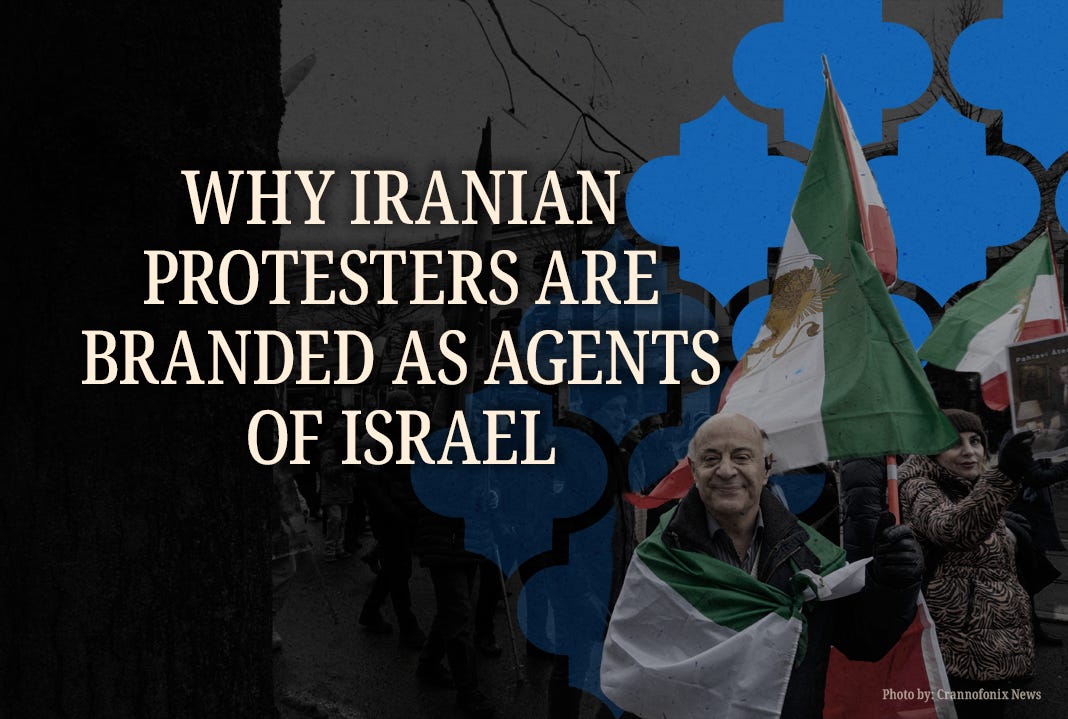
A young Iranian woman dances to Around the World by Daft Punk, wrapped in the Lion and Sun flag. (It symbolizes Persian heritage, sovereignty, and strength, and is now primarily used as a symbol of opposition to the current Iranian regime.) She looks straight into the camera, confident and unapologetic. The text in the video reads: “When the username @love_muhammad calls me a Zionist and puppet of Israel because I stand against the Islamic Republic of Iran.”
But what does opposing the Islamic Republic have to do with Israel?
The answer might seem complicated, but in reality, it follows a pattern repeated throughout history. When hatred is built on conspiracy theories, the list of enemies never stops growing. First, Jews are targeted. Then those accused of cooperating with them. Eventually, even unrelated groups are swept into the same accusation. Today, many Iranians are caught inside that expanding circle.
Across history, anti-Jewish hostility has rarely stopped at the Jews. People seen as protecting Jews, trading with them, or simply refusing to hate them often find themselves targeted. As historians like David Nirenberg have shown, “the Jew” operated not only as a real, marginalized community but also as a symbolic construct used to represent perceived social decay, moral threat, or political instability. Once this conceptual enemy was established, suspicion and exclusion could easily extend to others.
In medieval Europe, Jewish communities often lived under royal protection because rulers valued their economic roles. But when crises struck—plagues, economic strain, wars—anger that should have been directed at authorities instead fell on the Jewish people. And suspicion did not always stop there. Officials or neighbors accused of protecting Jews or benefiting from cooperation with them could also become targets. Later, accusations of being too close to Jews, or of “Judaizing,” became powerful political weapons. Entire groups were condemned not because they were Jewish, but because they were portrayed as corrupted by Jewish influence or sympathetic to Jewish interests.
Modern political antisemitism expanded this pattern even further. Jews were blamed simultaneously for capitalism, socialism, liberalism, and global finance—contradictory accusations united by conspiracy underpinnings. Anyone seen as cooperating with Jews or defending their rights could be portrayed as complicit. Antisemitism, in other words, is flexible.
Growing up in Iran, this pattern was evident long before I was old enough to understand it. Teachers and officials regularly spread hostility toward Bahá’ís. (Bahá’ís advocate for gender equality, the elimination of prejudice, and world peace.) A teacher once used an entire math class not for algebra but to explain that the Bahá’í World Center is located in Israel. Later, on the football field, classmates would shout, “Pass the ball, Jew!” at me.
As a child, this made no sense to me. Why would the location of a temple turn someone into a Jew? Why should that justify hostility? Later, I would come to understand that we were treated as guilty simply because of where we came from or who we knew. That alone was enough to make us targets.
In Germany, scholars use the term Israelbezogener Antisemitismus—Israel-related antisemitism—to describe how hostility toward Jews often appears today through hostility toward Israel. Israel becomes a symbolic stand-in, and anyone associated with it becomes suspicious.
This same pattern now ensnares Iranians who oppose the Islamic Republic. The regime positions itself as the leader of “resistance” to “white colonialism.” Under that frame, opposition becomes collaboration, and critics are cast as serving Israel. Once accused, everything else is dismissed.
More than 36,000 Iranians were killed in recent protest crackdowns. Videos circulated endlessly of black plastic bags carrying the dead, drowned out by the cries of grieving families. Many were forced to pay for the bullets that killed their children. Some injured protesters were shot again in hospitals, while others stayed home for days, too afraid to seek treatment. Some still live with shotgun pellets in their bodies because removing them safely was never an option. And yet, the world remains eerily quiet. No flotillas. No campus occupations. No city centers brought to a halt. Once protesters are labeled as agents of Israel, public empathy vanishes.
Solidarity today often comes with conditions. Influencers who built their platforms around anti-Zionist narratives quickly faced backlash when they criticized the Iranian regime. Some were labeled “Zionists” simply for expressing support for Iranian protesters. The message was unmistakable—challenging certain regimes aligns with the narrative; challenging others crosses a line.
What often passes for activism follows trends rather than principles. Supporting fashionable causes elevates social standing, and defending inconvenient victims risks it. For Iranians, this contradiction has become painfully obvious. The ideology that some activists defend elsewhere is the same ideology currently crushing Iranian society.
It’s even more surreal when narratives that echo regime talking points are repeated abroad by influential figures. When prominent figures like Huda Kattan or Roger Waters amplify positions that align with the regime’s framing while tens of thousands of Iranians face repression, imprisonment, and death, many Iranians feel erased from the conversation. Geopolitical narratives eclipse the suffering inside Iran, rendering the victims inconvenient to the story being told.
The Islamic Republic knows how to weaponize this framing. Shortly after recent protest crackdowns, Mehr News Agency declared that rioters and protesters were “agents of the Zionist regime” who must be punished without leniency. The logic that follows is brutally straightforward: protests are framed as foreign plots, plots become acts of treason, and treason becomes a justification for violence. A young Iranian rapper summarized it perfectly days before the massacre: “You protest, they label you Israeli and have you killed.”
Something else has also happened. The regime’s obsession with enemies has unintentionally united many Iranians. People with different beliefs and backgrounds are starting to recognize the pattern. They’re witnessing in real time how propaganda divides societies. Iranians who once received widespread support during the Woman, Life, Freedom movement are now confronting a painful truth: parts of the progressive world have unknowingly adopted elements of the regime’s narrative.
History shows that antisemitism rarely remains confined to its first targets. Jews are attacked first. Then come those accused of cooperating with them. Over time, entirely new groups are absorbed into the same conspiracy. Today, Iranians who oppose the Islamic Republic are increasingly cast in that role—labeled agents, puppets, or Zionists, not because of real ties, but because conspiracy thinking demands a constant supply of enemies.
The young woman dancing with the Lion and Sun flag was not thinking about geopolitics. She was asserting dignity, identity, and the right to an ordinary life. Yet even that is turned into something political within an environment shaped by conspiracy. The tragedy is that once propaganda takes hold, innocent Iranians fade from view, left defenseless against a regime that kills them for peaceful protest.
Propaganda works like blinders on a horse—you see only one path and nothing else. History has shown, time and again, that hatred rarely stays where it starts. It spreads—crossing borders, turning inward, and consuming those who once felt distant from its reach. Today, many Iranians are living through exactly that.
Middle East Uncovered is powered by Ideas Beyond Borders. The views expressed in Middle East Uncovered are those of the authors and do not necessarily reflect the views of Ideas Beyond Borders.

Looks like you were wrong bro. Also, I heard 3,500,000 Iranians died at the hands of the government.
I doubt you thought that the Iranian opposition would be so deligitimized as it is today. Any comment?