

Huda Kattan Tests the Limits of Influencer Activism
From Iran to Israel, the beauty mogul’s forays into politics and conspiracy theories have triggered boycotts and backlash across social media.

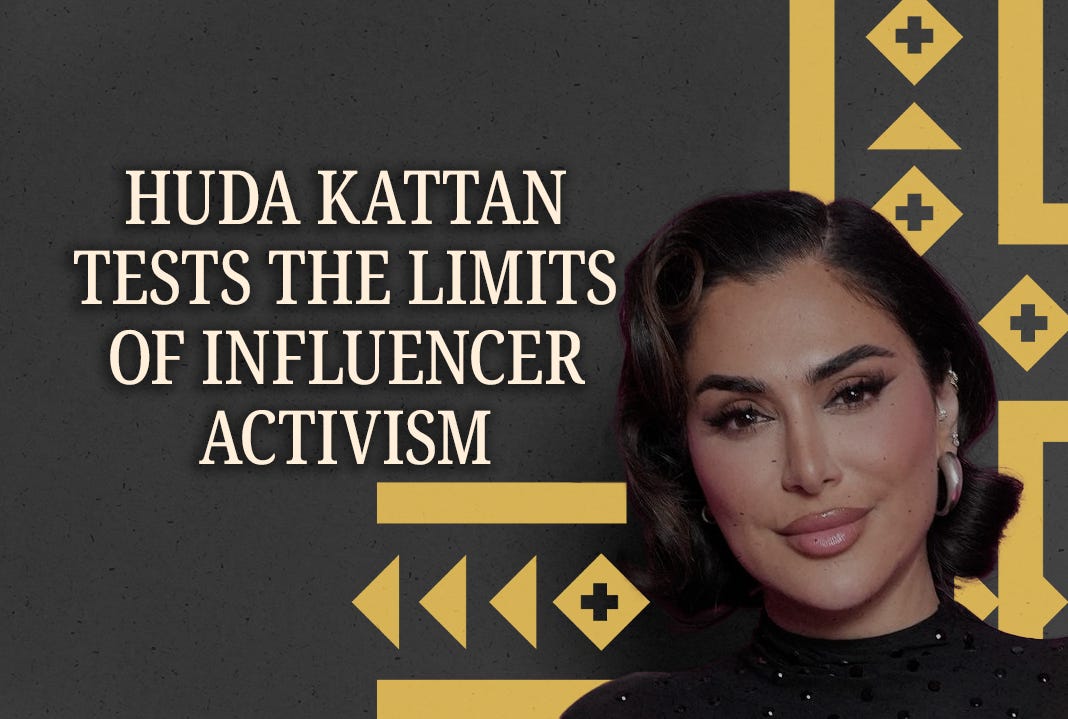
Huda Kattan is not just a makeup entrepreneur. The face of Huda Beauty, a global cosmetics empire now worth over $1 billion, her transparency, relatability, and makeup expertise resonated with millions, making her one of the most influential women in the world.
Kattan wasn’t merely selling lipstick, concealers, or eyeshadow palettes; she created a community, one that grew not from corporate brands or legacy cosmetics companies, but organically from her Instagram stories and YouTube tutorials.
People felt as if they knew her personally. But there’s a downside to that kind of influence and perceived intimacy with followers.
Kattan, who was born in the USA to Iraqi parents, is no stranger to speaking her mind. The “Free Palestine” activist uses her massive platform to comment on certain injustices. Last year, she was accused of being antisemitic due to her comments on Israel. And for the past week or so, Kattan has been embroiled in a fresh boycott.
The entrepreneur shared a video that seemed to show pro-regime protesters in Iran burning images of Reza Pahlavi, the son of the shah who was deposed in the 1979 revolution.
Iranians accused her of amplifying content that supported the Islamic Republic, a government with a well-documented record of abusing and killing its own people.
Online users argued that the video was erasing the voices of anti-regime activists and promoting state propaganda.
Kattan swiftly deleted the video from her Instagram stories, but not before the backlash spread, with the 42-year-old influencer facing accusations of supporting the Islamic Republic regime. Several consumers posted videos of themselves discarding or publicly denouncing Huda Beauty products. One Instagram reel had the caption “no filter can hide your lies.”
Since protests erupted in Iran on December 28, more than 6,000 are feared to be dead, according to the US-based Human Rights Activists News Agency, which also says 17,000 more recorded deaths are being investigated. Other sources believe the death toll has exceeded 36,000, but the verification is hampered by a near-total internet shutdown now in its fourth week. At least 42,324 arrests have been made across the country, with little news of their fate.
In the face of such brutality, “what [Kattan] is doing is not just careless, it is actively serving the Islamic Republic,” said British-Iranian activist Ellie Borhan, from the rights group Stage of Freedom.
“Some of these influencers have spent years talking about women’s empowerment, but when it comes to it, they don’t care about women who are raped, murdered, whose bodies are dismembered [by the Islamic Republic].”
As the uproar intensified, Kattan backtracked on her comments. Insisting that she was not pro-regime, “I also don’t know enough about the regime. I’ve heard a lot of mixed things,” she said. “I don’t think I have the right to have an opinion on what’s going on in Iran—this is just my opinion.”
The beauty mogul said a regime change orchestrated by the USA “is a scary thing,” before adding: “People out there are angry at me because they think that I support the regime of Iran or that I am supporting anything that is hurting the Iranian people—that’s just wild. I can’t believe anyone would think I would support that.”
But this “non-apology” has failed to satisfy Kattan’s critics.
“How can someone be so blind to what the Islamic Republic is doing?” said Borhan. “You don’t need to be a scientist or politician. You just need a bit of humanity and to not support the Islamic Republic.”
This is not the first time Kattan has found herself in hot water.
In July 2025, she shared a video in which she bizarrely claimed there was evidence that Israel was responsible for the First and Second World Wars, the 9/11 attacks, and the Hamas-led atrocities on October 7, 2023.
She deleted the video, but not before it was seen by 2 million TikTok followers.
Sephora was due to include Kattan’s company in its upcoming autumn campaign, but following the outcry, reportedly dropped Huda Beauty from the rollout.
Kattan took to social media to defend her conspiracy-laden comments, insisting that people were “taking it out of context… I did not even say anything about Jews, or even the Israeli people, so I chose to remove the video. It is no secret that I have been speaking out about Palestine for quite some time, and that happened as a result of me learning about the Palestinian cause.”
Claiming that there was a “smear campaign” against her, Kattan insisted that she was not antisemitic.
“I stand against hate and discrimination; the video was misinterpreted,” she added.
Huda Kattan is still a powerful businesswoman admired for her inclusive cosmetics brand and bold voice. But her controversies offer a lesson for influencers: we’re living in an era where every post or statement is dissected and goes viral within minutes. And the bigger your platform, the more you’re expected to get right, or face the consequences.
When celebrities have a large platform, be they actors, singers, or even beauty influencers, when should they speak out? How much is acceptable for them to say? Or is it simply easier to say nothing at all?
As Huda Kattan’s controversies show, blending beauty with activism is not as straightforward as blending your makeup.
Middle East Uncovered is powered by Ideas Beyond Borders. The views expressed in Middle East Uncovered are those of the authors and do not necessarily reflect the views of Ideas Beyond Borders.
 | A guest post by
|
A lucid and accurate account! Thank you.