


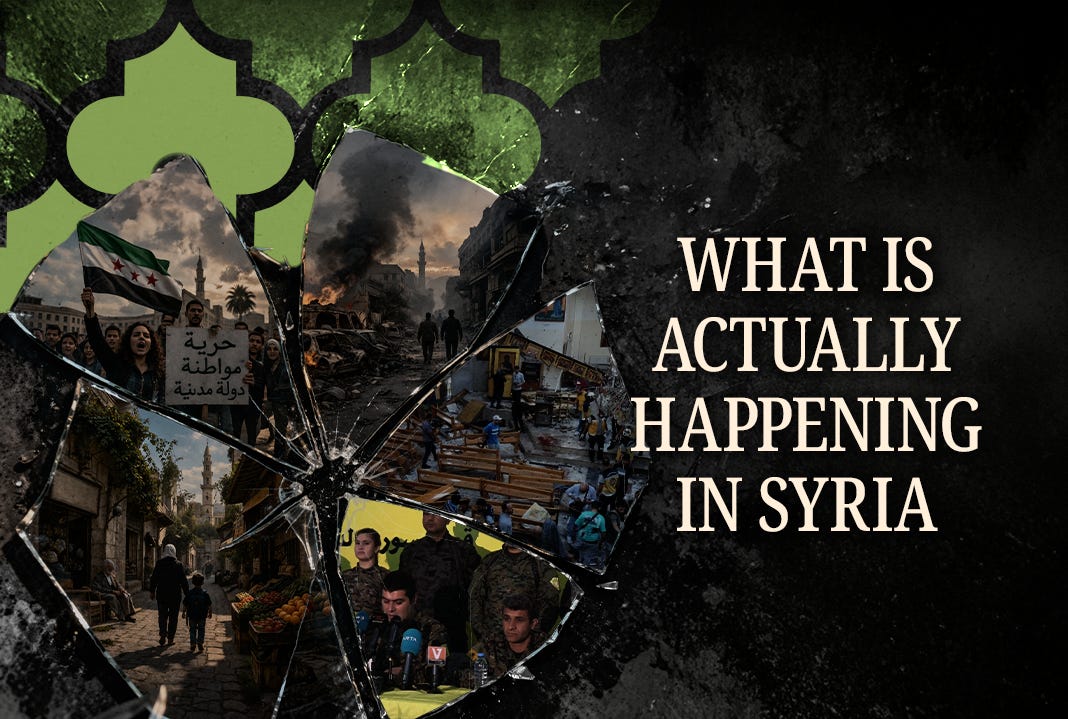
From the massacres of Alawites in the coastal mountains in March 2025, to the suicide bombing of Mar Elias Church in Damascus in June, to the massacres of Druze civilians in Sweida in mid-July, Syria has experienced one communal shock after another. In the northeast, clashes between the Syrian Democratic Forces (SDF) and the central authorities helped push large-scale Kurdish autonomy toward its end, before American mediation yielded a January 30, 2026, integration deal. Then, in March 2026, the Christian town of Suqaylabiyah came under sectarian attack after what began as a local dispute. And in the months between those two Marches, Syrians also witnessed sporadic efforts to curb personal freedoms through administrative measures, including the recent restrictions on alcohol sales in Damascus. Small wonder, then, that so many observers now speak as though Syria is simply repeating the cycle of sectarian strife once again. But the plotline is far more complex this time.
Taken separately, each episode can be made to fit a familiar narrative: minorities under siege, Islamists ascendant, the state either complicit or absent, and Syria slipping toward a new sectarian order. That narrative contains elements of truth. But it also misses something essential. What is happening in Syria today is the violent and deeply unstable renegotiation of boundaries and relations between communities, regions, classes, and local power centers after the demise of an old order and in the absence of a credible new one.
This is what many observers, especially on social media and in sensationalist media coverage, continue to misunderstand. They seize on each atrocity or controversy as proof of a fixed communal or ideological logic. But Syria’s reality is more dangerous and more complicated than that. The country is going through a moment in which old fears, accumulated grievances, wartime dislocations, economic decline, shattered institutions, local vendettas, and external meddling are all interacting at once. In that environment, even minor disputes can rapidly acquire sectarian dimensions. The recent attack on Suqaylabiyah is a case in point: what began as an altercation between young men from different communities spiraled into mob violence targeting Christian homes, shops, and property, reigniting broader communal fears—even though its causes were local rather than ideological.
Any government would struggle under such conditions. Syria’s transitional authorities, however, carry additional burdens of their own making. They came into power with an Islamist pedigree, a thin technocratic capacity, and a persistent reluctance to incorporate too many outsiders into decision-making circles. That reluctance is understandable at one level: movements forged through war and underground discipline tend to fear dilution, infiltration, and loss of internal cohesion. But it is also politically costly. It narrows the regime’s social imagination, limits its competence, and leaves too many decisions in the hands of provincial officials, security actors, or ideological zealots operating with little effective oversight.
Transitional President Ahmed al-Sharaa’s recent visits to Berlin and London are genuine foreign policy achievements, and should be regarded as such. But international normalization is not ideological endorsement. Western governments are engaging a transitional authority they hope will stabilize Syria, not ratifying an Islamist project. More to the point, the hardest constraint on any such project is not diplomatic but strategic. Israel has already declared Syria’s new leadership a security threat, seized additional Syrian territory as a buffer zone, is demanding demilitarization south of Damascus, and is actively supporting Druze calls for autonomy—and potentially independence. Any Syrian leadership that imagines it can pursue an Islamist agenda along Israel’s border, after Israel’s experiences with Hezbollah and Hamas, is not reading the room. It is courting the kind of military and territorial consequences that would accelerate Syria’s fragmentation rather than consolidate its recovery.
This produces a familiar Syrian pattern. Formal authority is centralized enough to avoid accountability but decentralized enough to allow local excesses, improvisations, and ideological freelancing. Governors and local officials act on their own instincts, biases, or calculations. The center then tries, quietly and belatedly, to contain the fallout. That may look new to outside observers. It is not. It is deeply Syrian in the modern authoritarian sense. It is how factional rule reproduces itself.
That is why I argued from the early weeks after the fall of the Assad regime that al-Sharaa would end up borrowing more from the Assad playbook than many observers expected. Not because the two projects are identical, but because the governing dilemmas are similar and because factional leaderships in Syria tend to converge in method even when they differ in rhetoric. As I wrote earlier in The Hill, Syria’s history has a way of punishing those who think they can manipulate its social balances without being consumed by them.
Under Assad, the regime’s informal justification gradually hardened into a doctrine: the state, and more specifically the security state, existed to protect minorities from a Sunni threat. The Alawites were pushed to the forefront of the military and intelligence apparatus not simply because of communal solidarity, but because the regime required a loyal social base bound to its survival by fear. That arrangement also distorted Alawite communal life itself, upsetting internal balances among clans and local networks and turning the specter of Sunni revenge into a permanent instrument of regime consolidation.
Something structurally similar is now emerging from the other side.
Yes, Syria’s new rulers are Sunni Arabs, and Sunni Arabs are the country’s demographic majority. Yes, after decades of repression under Assad, many Sunnis have developed a heightened sense of shared grievance and identity, and deadly fear of the possibility of the return of minority rule. But that does not mean the current leadership represents “the Sunnis” in any straightforward sense. It does not. The men now governing Syria emerge from a hardline Islamist milieu that remains ideologically distinct from the much broader Sunni mainstream in the country.
Most Syrian Sunnis do not share the Salafi-Wahhabi worldview that shaped Hay’at Tahrir al-Sham, the movement that toppled the Assad regime and was long designated a terrorist organization before al-Sharaa recast it as a ruling political force. Their religiosity is more traditional, socially embedded, and often influenced by Sufi sensibilities. Others are socially liberal, politically pragmatic, or simply exhausted by ideology altogether. So the return of “majority rule” is, in fact, being mediated by a faction that represents a minority current within that majority. That is one of the central facts of the present moment, and it is one of the new authorities still seem reluctant to confront honestly.
The recent alcohol controversy in Damascus made that painfully clear. Authorities moved to limit alcohol sales in restaurants and bars, triggering protests from Syrians who saw the measure not merely as a lifestyle issue but as a test of public freedom and equal citizenship. This sparked a demonstration in the neighborhood of Bab Touma, attended by a diverse group of secular activists from all communal backgrounds, as well as extensive commentary on social media and an unexpected, focused international response given other developments in the region. The Governor of Damascus ended up walking back some of the more controversial elements.
What followed mattered even more. Islamists attempted to seize on this opportunity to demonstrate strength by calling for major protests throughout the country on March 27, demanding a total ban on alcohol sales. The turnout was meager: instead of the tens or hundreds of thousands expected, only a few hundred hardline protesters appeared across different locations. It was one of the clearest signs yet that a radical Islamist social agenda does not enjoy broad spontaneous support in Syria today—not among the country’s minorities, and not among the Sunni majority either.
The violence in Suqaylabiyah, unfolding in the same period, belongs to a different story—though it has been wrongly conscripted into the same narrative. What happened there was not an extension of the national discourse around alcohol and Islamist mobilization. It began as a local brawl between men from two neighboring towns with decades of accumulated tension, a fight that escalated through false rumors spread on WhatsApp claiming a man had been killed. What followed was a mob of two to three hundred, not an ideologically organized assault. Crucially, it was contained not by the state alone but by a robust local civil network whose leaders cleared the streets before the mob arrived, almost certainly preventing deaths. Government security forces responded with reasonable speed, given their resource constraints.
None of that fits the narrative of sectarian implosion that spread immediately on social media, where the town’s wartime history was weaponized to frame the entire event as proof of Sunni aggression against Christians. That framing was opportunistic and inaccurate. But it was also predictable—and the government must reckon with why it remains so easy to manufacture. The near-universal amnesty extended to regime-era figures, without explanation or a credible transitional justice framework, leaves a vacuum that bad-faith actors will continue to fill. Demanding that affected communities simply stay patient is not a policy. It is an invitation to the next provocation.
Taken together, these episodes—the failed Islamist mobilization, the local riot misread as sectarian design, and the governor’s retreat under public pressure—tell a more honest story than the dominant narrative allows. The country is not naturally aligning behind a project of moral authoritarianism. To be sure, if the government wanted to manufacture the appearance of mass support, it could likely put far larger crowds in the streets. But that would mean embracing the Assad model more openly: choreographed demonstrations, coercive legitimacy, and the state speaking through managed public theater. And that road leads to the destruction of whatever domestic, regional, and international credibility this transitional leadership still retains.
The current leaders of Syria enjoy wide support among the Sunni Arab majority, but that support is not an endorsement of their Islamist worldview. It never was, neither among Sunnis nor among the country’s other communities. What Syrians and the international and regional powers that recognized this transition actually conferred was something more demanding: a mandate to find common ground between Syria’s diverse communities, around which something resembling a shared modern identity might be built.
But that obligation does not rest solely on the leadership. Every community must understand it. Syria did not arrive at this point because a single sect failed. Every community carries its own unresolved crisis: habits of denial, dependence on patrons, authoritarian reflexes, fantasies of innocence, and a deep reluctance to examine how fear has shaped political behavior. To turn this moment into a morality play about Sunni excess is to continue the escapism that flourished under Assad—to evade responsibility, to treat factionalism as the permanent grammar of Syrian political life, and to hand extremists an influence far exceeding their actual numbers.
The real significance of this moment is larger and harsher. Syria is confronting itself—not as a slogan, or an imposed national mythology, but as a fractured human reality. Syrians are being forced to ask, perhaps for the first time without a regime scripting the answer, who they are as a people: a collection of communities bound by history, geography, and catastrophe into a state that has never quite decided what it wants to be.
That confrontation has not been and will not be comfortable. It will produce more crises, more distortions, and more temptations to retreat into communal myths. But the meager turnout at the Islamist protests, the cross-communal character of the Bab Touma demonstrations, and the speed with which the Damascus governor walked back his overreach—these are not nothing. They are signs that ordinary Syrians, across communities, are already pushing back against the scripts being written for them. Whether citizens rather than clients, communities rather than camps, a republic rather than an arrangement among frightened factions—that possibility is still alive.
Whether it survives will depend less on the current leadership’s intentions than on its willingness to be constrained: by law, public pressure, and the evidence of what Syrians actually want. Syria has squandered opportunities such as this before, usually by allowing the loudest and most ruthless voices to fill the vacuums that the exhausted and moderate leave behind.
After everything, the question is whether enough Syrians—across all communities—have been burned badly enough in the past to stop it from happening again.
Middle East Uncovered is powered by Ideas Beyond Borders. The views expressed in Middle East Uncovered are those of the authors and do not necessarily reflect the views of Ideas Beyond Borders.