


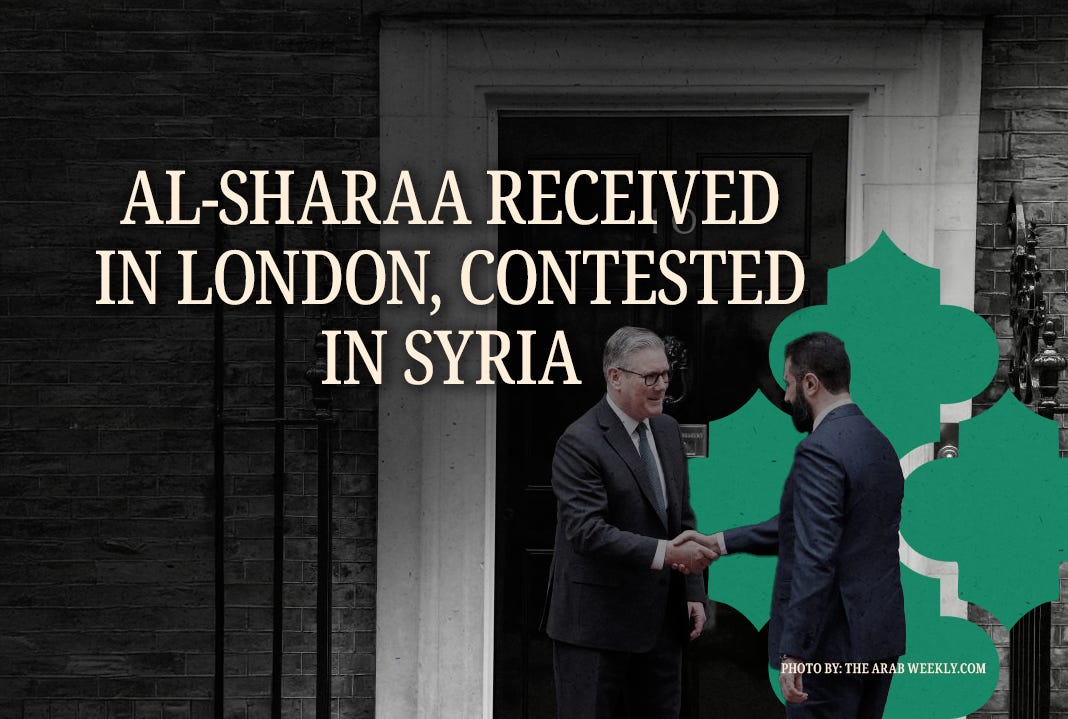
Ahmed al-Sharaa shaking hands with Sir Keir Starmer on the steps of 10 Downing Street was probably not on anyone’s bingo card for 2026.
Yet the interim Syrian president, once known as Abu Mohammad al-Jolani, strolled along Downing Street on Tuesday morning, suited and booted, for bilateral talks with the British prime minister—a remarkable turnaround in his international standing.
The landmark meeting reflects the enormous shift in UK-Syria relations since the fall of longtime autocrat Bashar al-Assad in December 2024.
Later that day, al-Sharaa visited Chatham House for a conversation about his government’s position on Iran (he said he would remain neutral unless attacked), Israeli strikes on his country, and whether he was still on track to hold elections (“certainly,” he said).
Yet not everyone gave the Syrian leader a warm welcome.
Outside, dozens stood opposite the think tank in St James’ Square, waving placards and chanting “Jolani terrorist” and “shame on Chatham House.”
“There is a big terrorist inside,” a man named Daleel said. “They’re giving him legitimacy. Shame on them.”
Demonstrators, including members of the Syrian diaspora and Kurdish activists, pointed to al-Sharaa’s past as the leader of Hayat Tahrir al-Sham (HTS). The group, which played a central role in the overthrow of Assad, had until recently been designated a terrorist organization due to its origins as an al-Qaeda affiliate.
For many critics, that history remains unresolved. Al-Sharaa himself is a former member of al-Qaeda, who once had a $10 million bounty on his head. His transformation into a Western-suited head of state has been viewed by some as unconvincing.
The protest attracted counter-demonstrators who were broadly behind their president. Some were draped in revolutionary flags, emblazoned with the date of Assad’s overthrow: 8/12/24.
“I don’t think a single one of those people is even Syrian; the majority are from Turkey,” said Muhammad, looking at the protesters. A few started chanting the anthem of the Syrian revolution: “Raise your head high, you are a free Syrian.”
Many of the people on this side of the protest had personal stories of loss and suffering under Asaad’s regime. For them, al-Sharaa is already an improvement.
“I think he is doing a good job,” said another man who declined to give his name. “Given the circumstances, he’s the best option. Our president has given them [the Kurds] more rights than they have had in 60 years, so I’m not sure what they’re complaining about.”
When al-Sharaa’s convoy left Chatham House, his supporters rushed towards him, but a police blockade kept them at least 50 meters away as they chanted “qaedna”—our leader—and “al-shab al-soori wahid”—the Syrian people are one, drowning out the opposition voices.
The demonstrations also reflected broader anxieties about the direction of Syria’s post-Assad transition, particularly among minority communities who fear the new regime is insufficiently accountable.
In March 2025, around 1,400 people, mostly civilians, were killed in coastal regions in western Syria. Alawites were the primary targets, and conflict monitors reported instances of “revenge attacks.” Bashar al-Assad was from the same sect.
That summer, a local dispute in Sweida quickly escalated into intense clashes between Bedouin tribes and Druze fighters, further inflamed when the interim government forces attempted to enter the southern province. Around 1,500 Druze were killed, with reports of women and children being kidnapped.
Members of the diaspora were planning to attend the protest, but dropped out at the last minute due to safety concerns.
However, one Druze man, Emad, did come along. He told me about three of his uncles who were killed by government forces, and several family homes that were burned.
“The Druze are still not allowed to go to Damascus, because his people have threatened them. There is no oil, food, or medicine in Sweida. Their excuse is that the Druze are supported by Israel,” he said, referring to Israel’s recent air strikes on Syrian government infrastructure, claiming it was doing so in response to attacks on Druze civilians. “But the killing started before Israel got involved. This ISIS ideology is being spread throughout Syria now—because of al-Sharaa.”
And, most recently, church leaders have canceled public Easter celebrations following a recent outbreak of sectarian violence in the predominantly Christian town of Suqaylabiyah, in the west.
Then there’s the question of Kurdish autonomy. In January 2026, fighting between Syrian government forces and the Kurdish Syrian Democratic Forces (SDF) led to Damascus reclaiming much of the territory previously held by the autonomous northeast region. Once backed by the US in its fight against ISIS, the SDF has now been sidelined as Washington shifts support toward the Syrian government’s push for national reunification. While some concessions have been made—such as integrating SDF units into the army, retaining civil servants, and recognizing Kurdish rights—the loss of territory, resources, and US backing leaves the SDF in a weakened position with an uncertain future.
“I look at actions on the ground, and when you disarm a population, that doesn’t mean you support them,” says Jonathan Hackett, a US Marine Corps veteran specializing in counterintelligence and the author of Iran’s Shadow Weapons: Covert Action, Intelligence Operations, and Unconventional Warfare. “The Kurds have lost the sovereignty that they fought for.”
While violence and extremist influence continue on the ground, the international response has moved toward renewed engagement.
In July, Britain fully re-established diplomatic relations with Syria, 14 years after severing ties with Assad’s government. Starmer’s government then moved to de-proscribe HTS the following October.
Al-Sharaa’s visit is expected to accelerate that normalization process. Plans are underway for the full reopening of Syria’s embassy in London and the British embassy in Damascus, while the UK government is also preparing to announce a new export finance scheme to support British companies seeking to do business in Syria.
While al-Sharaa has swapped his khaki fatigues for a suit and tie, questions remain over whether this transformation represents a genuine ideological shift or a pragmatic rebranding designed to secure international legitimacy.
“If you noticed in the speech, he didn’t mention Turkey at all. He talked about Russia, he avoided talking about Russian bases, he talked about Israel, but very conspicuously left out any mention of this major player on its northern border…that essentially brought him to power,” says Hacket. “I think he doesn’t want to acknowledge that, he wants to portray himself as a neutral player who came through meritocracy… but that’s not what’s going on here.”
As for Ankara’s motives, “This has been a Turkish masterstroke in the region, regaining some ground in that former Ottoman space that Turkey wishes so much to reintegrate,” says Hackett.
Immediately after the fall of Assad’s regime, Russia started a large-scale withdrawal of its forces from Syrian territory. Among dozens, two remain—al-Sharaa announced at Chatham House that he was trying to turn them into training bases for the Syrian army. The Russian naval base at Syria’s port city of Tartus has been a particular focus due to its strategic significance in affording access to the Mediterranean.
Al-Sharaa also said there would be parliamentary elections, with the first session beginning soon. But “he picked one third of the parliament himself,” says Hackett. As for presidential elections, “I’ll believe it when I see it; or will it be someone that al-Sharaa handpicks?”
So what would proof of change look like?
“An alignment between statements he made—on rights and elections—and what is implemented,” says Hackett. “Even an attempt would be positive. Let’s have a referendum on al-Sharaa’s presidency. If his support is strong, let’s see.”
The London visit followed a stop in Berlin, where al-Sharaa addressed one of the most politically sensitive issues facing Europe: the future of Syrian refugees.
He suggested that Syrians who had fled to Germany should consider returning to help rebuild the country.
“These are Syrians who have studied at German universities, acquired German expertise, and are now working in German companies,” he said. “Through investments in Syria, they can then bring this expertise back to Syria.”
German Chancellor Friedrich Merz, who took office in May, has argued that with the war now over, Syrians may no longer have grounds for asylum.
Hackett, however, says, “There’s a big concern for their safety. Is Syria even ready to repatriate these people who have been gone for a long time? I think the West would like to forget the Syrian war, and they’re willing to make poorly thought-out concessions to be able to achieve that.”
Nevertheless, regional powers, including Qatar and Saudi Arabia, recognize both the strategic importance of Syria and the opportunity to shape its post-war future.
Al-Sharaa’s European tour illustrates the complex and often contradictory dynamics at play—a leader seeking international legitimacy while still facing deep skepticism at home and among diaspora communities.
The arguments playing out in St James’ Square offered a glimpse of the divisions that still define Syria’s future. For some, Ahmed al-Sharaa represents stability and a break from Bashar al-Assad’s despotic rule, while many others are still asking whether anything fundamental has really changed.
Middle East Uncovered is powered by Ideas Beyond Borders. The views expressed in Middle East Uncovered are those of the authors and do not necessarily reflect the views of Ideas Beyond Borders.
The Golan’s Heights is no longer under the control of Damascus.