


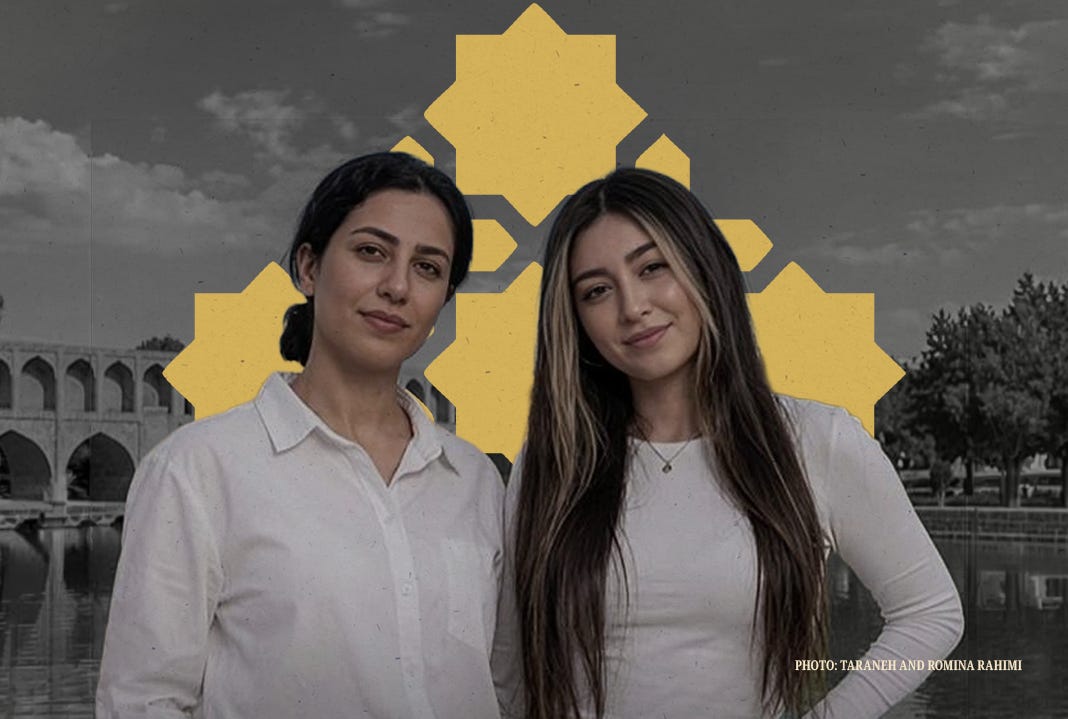
As soon as she turned 18, Romina Rahimi got a tattoo of a map of Iran on her neck. It was the only way their cousin, Masoud Nourmohammadi, was able to tell her apart from her twin sister Taraneh—something for which he was eternally grateful.
More than anything, the tattoo was a symbol, he says, of how Gen Z Iranians feel about their country, and the hope they still have for their future.
“This generation of Iranians has a deep love for the culture, for Iran, and their people,” says Nourmohammadi.
It seems tragic, then, that someone so patriotic has been languishing behind bars for the past 10 months.
The Rahimi girls, then 20, joined their compatriots at Isfahan’s Shoahada Square during the January uprising against the Islamic Republic.
On August 31, in Branch 1 of the Isfahan Revolutionary Court, they were convicted of charges relating to moharebeh, or “waging war against God.”
Taraneh has been sentenced to death while Romina was given 25 years in prison.
“They are broken, mentally,” says Nourmohammadi.
Taraneh was the more extroverted, athletic of the two, he says. An equestrian, she dreamed of one day having her own stable.
“She was one of the kindest people you will ever meet. If you ever looked into her eyes, you would get that vibe,” he tells Middle East Uncovered from his home in Utah.
“Romina was more introverted. I could have deep conversations with her about philosophy for hours. She was really curious. She was really into music and shoes.”
While many people have lost hope in Iran, Nourmohammadi insisted that the young women were the opposite.
And so, full of hope for their future, they took to the streets among millions of other Iranians.
What began as demonstrations over economic hardship at the end of December 2025 escalated into open calls for regime change by January.
The security forces responded with widespread violence, with tens of thousands massacred by the state. The exact number has yet to be verified, but some estimates claim it could be as many as 40,000.
Two weeks later, the Rahimi twins were arrested by dozens of masked men in the middle of the night. Taraneh was staying with a friend while Romina was with her mother.
“We later found out they were IRGC [Islamic Revolutionary Guard Corps],” says Nourmohammadi. “They put a bag on Taraneh’s head and handcuffed her. A few hours later they did the same with Romina. My aunt was fighting back; she didn’t want them to take her daughter.”
With that, they were gone into the night. Their family had no idea where they were or what had happened to them. This period coincided with the nationwide internet blackout. The silence was agonizing.
“We thought they had killed the girls; they are certainly capable,” says Nourmohammadi.
One day, their mother, Marzieh, got a phone call to say the girls were in Dowlatabad Prison in Isfahan. It was four weeks later that she got an appointment to see her daughters—four months after they were abducted.
Marzieh couldn’t recognize them, says Nourmohammadi. The girls had bruises all over their bodies. Taraneh was limping. Both had chunks of hair missing from their heads, as they had been dragged from place to place.
The girls later told their lawyer that they had been sexually assaulted.
“The IRGC has something they call a ‘magic table’,” says Nourmohammadi. “They tie people to it and beat them for hours and hours until they confess.”
He pauses for a moment. “They are like animals. No, actually, animals are good. They are barbaric; they’re not even human beings.”
The prisoners were reportedly tortured in front of each other. Taraneh was beaten so badly that she was left with a broken skull, leading to an inner ear infection and a loss of balance.
Taraneh told her cousin that she would bite down on her teeth to prevent herself from screaming, as Romina was in the cell next to her.
“She broke all her teeth,” says Nourmohammadi. “They also said if you don’t sign this confession, we will rape your sister in front of you. And they would have done it.”
The “confession,” he says, is the only “evidence” the regime has against Taraneh.
Moharebeh carries the death sentence under Iranian law. Human rights groups report that it is a vague, catch-all charge used to suppress anyone—from political dissidents and ethnic minorities to anti-government protesters.
Taraneh and Romina were prosecuted alongside 14 other defendants over events surrounding the protests in Isfahan.
Ten of them, including Taraneh, were sentenced to death.
As the war between the US, Iran and Israel continues to dominate international attention, with much of the focus on the Strait of Hormuz and rising oil prices, Iranian authorities are pursuing executions of dozens of protesters arrested during January’s uprising.
At least 56 people have been executed on national security-related charges, including 27 individuals in cases linked to protests at the start of the year, according to the UN’s human rights office.
Mahboubeh Shabani, a civil engineer from Mashhad, was arrested in February after she was accused of helping injured demonstrators reach a hospital. She also faces accusations of “operational action to strengthen Israel, the United States and agents affiliated with Reza Pahlavi” under the new “Law on Intensifying the Punishment for Espionage and Cooperation with the Zionist Regime and Hostile States against National Security and Interests,” enacted in October 2025 following approval by parliament and the Guardian Council.
The Rahimi sisters turned 21 in prison. It is unclear why Taraneh has received the death sentence while Romina has not.
Nourmohammadi has a theory.
“There is a pattern with this regime. Taraneh is an athlete, and there are a lot of athletes being imprisoned,” he says. “They take the brightest, and they want to create fear.”
Shabani practiced martial arts—she was arrested violently and beaten in prison.
Taraneh and Romina’s family appealed to the Supreme Court. But the IRGC arrested their lawyer, Amirsalar Davoodi, on October 10. Any hope of justice is fading.
The prison conditions are excruciating. As well as torture, the Rahimis have to buy their own drinking water and are not allowed to receive fresh clothes or menstrual products. At one point, says their cousin, Taraneh was forced to eat other prisoners’ leftovers.
A date for Taraneh’s execution has not been set, but it could be any day now.
For their family, the wait is agonizing.
“Their mom is just terrible, like most of us. We’ve lost our minds,” says Nourmohammadi.
He feels powerless to do anything except to continue telling their story. Yet the father of three says he’s received death threats for speaking out.
“I received a text on Telegram saying, ‘We know where your kids go to school; one day we will pick them up’. I’ve reported it to the local police, but I was advised to tell the FBI.”
Nevertheless, he continues to speak out. He does it because the twins want him to be their voice.
“What happened in January was a massacre. The world needs to recognize that,” says Masoud Nourmohammadi. “It has not stopped. It’s still happening in prisons.”
You might also be interested in:
Iran’s Regime Didn’t Just Want Protesters Silenced. It Wanted Them Dead.

Middle East Uncovered uses pseudonyms to protect our sources in Iran.
Middle East Uncovered is powered by Ideas Beyond Borders. The views expressed in Middle East Uncovered are those of the authors and do not necessarily reflect the views of Ideas Beyond Borders.