


Any American paying at the gas station today can see the effect the war on Iran is having on their wallet. The national average price of regular gasoline is now around $4.10 a gallon, up from less than $3 before the war broke out. Crude oil is up well above its pre-war levels, while the Strait of Hormuz, through which a huge share of the world’s oil and gas passes, continues to see severely disrupted shipping.
And despite President Trump claiming more than 38 times since the war began that a deal is near, it doesn’t seem to be coming to a close any time soon.
Now, the administration is trying another way to squeeze Iran through an effort dubbed Operation Economic Outcast, a name that leaves little to the imagination.
On Monday, US Treasury Secretary Scott Bessent announced a new round of sanctions on 60 individuals and entities.
Bessent described it as an “economic onslaught” against Iran’s financial connections around the world and said the goal was to cut off every source of revenue still available to the country.
Iran has claimed the new measures will fail. But this time, the US is also grappling with a problem it has faced for years: China.
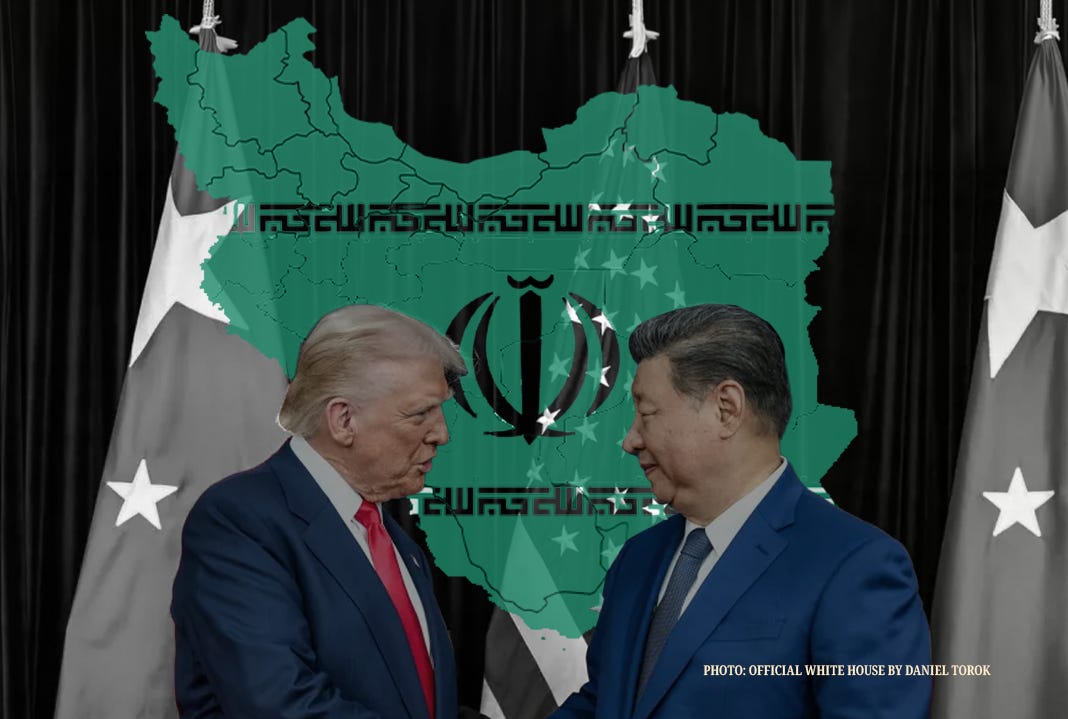
The latest wave of sanctions against Iran and its trading partners includes Beijing.
China is the biggest buyer of Iranian oil, although the trade has declined under the US blockade of Iran’s ports.
The Chinese foreign ministry spokesman, Lin Jian, said the country was firmly opposed to what it called “illegal unilateral sanctions” and would take “all necessary measures” to safeguard its rights.
The timing is precarious, not least because President Donald Trump is preparing to host Chinese leader Xi Jinping in September to maintain an already strained trade truce.
However, no Chinese financial institutions were on the US list. Asked why the Trump administration had not declared immediate sanctions, Bessent replied: “Why would I want to blow up the global financial system?”
“Ultimately, China needs to be part of any sanctions regime against Iran,” says Jonathan Hackett, a US Marine Corps veteran specializing in counterintelligence and the author of Iran’s Shadow Weapons: Covert Action, Intelligence Operations, and Unconventional Warfare.
Around 90 percent of Iran’s oil exports are believed to end up in China, making Beijing Tehran’s most important customer by far.
China has been a steadfast economic ally of Iran since the US pulled out of the 2015 nuclear deal in 2018 under the first Trump administration. It is a crucial part of the network Iran uses to subvert US sanctions.
That means the success of Operation Economic Outcast may depend as much on what Beijing does as on what happens in Tehran.
Hundreds of Chinese entities have already been sanctioned by the US. The difficulty has been enforcing those sanctions without triggering a much bigger confrontation.
Hackett argues that China has always been the missing piece in the US sanctions strategy. But going after Chinese companies more aggressively would come at a price for Americans too. Rising gas prices and mounting pressure ahead of the midterm elections means the administration has to tread carefully. His concern is that the US could succeed in hurting Iran’s economy without actually forcing its leaders to change course.
The US can target Chinese refiners, banks, shipping companies, and other businesses helping Iran sell its oil. But the further it goes, the harder it becomes to pretend this is only about Iran.
Ahmed Khuzaie, a Bahrain-based analyst, sees it that way:
“By targeting Chinese refiners, banks, and shipping firms that facilitate Iran’s oil trade, the US is not only trying to choke off Tehran’s revenue but also challenging China’s role in global commerce,” he says.
China needs energy, and Iran sells it cheaply. For Beijing, simply cutting Iran off is unlikely to be an attractive option. It has spent years building a relationship with Iran that gives it influence in the Gulf.
China has also consistently rejected unilateral US sanctions, so it is unlikely to suddenly accept the argument that it should help enforce them.
Instead, it is likely to look for ways to keep the relationship going without putting its biggest companies directly in the firing line.
Iran has plenty of experience doing the same thing. Its oil trade has increasingly relied on small refiners, front companies, intermediaries, and a shadow fleet of tankers. Payments can be moved through less visible channels or settled in currencies other than the dollar.
As a result, sanctions can make Iranian trade more difficult and more expensive without necessarily stopping it.
Khuzaie expects China to continue toeing that line:
“Compliance, therefore, tends to be partial and tactical,” he continues. “Enough to ease diplomatic friction with Washington when necessary, but never to the point of cutting off Iran entirely.
“In effect, China balances between energy needs, geopolitical rivalry, and sanctions evasion, ensuring it keeps leverage over both Iran and the United States.”
And the harder the US tries to isolate Iran, the more dependent it can become on China:
“The paradox is that while US sanctions aim to isolate Tehran, they can instead consolidate a tighter Iran-China axis, reducing Western influence and embedding China more firmly in Gulf energy and security dynamics,” Khuzaie says.
That brings us to the other reason Beijing may be uncomfortable with the direction of the war—it has major economic interests across the Gulf.
China buys energy from the region, has invested heavily in infrastructure and trade, and needs shipping through the Strait of Hormuz to be reliable.
That gives it an interest in seeing Iran de-escalate, and the Gulf monarchies have already looked to China to use its relationship with Tehran to encourage restraint.
For kingdoms like Bahrain, the hope is that China can use its influence with Iran without dragging the Gulf into any further confrontation. Bahrain is particularly interested in whether the sanctions actually reduce Iran’s ability to threaten its neighbors.
Khuzaie says Gulf governments will be watching for signs that Tehran has fewer resources to support regional proxies, less capacity to threaten shipping, and a diminished appetite to pressure Gulf states.
If that happens, the sanctions may begin to look like they are achieving something beyond simply hurting the Iranian economy.
But Hackett is less convinced that economic pain will change the behavior of Iran’s leadership.
“The Iranian Revolutionary Guard Corps (IRGC) will probably not behave much differently given the new sanctions. They are more of the same,” he says.
His concern is that the Iranian leadership has shown before that it’s prepared to let ordinary people absorb the economic pain while protecting its own grip on power.
And Iran is not without options.
Hackett expects Tehran to continue looking for ways to retaliate, including through military activity, while also trying to influence American public opinion through social media and other information campaigns.
He says US officials should be on the lookout for signs such as increased movement of ballistic missiles, the dispersal of military equipment, changes in the leadership of the IRGC’s Aerospace Force, and the decentralization of military command.
None of that necessarily means Iran is preparing for an immediate escalation. But it would show that it is preparing for a long fight.
And that is perhaps the biggest lesson from the past six months.
Iran has taken enormous damage. Its economy is under severe pressure—the currency has depreciated to roughly two million rials per US dollar—and its ability to operate normally in international markets has been badly constrained.
But damaging an economy is not the same thing as changing a regime.
The Trump administration now has to prove that the pain it is inflicting can translate into political results. That is particularly difficult when the economic consequences are being felt at home in the United States.
The US can increase pressure on Iran by going after the Chinese companies that keep its oil trade alive. But if Beijing retaliates, American businesses and consumers could feel some of the consequences.
If the administration backs off, leadership in Iran may conclude that its most important economic lifeline is safe—something Beijing is well aware of.
“China is highly unlikely to fully comply with US sanctions on Iran,” says Khuzaie. “Doing so would mean sacrificing both its energy security and its broader strategic posture.”
For now, China has little reason to choose a side. It can condemn the sanctions publicly, maintain its relationship with Iran, and try to ensure its own companies are not caught in the crossfire all at the same time.
The Gulf states would welcome a weaker Iran. But a direct US-China confrontation in the Middle East is the last thing anyone wants.
Khuzaie says the real test will be whether the sanctions change Iran’s behavior, not just hurt its economy. The regime has not only survived sanctions before, but also isolation and periods of enormous economic hardship.
While American politicians are beholden to their voters, the IRGC doesn’t really have the same dilemma:
“If the sanctions succeed economically but fail politically, the US may end up with a more extreme Islamic regime than even the worse one that popped up after February 28,” says Hackett. “If anything, the IRGC will become wealthier as the Iranian people suffer.”
That is the crux of the matter. World leaders may talk a big game, but it’s the people who ultimately pay the price—whether inside Iran or at the gas pump in America.
Read more about the price the Islamic Republic is willing to pay to stay in power:
Iran’s People Are Paying the Price for the Regime’s Survival

A strange calm hangs over Iran today. The government has claimed victory and is feverishly projecting propaganda painting the regime as an indomitable military force incapable of defeat. But inside Iranian homes, families are beginning to panic. Their savings are rapidly depleting, and many can’t find jobs to replenish what they’ve lost over the last si…
Middle East Uncovered is powered by Ideas Beyond Borders. The views expressed in Middle East Uncovered are those of the authors and do not necessarily reflect the views of Ideas Beyond Borders.