


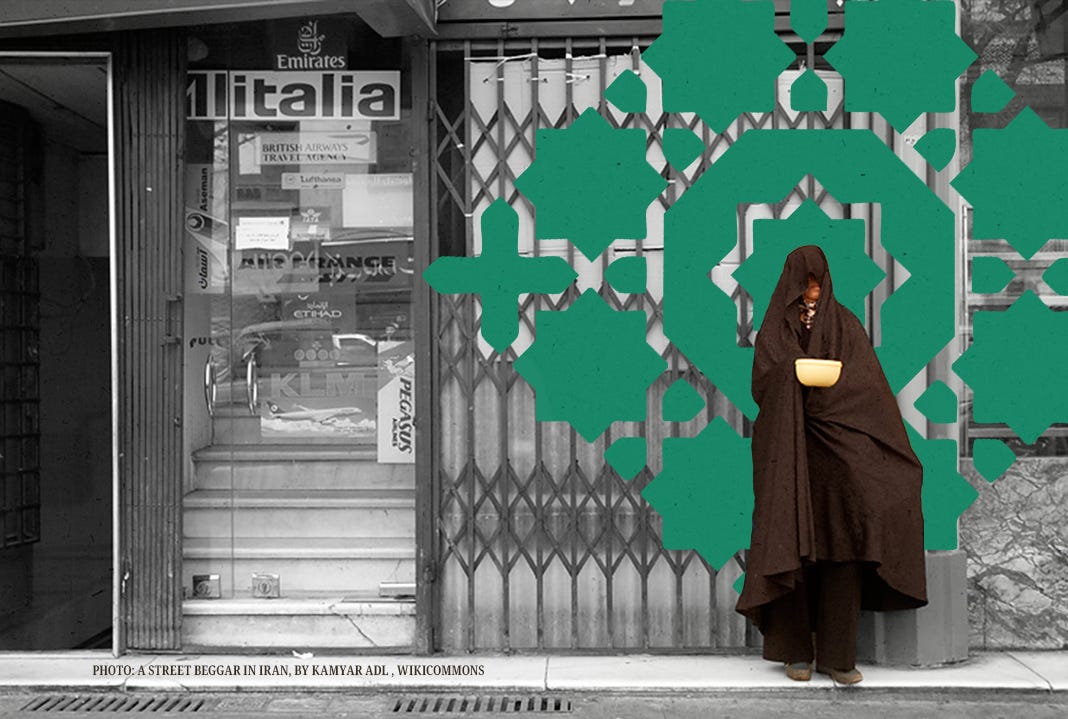
A strange calm hangs over Iran today. The government has claimed victory and is feverishly projecting propaganda painting the regime as an indomitable military force incapable of defeat. But inside Iranian homes, families are beginning to panic. Their savings are rapidly depleting, and many can’t find jobs to replenish what they’ve lost over the last six months. While the regime touts its strength, its people are barely getting by.
But you wouldn’t necessarily notice this walking through the streets of Tehran or Isfahan. Many shops are still open, and those lucky enough to still have jobs go to work every day as usual. The economy is functioning even as its population grows progressively poorer. Despite existing sanctions, whose burden falls most heavily on ordinary Iranians while regime officials continue to enrich themselves, the country is surviving.
Iran’s official labor-force participation rate was just 39.7 percent in the winter of 2025–26, with more than 40 million people classified as “economically inactive.” The official unemployment rate was 7.6 percent, but that figure applies only to the economically active population. It does not include those who have been forced out of the labor market altogether.
Official figures for July 2026 put annual inflation at around 66 percent, while food, beverages, and tobacco prices were considerably higher. Point-to-point food inflation reached 128.1 percent, with oils and fats, dairy products, eggs, and meat seeing the most severe increases.
Having a source of income no longer guarantees financial security; even those with a regular salary are struggling. As soon as the money hits the bank, it loses purchasing power almost immediately. Young people who earn their salaries in Rials (with approximately 2 million Iranian Rials now equaling one U.S. dollar) have little to no ability to save in the national currency. By the time the next paycheck arrives, the money they earned previously already buys less than it did when they received it.
In response, the Iranian government is calling on people to be frugal and make sacrifices as it continues to spend enormous resources maintaining itself and its regional proxy networks. Not to mention sustaining an enormous propaganda apparatus.
This is not new to Iranians. Ordinary people are repeatedly told they must accept less while the state keeps magically finding resources for the priorities it considers essential.
Education doesn’t guarantee financial independence anymore, either. As young adults watch their savings depreciate, homeownership has become an impossibility.
Iran’s fertility rate is in free fall. In the 1980s, the average Iranian woman would give birth to six or more children. Today, it’s closer to 1.35, well below the stable population replacement level of 2.1. Iranians aren’t rejecting family life. They are understandably hesitant to bring children into an economically volatile environment ruled by a hostile government—in a region engulfed in war.
In December 2025 and again in January 2026, Iranians took to the streets in protest, at least in part over economic dissatisfaction. Thousands were gunned down and arrested by regime forces, and then the war broke out. There is little appetite left for uprising. Most people are focused on surviving. Hardship that might otherwise be a driving force for political change has happened upon an exhausted population.
Iran is facing serious pressure on its gasoline supply, with daily consumption of roughly 135 million liters outpacing domestic refinery production. The government is considering restricting supply, raising prices for consumption above the subsidized quota, or changing how it allocates fuel. On August 24, President Masoud Pezeshkian’s chief of staff said government intervention was unavoidable, arguing that wartime production losses meant consumption also had to fall.
For decades, the Iranian state has relied heavily on restrictions imposed on people’s daily lives to solve its problems. People must sacrifice fuel, electricity, currency, food, and other basic necessities—yet the propaganda machine will keep churning out messages of victory and success.
Power cuts have made matters worse. Some cities are losing electricity for hours at a time in the summer heat. The war has damaged an already strained power system, leaving homes and businesses to deal with rolling blackouts.
And all the while, the government prioritizes finding convenient scapegoats over fixing the problems facing its population.
Petty theft has even become part of the regime’s excuse for why Iranians are suffering. Videos of people stealing electricity and telecommunications cables have circulated online, and the theft is real. But stolen cables hardly explain a nationwide electricity crisis.
I have experienced this cycle myself. The Islamic Republic has refined its two-step process to avoid accountability. First, it dismantles social cohesion and creates an environment in which citizens become suspicious of each other. Then, at the peak of the chaos it intentionally caused, the same state presents itself as the force protecting people from it.
Distinguishing truth from propaganda is sometimes easier than it sounds. Just look at who benefits in the end. Ask who stands to gain from the proposed explanation, what responsibility disappears when people accept it, and what new powers are granted to the government once they do.
But state broadcasts aren’t enough this time to bridge the gap between regime rhetoric and daily reality. The primary threat is not just economic recession, but the gradual loss of the people’s expectation that life will improve.
Societies can tolerate hardship for a long time; they can adapt to inflation, shortages, blackouts, and declining living standards. Patience runs out when people start to feel there is no way forward.
The adaptations seen today—postponed marriages, talent drain, reduced consumption, disappearing savings, and young people who can no longer imagine building an independent life—are the calm before the next storm.
And that storm may be fast approaching from both directions. As the regime focuses on psychological warfare against an increasingly impoverished and desperate population, the United States has announced Operation Economic Outcast in another effort to tighten the financial pressure on Tehran. For ordinary Iranians caught between a government that shows little concern for their well-being and mounting pressure from abroad, it looks like a perfect storm. Once again, they will be the ones forced to weather it.
Middle East Uncovered is powered by Ideas Beyond Borders. The views expressed in Middle East Uncovered are those of the authors and do not necessarily reflect the views of Ideas Beyond Borders.

One of the most important lessons from Iran is that the survival of a state and the well-being of its people are not always the same thing.
When a government defines national survival primarily through the preservation of its political and security structures, ordinary citizens can become the ones who pay the strategic bill—through inflation, unemployment, displacement, fear, and the loss of hope for a normal future.
This is where the human dimension of geopolitics matters.
A country is not merely its regime, its military capabilities, or its regional influence. It is also the millions of people who wake up each morning trying to work, feed their families, educate their children, and imagine a future beyond permanent crisis.
Iran’s experience should therefore be studied not only as a confrontation between states and regimes, but as a warning about the distance that can emerge between national power and human security.
When that distance becomes too wide, the greatest strategic cost is ultimately paid by the people.
— Wahidullah Noorzai
Former Afghan National Police Officer | Strategic & Security Analyst
Sure , start an illegal war then write on how poorly the bombed out
Country is doing… great journalism