


Middle East Uncovered uses pseudonyms to protect our sources in Iran.
When I first spoke with Kazem earlier this year, he was in Turkey. He and his wife left Iran after the regime shut down internet access in the wake of the January protests and the crackdown that followed. Both had participated in the anti-regime demonstrations and watched security forces open fire on fellow citizens. But it was the internet blackout that made it impossible for them to continue their work online and ultimately pushed them to leave the country.
A few months later, they returned to Iran. Then war broke out.
“We came back, and days later, the war started,” Kazem told me from Isfahan. “It looks like it’s our destiny to be here when there’s no internet.”
Since April, Iran and Israel have operated under an uneasy and increasingly strained truce linked to broader U.S.-Iran ceasefire negotiations. Following the most recent exchange of strikes between the countries—the most serious breach of the truce since it was announced—Kazem told me he was safe and had not heard of any repercussions among those close to him. But the ceasefire is now facing its most serious test since it was announced, with President Donald Trump describing it as being on “life support.”
Despite the ceasefire, Iranian-backed groups have continued to attack American and Israeli targets across the region, and Israel has signaled that it is prepared to formally resume military action if it believes Tehran is rebuilding its nuclear capabilities. Iran is portraying its survival thus far as proof it has weathered the storm. The Strait of Hormuz continues to be severely disrupted, and oil prices have risen again after the latest escalation. In Kazem’s view, Tehran may be betting that time is on its side: that economic pressure, rising costs, and growing public fatigue in the United States will eventually weaken Washington’s position.
Inside Iran, Kazem says he is both deeply disappointed and increasingly afraid.
What will the regime do to its own people now that it has survived?
The regime remains firmly in control, while the political change many hoped for—and that President Trump suggested military pressure might help bring about—has yet to materialize.
In the early days of the conflict, he said, many Iranians believed they were watching the beginning of the end.
“That first night of the war, people came out to celebrate,” Kazem told me.
For years, Iranians opposed to the Islamic Republic had imagined what it would feel like to celebrate the deaths of the rulers who lorded over them. Suddenly, it seemed possible. Senior officials had been successfully targeted, and the regime looked shaken. The fear that normally kept people inside appeared, for a few hours, to dissipate.
Then the motorbikes arrived.
“People were out trying to celebrate, then suddenly we heard the motorbikes. The anti-riot bikes quickly turned up to send people back home,” he said. “They were offended by people celebrating.”
Years of crackdowns on protest movements have left little room for organized opposition or spontaneous celebrations.
“A lot of people have lost hope,” he said. “The last grain of hope for any change was foreign intervention. And that looks like it didn’t work.” He said the only way he sees the regime falling is with American boots on the ground, a scenario that few observers see as realistic.
Kazem says the regime’s current priority is to make sure the next uprising never begins.
Across cities, regime supporters now gather at key intersections at night. Many use temporary religious stalls known as mawkibs, which are normally associated with religious festivals, free tea, and public displays of piety. Now, he says, they have become political checkpoints.
“They’ve set up mawkibs in every corner now,” he said. “They’re present in every important cross section, especially ones where riots happened. They’re holding station at key points in every town.”
Many of those gatherings include armed Basij and Islamic Revolutionary Guard Corps (IRGC) personnel.
“In many of these mawkibs, there are people with guns, with AK-47s,” he said.
Kazem was stopped once while traveling for a camping trip. The men searched his car, saw camping gear, and let him go. But he does not believe these checkpoints are really about catching spies or dissenters.
“It’s just to threaten people,” he said. “It’s just to create an atmosphere of fear.”
And it’s working.
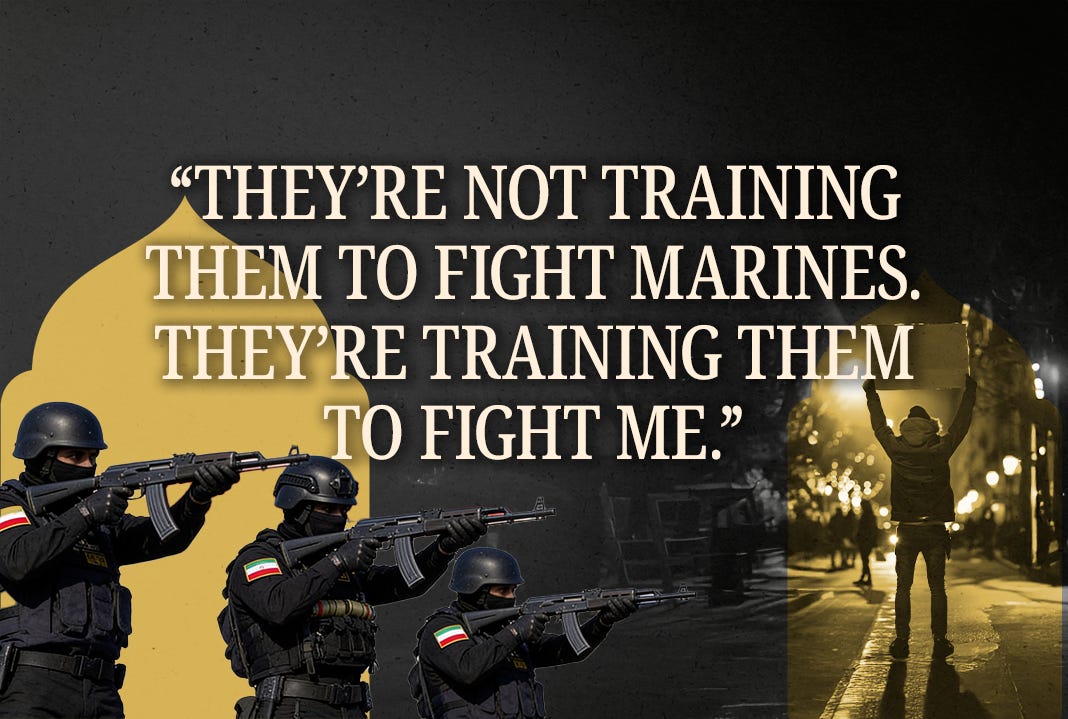
Kazem told me about women and children being trained to handle AK-47s. In one case near Isfahan, he said, middle-aged women volunteers were taken for weapons training. One accidentally shot and killed another volunteer.
The image of civilian women training to fight US troops is absurd until Kazem explains what he thinks it means.
“You may ask, hang on, how is a middle-aged woman with an AK-47 any threat to an American Marine?” he said. “But they’re not training them to fight Marines. They’re training them to fight me if I come out on the street.”
Kazem describes a regime that has absorbed the shock of war and subsequently turned its attention back to the threat it fears most: its own citizens.
“If we have another 8th of January, it’s going to be over,” he said. “So they’re doing everything they can to prevent that.”
Kazem does not think people will risk protesting again.
He told me about someone he describes as one of the bravest people he knows, a man who has taken part in every major protest movement since 2009. He had been arrested before and continued to protest after his release.
Even he wouldn’t dare to protest now.
“He made it very clear to me that he’s not going to go anymore under these circumstances, and nor should anyone go,” Kazem said. “Even he says we shouldn’t go out because we’re just going to die.”
Daily life, meanwhile, has resumed in the strange way it often does under dictatorships. During the day, Kazem said, shops are open. Food is available. People work, shop, visit relatives, and try to preserve whatever pieces of ordinary life they can.
At night, the mood changes.
“Every night there’s a lot of noise pollution,” he said. “They play loud music by speakers, pro-regime music.”
He and his wife try not to go out after dark.
“We do all our business during the day,” he said. “Because if we go out at night, they create traffic jams. You would think there are a lot of them on the street, whereas we know they’re not. But it doesn’t matter. As long as one of them has an AK-47, that’s enough.”
The economic consequences of the war are felt, though not always in ways outsiders might expect. Kazem said there are no major food shortages where he lives. But prices have risen sharply in specific sectors hit by the conflict.
Plastic goods, he said, have become far more expensive because of the petrochemical companies that were attacked. Disposable plates, cups, and milk bottles now cost much more.
“Milk itself has not seen a price rise,” he said. “But milk bottles have.”
Cars have also become more expensive because steel factories were targeted and production is expected to slow.
But for Kazem and his wife, the most damaging economic blow is lack of reliable internet access. He spoke to me via WhatsApp using an expensive VPN.
“We technically didn’t make any money for the first four months of this year,” he said.
In January, they lost weeks of income. In February, what they earned went toward surviving in Turkey. In March and April, they were back in Iran with no reliable internet. They only began earning again in May.
VPNs, once an inconvenience, are now a necessity. Kazem described buying access to the open internet like buying illicit drugs.
“You have to ask a friend, ‘Do you know anyone who sells VPNs?’” he said. “Do you know a dealer?”
The prices, he said, have exploded. Some VPNs now cost up to 100 times as much as before because only the most powerful ones can bypass the new filtering systems. Worse, people fear that some VPN providers are tied to the IRGC.
“We heard about some VPN providers that are actually connected to IRGC,” he said. “So they can see what you’re doing.”
One person, he said, was arrested after using an insecure VPN to speak to a foreign journalist. “He did what I’m doing now, and he was caught,” he told me. He said he felt comfortable speaking only because he trusted the security of his VPN provider.
Despite everything, one area where the regime appears to have retreated is the hijab. When I asked whether more women were covering their hair, he didn’t hesitate.
“No,” he said. “No, they’re not.”
But Kazem does not read this as proof that the regime has softened.
“What we fear is that if a peace deal is achieved, and they are to stay, then we’re going to face even more suppression,” he said.
If the regime believes street protests can be crushed and foreign intervention can be survived, it may feel freer to reimpose the social controls it has temporarily deprioritized.
“They know they’re not going to lose power thanks to a street riot,” he said. “Foreign intervention… didn’t get rid of them either.”
The fear now is not that the Islamic Republic will return to normal, but that it will return more confident and brutal than ever before. Kazem says the IRGC is effectively running the country. The formal government, in his view, is secondary.
“President Pezeshkian is basically just a shadow government,” he said. “IRGC is the actual group in power because they are the ones with guns.”
Still, he and his wife are not planning to leave.
Their lives and loved ones are in Iran. Besides, Kazem said, leaving is not simple.
“It’s hard to leave home,” he told me. “Especially when you leave home with a broken heart.”
He knows people who say they will leave if the regime stays in power, and he understands that. But he also knows how hard that choice has become. Countries around the world are turning away migrants and refugees. Politicians win elections by promising to keep people out. Iranians who want to escape are left asking where they can go.
He and his wife try to make life bearable. They went to the cinema recently. They make small projects at home. A few nights before we spoke, they made kiwi jam.
“I strongly suggest you make that or try it,” he told me. “It’s really interesting.”
They used to travel often. In 2024, they camped eight times in four months. This year, they have gone once. Even then, they were stopped and searched.
“If the regime is to stay, life is not going to be very happy,” he said. “Not just for us, for a lot of people in the region.”
President Trump promised liberation at the outset of the war. Instead, Iranians who were encouraged to rise up are trapped inside a country where the regime that was supposed to fall is regrouping, launching fresh attacks against its enemies, and, most concerning to Kazem, turning its weapons inward.
The Islamic Republic has survived the war thus far. What comes next, Kazem fears, will be directed not only at foreign adversaries, but at the Iranians who still hope to see the regime fall.
Middle East Uncovered is powered by Ideas Beyond Borders. The views expressed in Middle East Uncovered are those of the authors and do not necessarily reflect the views of Ideas Beyond Borders.