


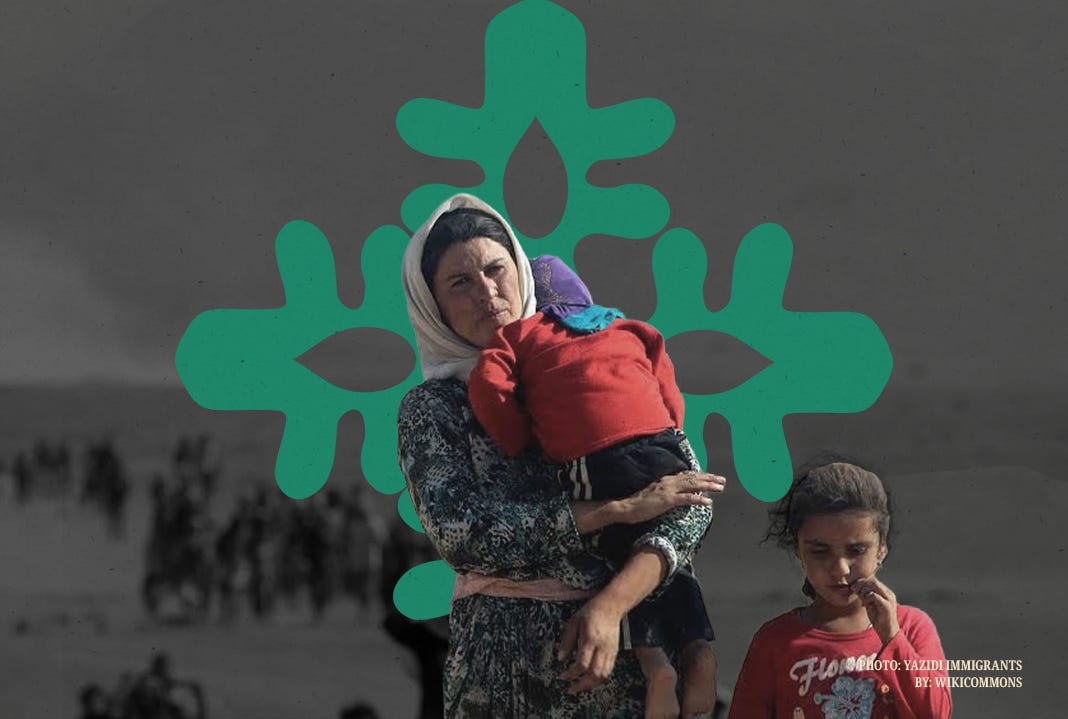
Ekhlas Bajoo was just 14 years old when ISIS terrorists raided her village in August 2014, killed her father, and forced her into sexual slavery. The abuse became so unbearable that she begged her captor, a 34-year-old man, to kill her.
Death, he said, was too good for Yazidis.
“This man did so many terrible things with me,” Bajoo said in an interview. “He used to tie my hands, feet, and mouth, so that I could not defend myself against him.”
Bajoo is one of 30 survivors who gathered in Berlin this month to give harrowing testimony at a “Truth Commission,” in an attempt to secure justice for the Yazidi people.
On June 29, 2014, ISIS leader Abu Bakr al-Baghdadi declared himself the “caliph” of the territory controlled by the group in Iraq and Syria.
On August 3, 2014, ISIS fighters attacked Sinjar, the Yazidis' ancestral homeland in northern Iraq. An ancient, pre-Islamic faith, ISIS terrorists viewed the Yazidis as “infidels” and heretical “devil worshippers.”
And so they slaughtered approximately 5,000 and enslaved at least 6,400 more, in a deliberate act of genocide.
But 12 years on, thousands of devastated families are waiting for news of their missing loved ones, and still waiting for justice.
The commission in Germany—home to one of the largest Yazidi diasporas in the world—has allowed some survivors of the genocide to testify for the first time.
Najlaa Matto recalled how ISIS fighters attacked her home village of Kocho, murdering both her father and brother.
“They killed the men because they refused to convert,” she told the panel. “I cannot forget what [ISIS] did to me.”
Her mother and other older women were abducted, while younger women—including Matto—were taken to Mosul, the capital of the group’s self-proclaimed caliphate.
Matto was “inspected, sold, and given away” to an ISIS fighter. After attempting to escape, she said she was subjected to rape and sold to another fighter, spending four months “close to starvation” before being freed.
She eventually escaped and was among 160 captives transferred to Kirkuk and brought to the Kurdistan Region capital of Erbil by the region’s Peshmerga forces.
Matto, now 39, said she hopes to face her captors in court one day. But she may have to wait a bit longer.
Survivors have repeatedly called for the establishment of an international tribunal that can prosecute the people responsible for the crimes committed against the Yazidis.
The United Nations ruled that ISIS had indeed committed genocide against the Yazidis. In 2017, it established the UN Investigative Team to Promote Accountability for Crimes Committed by Da’esh/ISIL (UNITAD), but it ended in 2024.
Despite international recognition of the genocide, justice has so far been elusive.
Following the hearings, the commission’s chair, British human rights lawyer Helena Kennedy, called for a dedicated international tribunal to prosecute ISIS members responsible for the atrocities. She argued that international recognition of the genocide must be followed by a "tangible pathway to real justice."
“The international system is broken, especially for people like the Yazidis who don’t have political power,” says Murad Ismael, a Yazidi Member of the Council of Representatives of Iraq.
“They are not rulers in any country. They don’t have big countries behind them.”
Iraqi courts have convicted thousands of ISIS prisoners, largely under counter-terrorism laws for group membership rather than specifically for genocide.
“The truth commission, it makes you feel that, yeah, another step has been taken. Even though it’s not a trial,” says Ismael.
But for the engineer-turned-activist—best known for co-founding the advocacy group Yazda, and elevating the testimonies of survivors like Nadia Murad—Yazidis are getting some sort of justice “piece by piece,” he says.
“I think a lot of people like myself are just struggling to live after this genocide. We feel accountability wasn’t done.”
More than 135,000 Yazidis are still living in displacement camps in Iraqi Kurdistan, with thousands more displaced elsewhere. According to regional authorities, more than 2,500 people are still missing or in captivity.
Although the Iraqi government has promised to compensate victims of ISIS, this has been slow to trickle out to the Yazidis as well as other ethnic minorities, including Turkmen and Christians.
Ismael recalls meeting the Iraqi prime minister, describing him as a “great guy.” But he says there’s a problem with “the system as a whole,” adding: “I said there’s religious discrimination against Yazidis and he got angry. He said Murad, we don’t have discrimination. I said I know it’s not you but still very little progress compared with other countries.”
What Ismael worries about is what will happen to his people if they can’t return permanently, comparing their plight to that of the ancient Assyrians, whose homeland spanned parts of Iraq and Syria.
“Sinjar is the last stronghold for Yazidis,” he says. “We are connected to our homeland. It is our compass. If you don’t have a center of gravity for a society, then it’s not going to live for a long time.”
Ultimately, however, the real challenge for Yazidis will be how to heal from the genocide—if they can, that is.
“It’s really an endless fight to just recover, or to forget what happened,” he concludes. “You can never forget, but you try to cope. We cannot move on because we have all these things that stop us every day.”
You might also be interested in:
Murad Ismael’s Win Signals a Turning Point for Yazidis

Eleven years after ISIS tried to wipe the Yazidis off Iraq’s map, Murad Ismael has pulled off one of the most unthinkable victories in Iraqi politics: winning a parliament seat with no party machine, no money, and a message that the world has forgotten Sinjar. Ismael didn’t plan to run for office. But years of stalled reconstruction, mass graves left un…
Middle East Uncovered is powered by Ideas Beyond Borders. The views expressed in Middle East Uncovered are those of the authors and do not necessarily reflect the views of Ideas Beyond Borders.