

Murad Ismael’s Win Signals a Turning Point for Yazidis
After years of stalled reconstruction and political sidelining, Yazidis have sent one of their most trusted advocates to Baghdad. His win gives voice to a community still fighting to return home.

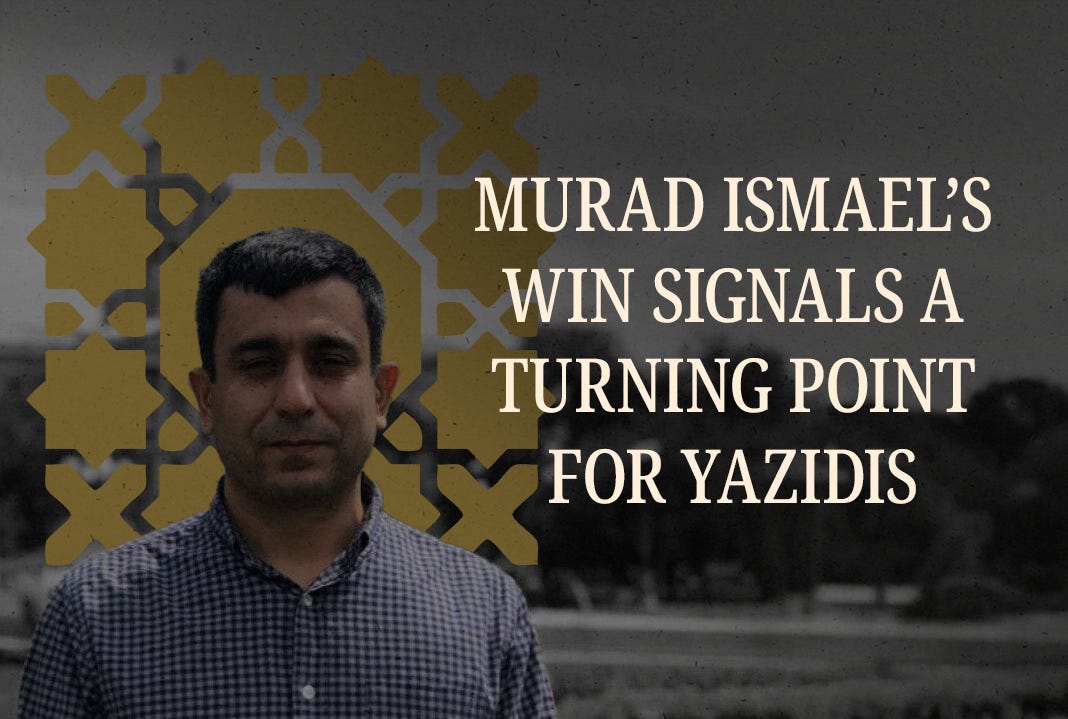
Eleven years after ISIS tried to wipe the Yazidis off Iraq’s map, Murad Ismael has pulled off one of the most unthinkable victories in Iraqi politics: winning a parliament seat with no party machine, no money, and a message that the world has forgotten Sinjar. Ismael didn’t plan to run for office. But years of stalled reconstruction, mass graves left untouched, and 150,000 Yazidis still in displacement camps pushed him into the race—and Yazidis showed up to vote. With a mandate built on trust, he is stepping into parliament with big goals and the broad support of the people he represents.
The engineer-turned-activist—best known for co-founding Yazda, elevating the testimonies of survivors like Nadia Murad, and launching Sinjar Academy with support from Ideas Beyond Borders—arrived in Baghdad this year not as an advocate or NGO leader, but as a newly elected member of parliament. His victory was fueled by a community that has waited more than a decade for justice.
And for Murad, the motivation to run can be traced to a single, stubborn fact: after all the promises, all the delegations, all the speeches before foreign governments, not enough has changed.
“We are eleven years after the genocide,” he says, “Internally Displaced Persons [IDPS] are still in camps. Sinjar has no functioning administration. Thousands remain missing. Even the mass graves are still not resolved. Our people have seen almost no progress.”
Since 2014, Murad has spoken before governments in Europe, the U.S., and the Middle East, making the case for Yazidi recognition, survivor support, and international accountability. He played a role in securing genocide recognition in more than a dozen countries. But at home, he watched his community lose political power, its representation diluted by Iraq’s quota-based system, changed in ways that allowed the largest parties to co-opt seats intended for minorities.
“Yazidis became very weak politically,” he says. “Our representation was hijacked.”
So when Yazidis formed their first unified electoral coalition, Murad submitted his paperwork almost on impulse. “I wasn’t serious at first,” he told Middle East Uncovered. “I just wanted to support the coalition.” But once he landed in Iraq, something shifted. His four-week annual leave from his job in the United States turned into a whirlwind of village meetings, camp visits, and conversations with displaced families who still live in tents a decade on.
In the weeks before the campaign gained traction, Murad also faced pressure intended to discourage him from entering politics. A politically charged arrest warrant, filed after he criticized the Migration Ministry’s handling of Yazidi IDPs, raised alarm among Yazidi organizations, who viewed the timing as a preemptive attempt to sideline a credible candidate. Despite this, Murad pressed ahead, and the effort to deter him only strengthened the depth of support he carried into the race.
By the time polls opened, it was clear the campaign had outgrown him. Crowds traveled from remote border posts, from IDP camps, from across Nineveh to cast a vote for someone they felt had already spent years fighting for them.
“People told me on the campaign trail, ‘You didn’t have to come. We would have voted for you anyway.’”
He spent only $1,000 of his own money plus a plane ticket. The rest came in small donations from Yazidis inside and outside Iraq. There were no billboards, no patronage networks, no bought votes. Elections in Iraq are often marred by cash and coercion, but Murad’s win stands apart as one of the highest vote counts in Nineveh province and among the top in the entire nation.
It was, he says, “historic—because it was clean.”
For Murad, winning the seat was the easy part. What comes next is a nearly impossible to-do list.
He represents a district that has had no mayor for eleven years, a region contested by national powers, militias, and neighboring states. He carries the hopes of 150,000 IDPs who want to go home but have no homes to return to. He speaks for families who still wait for news of 2,700 Yazidis still missing or in captivity. And he wants compensation for survivors whose lives were broken but never rebuilt.
“I have to meet the needs of my people,” he says. “With all my limited power.”
Iraq’s political system does not make that easy. Parliament is dominated by three major blocs—Sunni, Shia, and Kurdish—who divide the state among themselves. Minority MPs, no matter how strong their mandate, often struggle to be heard.
“I represent the Yazidi community with 23,000 personal votes, but that does not give me automatic power in parliament,” he says. “My challenge is to find alliances that match my values—human rights, rule of law, a functional state—and that also care about Yazidi recovery.”
He is already knocking on doors in Baghdad, seeking partnerships. “They won’t come to me,” he says. “I have to go to them.”
If political divisions between Baghdad and the Kurdistan Regional Government (KRG) have frozen Sinjar’s reconstruction for years, Murad believes the equation is now different. “We won more than 50% of the Yazidi vote,” he says. “That should mean something. It should give us a seat at the table.”
But he is honest about the obstacles. Turkish and Iranian strategic interests, national party rivalries, militia presence, and years of mutual distrust have turned Sinjar into one of the most complicated political files in the Middle East.
“I can’t promise success,” he says. “But I can promise to fight.”
Murad is part of a small but growing constellation of Iraqi voices, Hussam al-Haj among them, pushing for civil society, rule of law, and a politics not defined by sect or coercion. And like them, he is aware of the risks.
“Of course I’m concerned,” he says, “In Iraq, speaking openly can be dangerous. But I want to stay true to my values. I’m not a member of the establishment. I’m not here to create enemies. I’m here to find solutions.”
Nor does he intend to play the role of the perpetual activist.
“I’m here as a representative of my people. That means being practical. It means delivering results. It means working even with those I disagree with, because my community cannot wait another decade.”
He dreams of forming a bloc of like-minded MPs—not Yazidis, not Christians, not Kurds or Sunnis or Shia, but Iraqis who believe in human dignity, in anti-corruption, in governance beyond sectarian divides:
“Imagine twenty seats, twenty voices speaking together for a different kind of Iraq. You don’t have to be the same religion, the same ethnic group, or from the same region. You can simply be like-minded people who believe in human rights and citizens’ rights, who believe in an Iraq free of corruption—an Iraq that looks forward, not backward, and an Iraq that is big enough for everyone.”
Sitting in a Baghdad restaurant on Monday evening, Murad describes a country that is, in many ways, better than at any time since 2003. The streets feel safer. The economy, while unstable, is stirring. New cafes and businesses crowd the riverbanks. There is, he insists, a “new dynamic” in the air.
But Iraq’s stability is precarious. Wars in Ukraine and Gaza have pulled global attention away. International donors are stepping back. Oil prices fluctuate. Armed groups still test the boundaries of state authority. Climate pressures, especially catastrophic water shortages, are looming.
“Iraq still faces big risks,” he says. “But you also see the seeds of hope.”
He believes Iraq deserves to be seen not as a country perpetually on the verge of collapse, but as a nation with enormous potential: rich resources, culture, and human talent. It only needs space to breathe and leaders willing to earn trust.
He wants to be one of them:
“I want to show that politics in Iraq can be clean. You don’t need money. You don’t need militias. You don’t need corruption. You can win with a simple message: to be the voice of the people.”
He plans to run his office like an institution—transparent budgeting, local branches, staff tasked with actual public service. “I want to show what an MP should be,” he says. “Not someone who is here to make money, but someone who is here to serve.”
He does not promise miracles, but he does promise effort, integrity, and a long-term vision grounded in democratic values.
“Iraq must change from within,” he says. “And it must change one step at a time.”
For the people of Sinjar—for the survivors, the families waiting for news, the youth learning to code in crowded tents with unreliable electricity—that step begins with Murad Ismael taking a seat in parliament, carrying their hopes into the halls of a government that has too often ignored them.
“I will work for my people,” he says. “And for all Iraqis. I think these next four years could be the most important of my life.”
Middle East Uncovered is powered by Ideas Beyond Borders. The views expressed in Middle East Uncovered are those of the authors and do not necessarily reflect the views of Ideas Beyond Borders.
We as Yazidis, believe that Mr. Murad Isamel is the bright candle for us in this darkness which lasted 11 years.
That's quite a story of resilience and determination! Murad Ismael's victory sounds like a significant moment for the Yazidi community and a powerful statement about their enduring spirit. It's inspiring to see someone rise from such challenging circumstances to advocate for their people in parliament.