


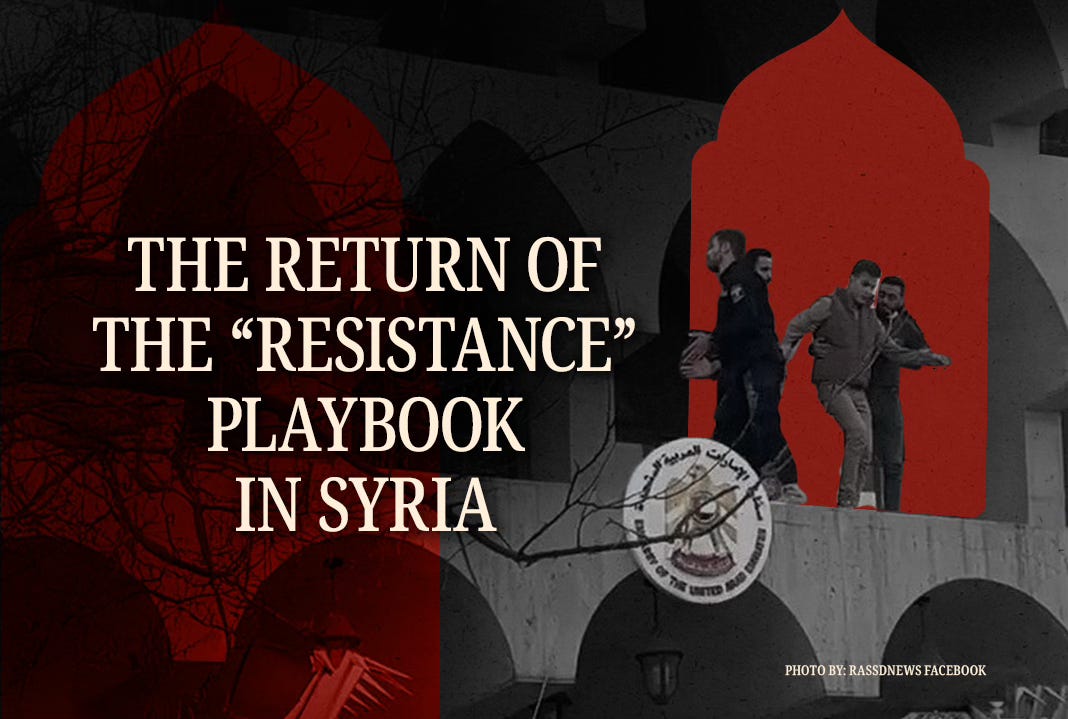
Recent weeks have brought new images of disorder to Syrian streets: protesters massing outside the American and UAE embassies in Damascus and in city squares across the country, demonstrators on motorcycles in Daraa attempting to rush the border with Israel before being turned back. To casual observers, these scenes fit a familiar template—an unstable post-revolutionary state losing its grip, streets filling with anti-Western sentiment, the transition unraveling.
That reading is not entirely wrong. But it is incomplete. What is playing out in Syria’s streets is not a spontaneous popular uprising against normalization or foreign influence. It is a performance—staged by a coalition of actors with distinct agendas, united less by shared conviction than by shared opportunity. Understanding who they are, what they want, and why this moment suits them is more important than the footage itself.
Among the most active participants in the embassy protests were members of Palestinian factions long resident in Syria, most prominently the Popular Front for the Liberation of Palestine – General Command. The PFLP-GC’s record in Syria requires no elaboration for anyone familiar with the country’s recent history: it backed Assad throughout the civil war, participated in the suppression of the Syrian uprising, and served as one of the regime’s auxiliary instruments of violence. It is not a liberation movement in any operative sense. It is a militia sheltering behind a cause—well, the Cause.
That shelter is now being reclaimed and renovated. The holy vocabulary of resistance—al-muqawama, al-qadiyya (the resistance, the cause)—is being deployed with renewed confidence, doing what it has always done: foreclosing accountability, immunizing its users from scrutiny, and allowing the reassertion of failed projects without any reckoning with their failure.
But the PFLP-GC is not alone in rediscovering the Cause’s lingering utility. They are all back—the Ba’athists, the Nasserists, the Syrian nationalists, the members of the Syrian Social National Party, the assorted ideological “whateverists”, and the residual Assadists who populate the left-nationalist spectrum of Arab politics. The fall of Assad, paradoxically, gave them oxygen: the regime in its final years had been suffocating its own base. Now the transitional government’s pragmatic engagements with Washington and its implicit accommodations with Israel have handed them the narrative they needed—betrayal, normalization, and the abandonment of the cause. They did not need to update their arguments. They only needed to dust them off.
None of these movements has undertaken any serious ideological reckoning with what they actually produced, not even regarding their own role in sustaining the Assad regime through more than five decades of repression and fourteen years of civil war. There is no accounting, no self-criticism, no apology, and no attempt to explain why their ideas and the institutions built around them failed, or what would be different this time. There is only the reassertion—louder now, emboldened by the chaos of transition—that the real problem was always imperialism, Zionism, reactionary tendencies, and the enemies of the Arab nation.
Among those rejoining the fray is a different kind of leftist: those who were part of the revolution from the beginning and watched with bitterness as it was forced into armed insurrection and then captured by Islamist factions flush with Turkish, Qatari, and Saudi funding. These are not Assadists. Their grievances against the hijacking of the revolution are real. But by boarding the anti-Zionism, anti-Americanism, anti-imperialism bandwagon now, they too are choosing the comfort of a sacred vocabulary over the harder work of reckoning with what went wrong and why.
The embassy protests have given all these currents a megaphone and a moment. Anti-Israel, anti-American, anti-Gulf, anti-normalization: this is the register in which the left-nationalist tradition feels most alive and most legitimate. It is also the register in which it most reliably avoids answering for itself. The sacred vocabulary does what it has always done: it elevates the argument to a plane where ordinary scrutiny cannot follow. The Cause is the vehicle. The destination is a return to relevance.
The pressure on Syria’s transitional government does not come only from outside its circles. Within the Islamist current that brought Ahmad al-Sharaa to power, there is growing consternation, expressed carefully, but unmistakably, about the pragmatic line he has chosen to follow.
Engaging Washington, tolerating rather than confronting Israeli military actions on Syrian soil, and accepting the constraints that come with international recognition. These are the calculated compromises of a leader who understands that Syria cannot afford another cycle of isolation and war. But to those who fought and bled under the banner of a different vision, they look like surrender dressed in diplomatic language.
The Muslim Brotherhood wants to recover the influence it considers rightfully its own. Radical factions—some inside the governing structure, some hovering at its edges—want to assert their presence before the transition hardens into an arrangement that leaves them marginal. Both can point to the same evidence: talks with Israel that yielded no tangible gains, painfully slow sanctions relief, and living conditions that have hardly improved since the fall of Assad.
What makes this moment structurally distinctive, and dangerous, is the convergence it produces. Islamist hardliners and leftist nationalists arrive from opposite ends of the ideological map, carrying irreconcilable worldviews, and find themselves marching toward the same intersection. The Palestinian cause, anti-Israel sentiment, anti-normalization, anti-American, anti-Gulf—this is the shared terrain where the two traditions meet without having to resolve their contradictions.
The transitional government finds itself, then, in a pincer: squeezed from without by spoilers exploiting the language of liberation, and from within by factions that supported its political rise but are losing patience with its compromises. President al-Sharaa’s room for domestic maneuvering is considerably narrower than the optics of his Berlin and London visits, or his reception of Ukrainian President Volodymyr Zelenskyy, would suggest. The performance of statesmanship abroad does not resolve the contest for legitimacy at home. And that contest is increasingly being waged in a vocabulary designed not to build Syria but to prevent anyone else from doing so.
Middle East Uncovered is powered by Ideas Beyond Borders. The views expressed in Middle East Uncovered are those of the authors and do not necessarily reflect the views of Ideas Beyond Borders.
Islamists always turn on leftists after they overthrow the established order. You'd think they'd learn at some point..