


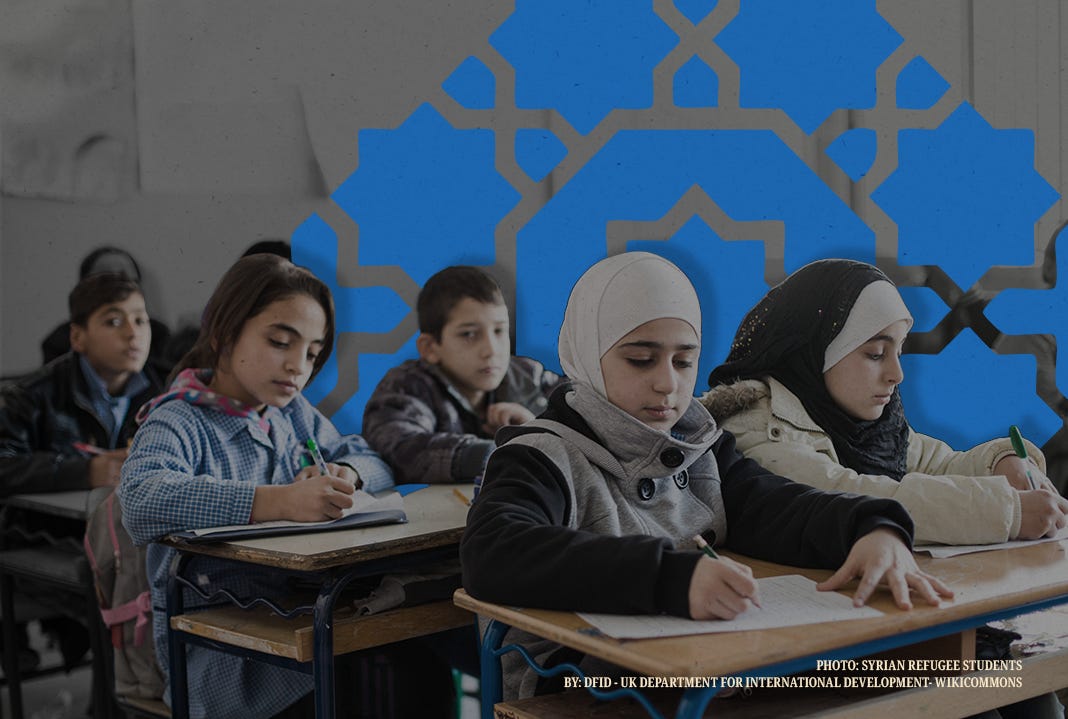
Syria’s new government is rewriting what children learn in school, and the changes are troubling. Under transitional president Ahmad al-Sharaa, the groups backing him are exerting influence across institutions, and Syrians who want a more open, inclusive society are struggling to make their voices heard.
Recent investigations have documented changes to Syrian school textbooks, including the addition of hijabs to illustrations of women, the removal of historical artworks, and the deletion of lessons about citizenship and democratic participation. An October study of 130 Syrian school textbooks by the education-monitoring organization IMPACT-se also raised concerns about the growing influence of Islamist ideology in the curriculum.
The Ministry of Education says it made the revisions in January 2025 to remove propaganda from the Assad era, although independent investigations have cast doubt on when the changes were made and how extensive they were. Either way, removing Assad’s propaganda only to replace it with the beliefs of those now in power is hardly an improvement.
Those of us who have lived through the process of Islamization know that it need not arrive through a dramatic constitutional declaration. It can creep in gradually, through small changes to what children learn in school, what women are allowed to do, and what people can say or express in public. Each decision may seem minor on its own, but over time, they can fundamentally change the kind of society people live in.
Some defenders of the recent changes invoke democracy and majority values. But their arguments betray a fundamental misunderstanding of both.
They assume that because most Syrians are Sunni Muslims, they must all share the same religious beliefs, values, and political views. But belonging to the same religious community doesn’t mean people necessarily think alike, want the same things, or vote the same way.
Even more concerning is what happens when a group in power claims to speak for the majority. It uses that claim to justify its authority and acts as though the country belongs to it, giving itself the right to impose its beliefs and values on everyone else.
We’ve seen this before in Syria. The Ba’ath Party claimed to speak for the country’s workers and peasants, presenting them as the true majority and using that claim to impose its own brand of Arab nationalism and socialism on the entire country. Now, under al-Sharaa and his former Hayat Tahrir al-Sham (HTS) associates, the state is increasingly being reorganized around a particular interpretation of Islam.
Neither the Ba’ath Party nor HTS came to power through democratic elections. But even if they had, winning an election wouldn’t give them the right to impose their beliefs on an entire country. Majority support doesn’t mean you get to decide how everyone else should live. Democracy also means protecting people’s rights, treating all citizens equally, and allowing different beliefs and opinions to coexist. That applies to public institutions too, especially schools, where children should receive an education that respects everyone, regardless of who is in power.
Al-Sharaa has shown that he can be pragmatic when dealing with foreign governments. At home, however, his power depends on an uneasy alliance of three groups with different priorities.
The first includes former jihadists and Salafis who have learned to adapt to political realities but still hold fundamentalist views about religion and society.
The second is made up of people who believe Syria’s Sunni majority should have the greatest say in how the country is governed. Their views are not necessarily driven by religion. Many are understandably motivated by years of repression under Assad, particularly during the past fifteen years, and a determination to ensure that Sunnis never lose political power again.
But having suffered under one government does not give anyone the right to dominate others under the next.
The third current comprises traditional Islamists and religious conservatives, including networks associated with established religious institutions. These groups are often considered moderate because they reject jihadist violence and defer to existing authority. But moderation in method does not necessarily entail liberalism in social outlook.
Traditionalist religious groups have historically opposed greater freedoms for women, artistic expression, and personal choices. They may disagree with Salafis on matters of religious doctrine, but when it comes to how people should behave in public, they often want many of the same restrictions. That leaves secular Syrians and religious liberals with fewer potential allies within the coalition than they might hope.
Al-Sharaa doesn’t have to agree with everything these groups believe. He just needs to keep them on his side. Allowing religion to play a greater role in government may be one way to do that. Keeping his conservative supporters happy may matter more to him politically than listening to secular critics, who are divided and have little organized political influence.
Assad relied on a similar arrangement, although the groups involved were different. His regime combined Ba’athist ideology with a system that increasingly favored his family and members of the Alawite community. Other groups went along with it for different reasons. Some feared the consequences of speaking out, others were simply trying to survive, and some saw opportunities to benefit from the system. Many may now be making similar calculations about how to deal with Syria’s new rulers.
Al-Sharaa’s ambiguity once allowed for competing interpretations of his intentions. His international pragmatism suggested that ideological flexibility might eventually produce greater domestic inclusiveness. That possibility has not disappeared entirely, but the accumulating evidence makes it increasingly difficult to interpret his silence in his favor.
Restrictions on alcohol sales, controversies over gender segregation and women’s participation, and the curricular revisions suggest a governing environment in which conservative religious preferences can increasingly acquire the force of public policy. These decisions need not constitute a centrally coordinated campaign. Administrative improvisation can produce ideological transformation without a comprehensive blueprint.
What matters is that al-Sharaa presides over a system in which executive authority remains concentrated and institutional safeguards are weak. His evolution increasingly resembles a transition from warlord to strongman. That does not make his government identical to Assad’s, but it raises concerns about the familiar dynamics of personalized rule.
A strongman needs an organized base and fragmented opponents. Al-Sharaa has both, and ample motivation to keep relying on them. Secular protests may occasionally embarrass his government, especially when amplified internationally. But sporadic demonstrations and individual criticisms are unlikely to substantially alter his political calculations.
If Syria’s secular and liberal forces want to change al-Sharaa’s political calculations and establish themselves as necessary partners in shaping the transition, they must overcome their differences and organize around a realistic and pragmatic political strategy.
This should be an organize-to-engage strategy, not an effort to build an opposition movement defined primarily by its hostility to the current authorities. Its objective should be to negotiate and institutionalize a form of governance in which neither religious conservatives nor secularists can use public authority to impose their worldview at the expense of others’ rights.
One reality should be clear by now: neither side is going to disappear from Syria’s political and social landscape, and neither will willingly accept permanent subordination to the other. We must either break the cycle of domination and oppression or bequeath its violence and injustices to future generations.
What Syria needs now is an organized civic political platform—not necessarily an ideological party at this stage—that brings together secularists, liberals, democrats, religious reformers, moderate conservatives, and independent professionals across communal boundaries.
Its unifying commitments should include equal citizenship, constitutional rights, freedom of conscience, women’s equality, political participation, institutional accountability, and the rejection of communal or ideological ownership of the state.
The platform should develop concrete policy proposals, starting with educational reform, and seek to engage both the transitional authorities and the international community wherever possible.
Waiting for the authorities to introduce a legal framework for political parties would be a strategic mistake. It would surrender political momentum while the governing coalition continues shaping institutions and public expectations. Civic coordination, policy development, professional networks, and lawful collective advocacy should begin now.
Al-Sharaa’s camp may currently feel little incentive to engage such a platform. But political arrangements change, and a serious civic movement must look further ahead than those preoccupied with consolidating their immediate advantage. It must articulate a future in which religious conservatives, secularists, minorities, and majorities all have a dignified place, without anyone enjoying privileged ownership of the state.
This is not fundamentally about opposing al-Sharaa or demanding his immediate removal, but about insisting on the right of all Syrians to participate in shaping the political, social, and economic arrangements governing their future and that of their children.
The end of Assad’s rule created an opportunity to escape a political order built on ideological monopoly and communal privilege. Replacing one form of ideological control with another simply puts power in different hands, leaving the underlying system unchanged. Those who believe in a civic Syria must organize before the emerging order solidifies into another system they will spend decades struggling to reform.
You might also be interested in:
The Damascus Alcohol Decree Was Never Just About Drinking

A government does not need to ban something outright to make its intentions clear. Sometimes it only needs to regulate it so tightly, so selectively, and so ideologically that the message becomes unmistakable. That is what happened in Damascus last week.
Middle East Uncovered is powered by Ideas Beyond Borders. The views expressed in Middle East Uncovered are those of the authors and do not necessarily reflect the views of Ideas Beyond Borders.