


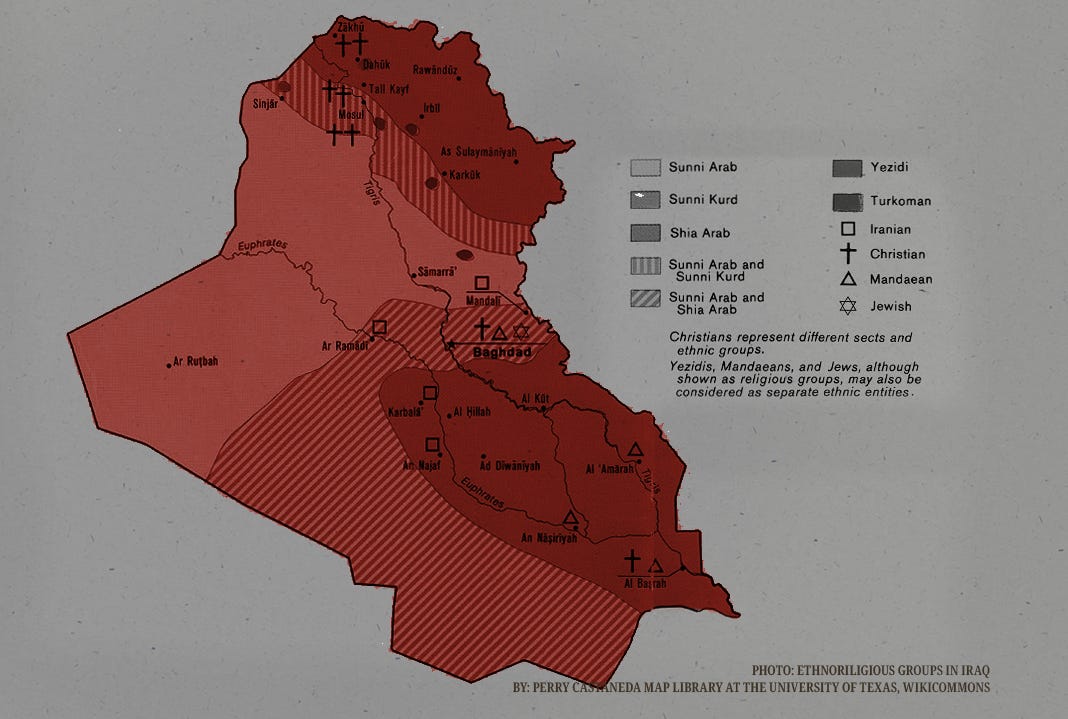
Growing up in Iraq, I learned a great deal about the histories and struggles of other countries. But I knew surprisingly little about the people who lived alongside me.
My generation was raised under an educational system that emphasized Arab and regional causes while neglecting Iraq’s own extraordinary diversity. We could discuss events in distant countries but knew little about the Kurds, Turkmen, Yazidis, Mandaeans, Christians, Jews, Shabaks, and Afro-Iraqis who had shared our land for centuries.
Under Saddam Hussein’s dictatorship, decades of political repression and forced assimilation marginalized communities whose histories did not fit the state’s preferred national narrative. Our textbooks presented an incomplete picture of Iraq, leaving generations unaware of much of their own country’s heritage.
When I published Minorities in Iraq: Memory, Identity, and Challenges in 2013, the response surprised me. The book became my most frequently reprinted work. As it turned out, people had an enormous appetite for knowledge about communities that have historically received so little attention in Iraq’s public discourse.
In 2014, I gifted a copy to the Syrian intellectual Michel Kilo. The next day, he told me he had stayed up all night reading it. He was struck by how much Syria and other Arab societies suffered from the same problem: people knew remarkably little about the diversity within their own countries.
Consider Baghdad’s Jewish history. For centuries, the city was a major center of Jewish religious scholarship and cultural production. Iraqi Jews contributed enormously to the country’s commerce, literature, music, and modern institutions. Sassoon Eskell, a Jewish Iraqi, served as the first finance minister of the Iraqi Kingdom and helped establish the foundations of its financial system.
Many Iraqis today know little about this history.
Or consider the Sabian-Mandaeans, followers of an ancient religious tradition associated with John the Baptist. For centuries, their community has preserved distinctive rituals, language, and craftsmanship. Mandaean silversmiths were renowned for their intricate metalwork, including delicate filigree techniques that was woven into Iraq’s artistic heritage.
These communities matter regardless of their size. Even as their populations decline, their religious and cultural traditions in Iraq live on.
The same is true of Iraq’s Christians, whose contributions to medicine, education, printing, and publishing helped shape the country’s modern intellectual life. In Mosul, ancient Christian communities once lived alongside Muslim neighbors, their churches and traditions forming an inseparable part of the city’s character.
When these communities decline or disappear, Iraq loses languages, professions, artistic traditions, historical knowledge, and the people who carried them forward.
The departure of Iraqi Jews in the mid-twentieth century, followed by successive waves of Christian and other minority emigration, diminished the country’s intellectual and economic life. Neighborhoods that once contained churches, synagogues, and mosques became less diverse. Traditions passed down through generations grew increasingly difficult to sustain.
As these communities shrink, younger generations have fewer opportunities to learn about their histories and traditions firsthand.
I have spent much of my academic career trying to understand what happens when societies forget parts of themselves. One of the most troubling consequences is how easily ignorance transforms into prejudice.
When people know nothing about their neighbors’ beliefs or histories, rumors and conspiracy theories fill the vacuum. Religious communities become objects of suspicion. Differences that were once accepted as normal are increasingly portrayed as threats.
We have seen the devastating consequences of such thinking. In 2014, ISIS attacked Yazidi communities in Sinjar and targeted Christians and other minorities across northern Iraq. Its campaign of violence was accompanied by the destruction of historical sites and cultural heritage, including ancient monuments at Nineveh and Nimrud.
The persecution of minorities was part of a broader assault on Iraqi society. The violence that devastated Sinjar and the Nineveh Plains also threatened the country’s wider security and stability.
This is why I have long argued that the treatment of minorities is one of the clearest measures of a society’s political health. When the rights of its most vulnerable citizens can be violated with impunity, everyone else’s rights become less secure.
But the problem cannot be solved simply by asking the majority to tolerate minorities. Tolerance can still imply that one group holds the authority to decide how much freedom another deserves.
A democratic society requires something more fundamental: equal citizenship. A Christian, Yazidi, Mandaean, or Muslim should enjoy the same rights and opportunities, regardless of how many people share their faith. No citizen should depend on the goodwill of a religious or political majority to belong in their own country.
I once spoke with the head of Iraq’s Sabian-Mandaean community, who complained that he had spent three years unsuccessfully seeking a meeting with the prime minister. I told him that a single tribe in southern Iraq might command more votes than the entire Mandaean population.
In this political system, a community’s size often carries more weight than its rights or historical significance.
During a visit to Afro-Iraqi neighborhoods in Zubair, near Basra, I saw photographs of Barack Obama and Martin Luther King Jr. displayed on classroom walls. Obama’s 2008 election had inspired members of this community, who recognized in the American civil rights struggle something of their own aspirations for equality and recognition.
Among their advocates was Jalal Dhiyab, an Afro-Iraqi civil rights activist who campaigned peacefully against discrimination before being assassinated in 2013.
How many Iraqis learn about him in school? How many know the history of Afro-Iraqis, whose presence in southern Iraq dates back to the 9th century during the Abbasid Caliphate?
These omissions shape how younger generations understand who belongs in their country.
For years, my work focused on academic research and books. Eventually, my university students began encouraging me to share that knowledge through social media. They started turning excerpts from my lectures and interviews into short videos, showing me that younger audiences were eager to engage with these subjects when the material was accessible.
Through House of Wisdom 2.0, I now help bring the histories of Iraq’s overlooked communities to Arabic-speaking audiences through digital content. An episode about the Turkmen, for example, challenged viewers’ assumptions by exploring the community’s religious and cultural diversity, including the existence of Christian Turkmen.
These discoveries may seem small, but they challenge stereotypes that have persisted for generations.
We cannot recover the communities and traditions that have already been lost. We can, however, document those that remain, teach their histories, and ensure that younger Iraqis understand the country they have inherited.
Iraq’s future depends partly on whether we can build a shared understanding of our past. That means recognizing the contributions of communities whose numbers may be small but whose place in our history is immense.
If we continue teaching children an incomplete version of Iraq, we should not be surprised when they grow up with an incomplete understanding of one another.
You might also be interested in:
The Ghost of 1941 Still Haunts Iraq

I write this from Baghdad, where April never passes quietly. It brings to mind 1941, when a coup d’etat led by Rashid Ali al-Gaylani and the “Golden Square” generals overthrew the pro-British Regent Abd al-Ilah. Seeking to break free from British influence and siding with the Axis powers, the new government triggered the 30-day
Middle East Uncovered is powered by Ideas Beyond Borders. The views expressed in Middle East Uncovered are those of the authors and do not necessarily reflect the views of Ideas Beyond Borders.

I don't know if you have read this week's article in the Free Press about the WW2 connection between Poland and Mosul. https://www.thefp.com/p/isis-mosul-omar-mohammed-nazi-holocaust-poland
A country should hold on to its history and remember it and Iraq has a far richer history than most.