


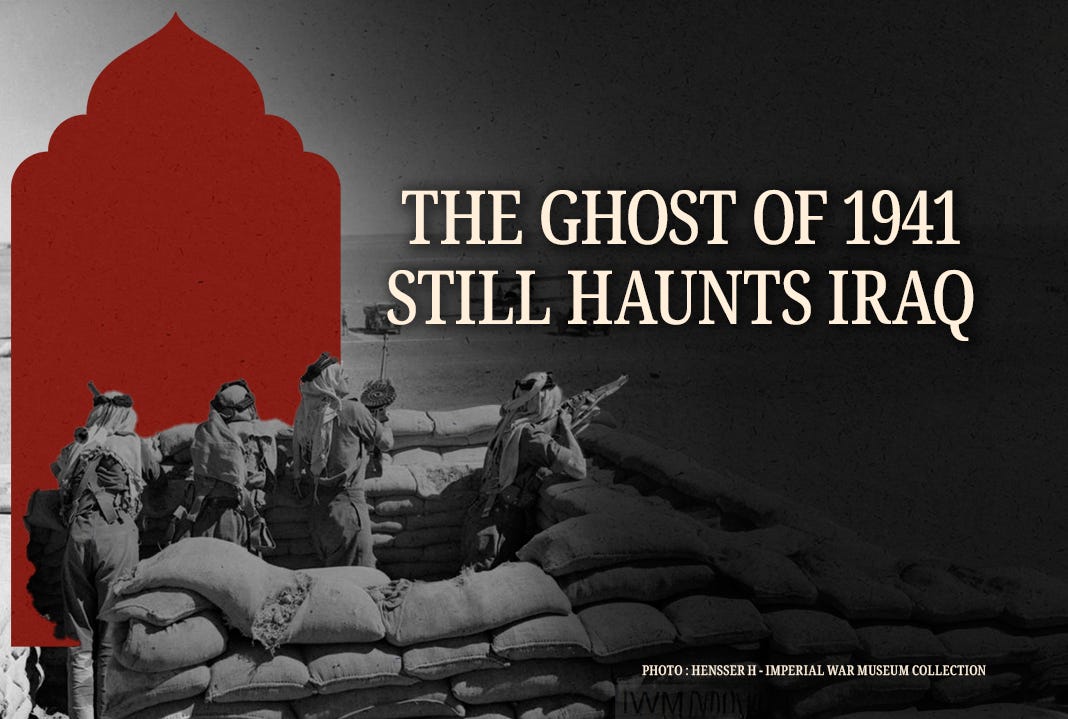
I write this from Baghdad, where April never passes quietly. It brings to mind 1941, when a coup d’etat led by Rashid Ali al-Gaylani and the “Golden Square” generals overthrew the pro-British Regent Abd al-Ilah. Seeking to break free from British influence and siding with the Axis powers, the new government triggered the 30-day Anglo-Iraqi War, which ended with British forces reinstalling the Regent in May.
Here, many still refer to it as a degga, a word Iraqis use for an impulsive act that ends badly. The label reflects how that moment is remembered not just as a failed uprising, but as a collision between ambition and poor judgment.
That episode was a defining moment in Iraq’s modern history. It exposed a recurring problem: attempts to assert independence without a clear grasp of the balance of power needed to sustain it.
In April 1941, with World War II upending global power dynamics, al-Gaylani tried to overturn the status quo and confront British influence directly. The mistake was not in resisting British control, but in choosing where to turn next. By moving toward the Nazi axis, he bet that global conflict would create an opening for Iraq. Instead, it triggered the Anglo-Iraqi War. It lasted four weeks and one day and ultimately ended in defeat.
The result strengthened British influence rather than weakening it. Iraq had aligned with a losing side without the means to defend that decision or protect itself from the fallout. The outcome was clear even at the time: misjudged alignment does not lead to sovereignty; it leaves the state more exposed and dependent.
I have spent more than two decades watching Iraq deal with the consequences of similar patterns. From here in Baghdad, the question has never been whether foreign influence exists. We all know it does. It is how deeply it penetrates the system, and how often decisions bend under pressures that are neither fully visible nor openly acknowledged.
It’s no secret that Iraq today has moved steadily into Iran’s orbit. This wasn’t the result of a single, deliberate decision, but was developed through uneven political relationships and the rise of armed groups that operate inside the state while maintaining loyalties in Iran.
These groups are formally part of Iraq’s structure, but they do not function like a unified national force. Many of them align more closely with Tehran than with Baghdad. This is a defining feature of how authority operates in the country.
In U.S. policy circles, Iraq is no longer seen as a stable anchor in the region. It is viewed as contested ground, where influence is shaped from outside and authority is divided within. That perception now drives how Iraq is handled diplomatically, economically, and strategically.
The cost of this position is already visible from here. It shows in declining international confidence, growing strain in Iraq’s relationships with Western partners, and in how Iraqi territory has become a space for proxy confrontation.
It is deeply embedded inside the political system. The repeated paralysis in forming governments is not only the result of domestic disagreement, but reflects external pressures corrupting the process. Competing powers shape outcomes from behind closed doors. Decisions that should be sovereign are delayed, redirected, or covertly realigned.
In 1941, Iraqi leaders acted under pressure from a larger global conflict, searching for an advantageous position within it. Today, Iraq operates under a different set of pressures, but the driving logic is similar. The country is again navigating between larger powers, feverishly seeking protection or leverage where there is none to be found.
In recent days, Iraq’s dominant political bloc has put forward a new prime minister after weeks of deadlock, while external pressure has intensified. Washington has moved to restrict dollar flows into Iraq, signaling growing frustration with the role of Iran-aligned armed groups inside the country. At the same time, security concerns have prompted warnings and partial evacuations linked to the risk of militia attacks.
None of this was borne out of a single decision, but through a series of accommodations that gradually narrowed Iraq’s options. What appears pragmatic in the moment often leads to dependence over time, trapping the state between a dominant global power and ideologically motivated, foreign-backed militias. The parallel to 1941 is not exact, but it is close enough to be useful. Then, Iraqi leaders misread their position and formed alliances without the means to sustain them. Today, the same dynamic is taking hold again, weakening Iraq’s position and limiting its future options.
From Baghdad, the problem is clear to those of us working toward a free and sovereign Iraq. The country does not lack options; it lacks the will to enforce them. Those in power are divided, operating within confines of their own making, as the line between national interest and external alignment continues to fade out of view.
Whether this pattern holds or gives way to something else will depend on what comes next.
Middle East Uncovered is powered by Ideas Beyond Borders. The views expressed in Middle East Uncovered are those of the authors and do not necessarily reflect the views of Ideas Beyond Borders.

Great piece! The 1941 Iraqi Revolt is such an understudied piece of Middle Eastern history, at least here in the West!