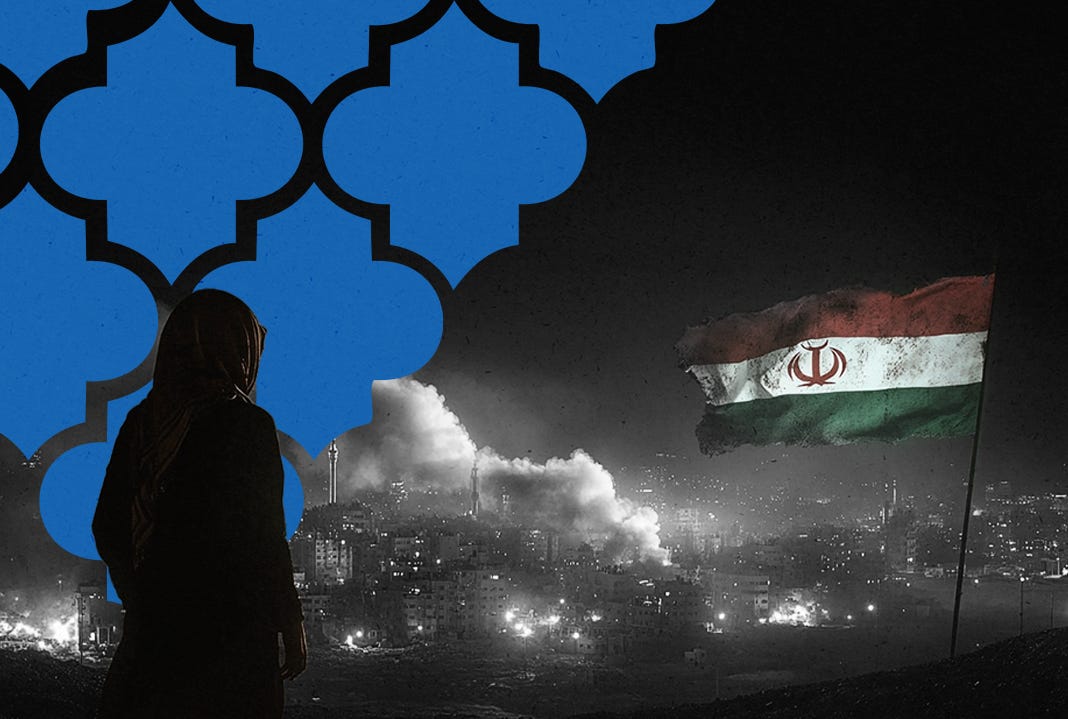
The Iranian Regime Will Fall
The Islamic Republic may endure protests for now, but treating it as a permanent fixture of the regional order ignores mounting evidence of irreversible decline.
The Iranian regime will fall. Whether this happens soon or further down the line remains uncertain, but the overall trajectory is becoming increasingly clear. Authoritarian systems rarely unravel because of a single protest or economic shock. They fail because they accumulate opposition faster than they can contain it and wear out the narratives that once sustained their legitimacy. The Islamic Republic of Iran is now well into that stage.
For years, Tehran framed its isolation as the result of principled resistance against Israel and the United States. That framing no longer holds. Iran did not merely antagonize Washington or Tel Aviv; it systematically alienated much of its own region. Today, its challenge is not external pressure alone, but regional estrangement layered on top of internal decay.
Across the Arab world, public opinion has shifted in ways that are difficult to reverse. As someone who studies and works closely on Arab public opinion, I have witnessed this change firsthand. The decisive rupture did not come from Israel, normalization agreements, or Gulf rivalries. It came from Syria. By standing unequivocally with Bashar al-Assad during the Syrian civil war, Iran tied its regional identity to mass repression. For millions of Arabs, Iran ceased to be a symbol of resistance and became an accomplice in the deaths of tens, if not hundreds, of thousands of mostly Muslim civilians. No invocation of Palestine could erase the images of barrel bombs, sieges, and chemical attacks carried out by a regime Iran helped sustain.
In 2017, Saudi Crown Prince Mohammed bin Salman compared Iran’s leadership to Hitler, capturing the depth of regional hostility at the time. While rhetoric has softened since the China-brokered Saudi-Iran agreement, the underlying mistrust has not dissipated. It has merely been managed. Tensions continue to surface, whether in Yemen, maritime disputes, or unresolved issues involving Emirati territory. De-escalation reduced immediate risk, but it did not produce reconciliation.
Since 1979, the Middle East has been radicalized in waves, and Iran has been a central driver of that process. By exporting revolutionary ideology, arming militias, and embedding proxy warfare into regional politics, Tehran helped normalize permanent conflict as a tool of governance. For a time, this strategy allowed it to wield influence. Over time, it has exhausted the region and its people. Societies that once romanticized defiance now associate ideological warfare with stagnation, sectarianism, and endless instability. The appeal of revolutionary slogans has steadily given way to demands for normal life, economic opportunity, and political dignity.
Iran attempted to compensate for its regional behavior by positioning itself as the moral champion of the Palestinian cause, while dismissing Arab states that pursued pragmatic arrangements with Israel as weak or submissive. But moral posturing has limits. It cannot indefinitely offset repression at home, economic collapse inside Iran, and bloodshed across the region. Championing a just cause does not grant immunity from accountability elsewhere. Over time, even sympathetic audiences recognize the contradiction.
The protests erupting inside Iran today are real, courageous, and rooted in long-standing social and economic frustration. But whether this particular wave will bring immediate change remains an open question. The Islamic Republic has spent decades preparing for unrest. It has built a dense security apparatus, learned how to divide the opposition, and mastered the art of survival. Protest alone does not topple regimes that have institutionalized repression.
Yet regimes do not survive indefinitely once legitimacy erodes across multiple fronts. Iran now faces a convergence of pressures it has never fully confronted at the same time: a younger population with no emotional investment in revolutionary mythology, an economy that can no longer purchase obedience, a region that increasingly views Tehran as a destabilizing liability rather than a leader, and an ideology that relies on coercion because persuasion has failed.
This reality should serve as a warning to policymakers. Treating the Islamic Republic as a stable, permanent fixture of the regional order is no longer a neutral assumption, but a strategic gamble. So is the belief that short-term de-escalation, tactical diplomacy, or managed containment can indefinitely substitute for long-term thinking about the regime’s fragility and post-regime consequences.
The danger is not that the Islamic Republic will suddenly collapse tomorrow. The danger is that, absent serious preparation, the regime will decay into something more erratic, violent, and externally disruptive before it falls. States in terminal decline do not become moderate. They become reckless.
The Islamic Republic may survive another protest cycle. It may even survive another decade. But it is governing against the grain of its own society and against the trajectory of its region.
When the system finally breaks—and history suggests it will—those who planned only for its survival will find themselves least prepared for its end.
Middle East Uncovered is powered by Ideas Beyond Borders. The views expressed in Middle East Uncovered are those of the authors and do not necessarily reflect the views of Ideas Beyond Borders.


Don't you think that China will agressively support the scarse oil producing countries free from US management, after their cut of Venezuela??