


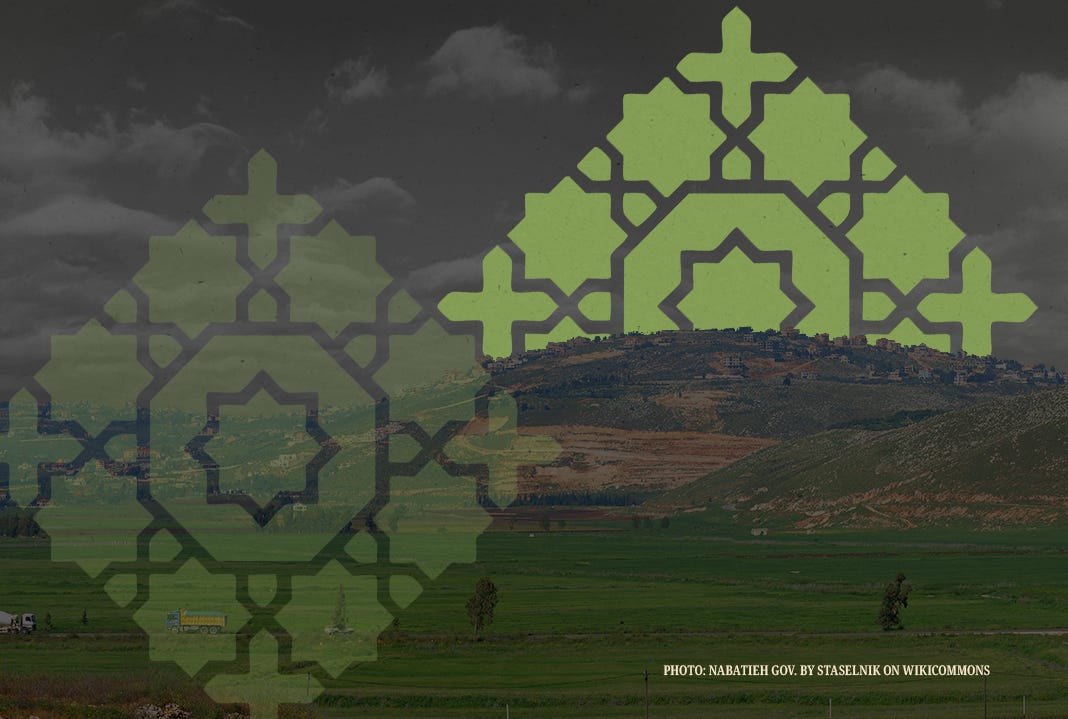
Last week, reports began to circulate in Western media about a looming confrontation over control of the Ali al-Taher Hills and Hezbollah’s underground tunnel network beneath them in southern Lebanon. The region braced for an escalation in the fighting between Israel and Hezbollah, but it never came. Israel simply announced it had gained operational control above and below ground. Western media, after contributing to the hype around it, all adopted the same basic framing. Israel had captured a major Hezbollah fortress and dealt the group a serious strategic blow.
So how did a position Hezbollah vowed to defend and refused to hand over to the Lebanese Army, and that Iran threatened to help protect, end up in Israeli hands without the confrontation all sides had prepared the public to expect? Was it really that important?
Claim: Ali al-Taher was a “strategic Hezbollah fortress.”
The New York Times referred to it as a “Strategic Hezbollah Fortress.” Fox News described it as a “major Hezbollah and Iran stronghold” whose capture inflicted a “severe blow” to Iran’s regional network. The Associated Press repeatedly described Ali al-Taher as a “strategic hill.” The Soufan Center went further, describing it as a “mini Pentagon” that houses Islamic Revolutionary Guard Corps (IRGC) and Hezbollah commanders.
Verdict: Partially true, but overstated.
Ali al-Taher rises roughly 600 meters and overlooks key routes and positions across southern Lebanon. It is clearly a valuable military position.
But calling it “strategic” or a “game changer” is a stretch. Its loss deprives Hezbollah of the high ground, infrastructure, and local supply routes, but there is no evidence yet that its capture has dealt a blow to Hezbollah’s already crippled command structure, missile arsenal, or ability to continue fighting. Hezbollah’s strategic ballistic missile arsenal was not housed there. It wouldn’t make sense to store your strategic assets a few hundred meters away from your enemy’s position.
Claim: Hezbollah planned to use Ali al-Taher to launch an October 7-style attack.
Fox News reported that Ali al-Taher was one of Hezbollah’s “key offensive bases to plan an invasion of Israel,” citing Israeli analyst Amit Segal, who claimed it was intended to be used to coordinate an attack by Hezbollah in Galilee.
Verdict: Unsupported.
The hills’ geography clearly makes Ali al-Taher useful for surveillance and missile launches. But no independently verified evidence has been published demonstrating that the complex was specifically the command center for a planned October 7-style invasion.
They are situated around 15 kilometers from the Israeli border, meaning Hezbollah fighters would need to drive for at least half an hour just to reach the border, and considerably longer to reach cities in the Upper Galilee. In such a highly monitored area, that would hardly be practical. For a site supposedly central to plans for an October 7-style invasion, it is striking that this claim did not surface earlier. It only appeared publicly last week, and no independently verified evidence has been released to support it.
The Israeli assessment was the sole foundation of Fox’s explanation.
Claim: Israel’s capture of Ali al-Taher was a major military victory.
Fox News said the capture was “stunning.” The New York Times presented it on September 3 as the clearing of a “major underground fortress.”
Verdict: Misleading.
Nobody was stunned. Operations in Ali al-Taher began in June, and multiple sources concluded they had operational control of the complex entrance weeks before the announcement. The announcement itself may have been stunning, but the capture was not. And as we’ll see, the story behind it is far more interesting.
Before its fall, Washington sought to have Ali al-Taher transferred to the Lebanese Army’s control. The Associated Press reported that Hezbollah rejected the proposal.
Hezbollah officials publicly insisted they would not abandon the position. Its fighters supposedly remained in “full control,” and a major Israeli assault was portrayed as something that would force a much wider confrontation. Yet it never came to pass.
Hezbollah’s narrative shifted from vowing to defend Ali al-Taher to disputing Israeli control, and eventually, after its loss, arguing that the position was not strategically important after all.
That is wartime propaganda at its best. Before losing it, Ali al-Taher was worth refusing a transfer to Lebanon’s own army. After Israel took it, its importance suddenly diminished.
The more interesting question is why the promised epic battle never materialized.
Reuters revealed that Tehran had warned Washington via Oman that an Israeli offensive against Ali al-Taher would provoke a large-scale Iranian attack. The report also said more than a dozen IRGC personnel, including senior officers, were believed to be stationed at the ridge alongside Hezbollah.
Israel ultimately took Ali al-Taher; Iran never followed through on its threat, and the reported Iranian personnel either vanished or were never there in the first place.
So what actually happened?
Perhaps Iran threatened retaliation and simply backed down. Another possibility is that Israel’s slow encirclement avoided the frontal offensive Tehran had defined as its red line, allowing the Iranian personnel to escape. But if they were there, how did they get out? Israeli forces were already stationed at the southern entrance to the complex and kept the northern entrance under heavy surveillance around the clock.
There is a third possibility. Before the Israeli takeover, Lebanese media had already reported negotiations over the evacuation of Hezbollah and Iranian personnel and the transfer of Ali al-Taher to the Lebanese Army. Other reports suggested Hezbollah was seeking such a withdrawal as its ability to hold the position weakened.
No secret arrangement has been proven. But with the reported Iranian personnel gone, Iran’s threatened response nowhere to be seen, and the expected battle never taking place, asking whether a deal was reached is hardly conspiratorial. Whatever happened behind the scenes, the outcome was politically useful for Israel.
On October 27, Israel will vote in a consequential election.
Prior to announcing victory over the hills, Former UNIFIL spokesman Andrea Tenenti told Reuters: “Before the elections, Israel needs a big win.”
The unanswered questions surrounding the capture make a political explanation more plausible. Hezbollah saved its fighters, Iran got its commanders out, if they were there at all, and Benjamin Netanyahu got the victory he needed ahead of the election.
Hezbollah could not expose such a deal without risking serious backlash from supporters after months of promising continued resistance, while Netanyahu would have every incentive to present the outcome as a purely military triumph. No proof shows such a bargain occurred. But taken together—the missing Iranian personnel, Tehran’s unfulfilled threat, Hezbollah’s retreat from its earlier rhetoric, and the useful electoral timing—the possibility deserves far more scrutiny than it received.
Middle East Uncovered is powered by Ideas Beyond Borders. The views expressed in Middle East Uncovered are those of the authors and do not necessarily reflect the views of Ideas Beyond Borders.

I found this piece very interesting, I hadn’t heard of this situation before. Definitely highlights the diminished capacity of Hezbollah, and its ability to deter Israeli aggression. Great work :)
Who cares as long as it helps get rid of Hezbollah…. There’s a reason why the vast majority of Lebanese people want them gone… They are sick and tired of having their lives destroyed the further Iranian policy
As far as your premise goes about it not being a big deal… Straight Iranian propaganda… They have been working on that mountain for 20 years