


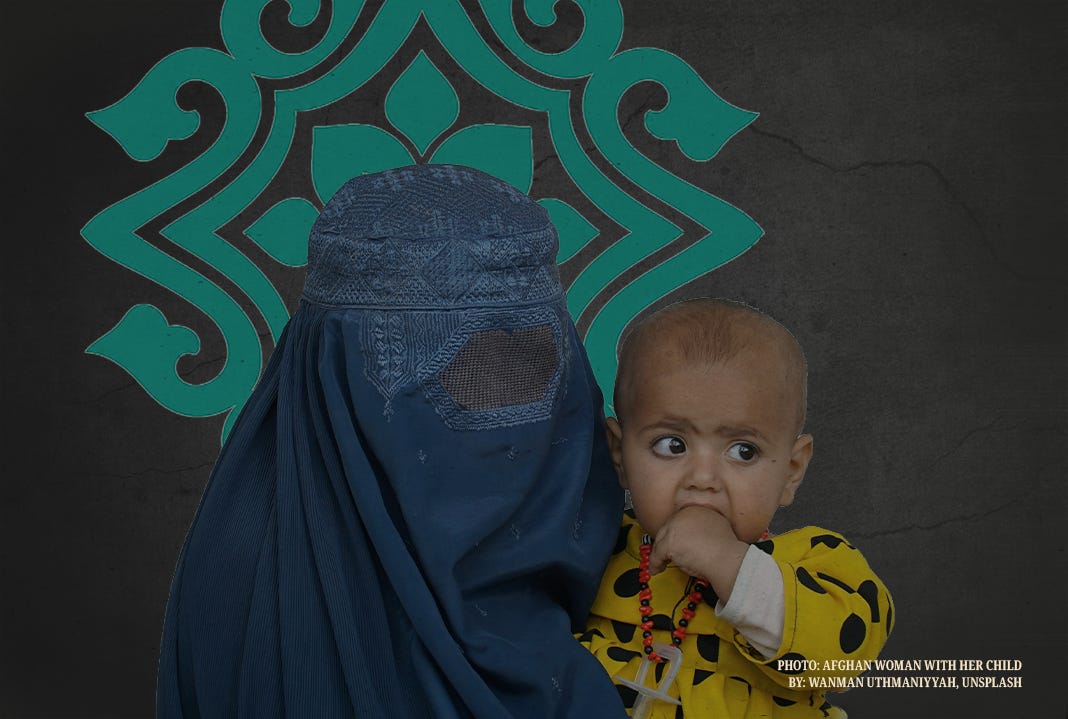
On a frosty morning in November 2021, in the early months after the United States-backed government fell to Taliban rule, I walk into the mottled, rundown halls of Kabul’s Indira Gandhi Children’s Hospital. Three male doctors with greying hair and weary eyes amble in and out, struggling to keep up with the impossible demand.
In a room that reeks of antiseptic and fried food, Nafisa fights to open her fluttering eyes. She is only five months old, but her pink skin, stretched tight over her gaunt frame, gives her the frail air of someone far older. Her cheeks, which should be full and warm, are gouged by hunger.
A doctor named Ahmadullah scans her chart and squares his shoulders, putting on a brave face in a job that should bring more light than dark.
“Nafisa has swelling, edema, an upset stomach, and wasting muscles,” he tells me. “She is five months old, but she looks a year old. Children with malnutrition age fast.”
Her young mother, almost as slight as the baby she nurses, watches with a numb, exhausted gaze.
“She lost her appetite. She lacks blood,” the mother says flatly. “It’s been six days here.”
Nafisa is not alone in her fight to survive.
I thought then that I was watching rock bottom. Five years on, I know better.
Afghanistan has long been one of the most dangerous places on earth to give birth. That autumn, a chart at Kabul’s Malalai Maternity Hospital laid out the monthly toll. Out of roughly 1,500 births, 41 were stillborn, 18 newborns died, and at least two mothers didn’t survive. Today, the World Health Organization estimates that an Afghan mother dies from preventable complications every hour.
For years, the trend went the other way. Plenty of donor money vanished into corrupt pockets, yet women still stopped dying at the rate they once had. Earlier United Nations estimates put maternal deaths at 1,346 per 100,000 live births in 2000, in the final stretch of the Taliban’s first rule. By 2020, the number had dropped by about half. The World Health Organization’s most recent figure stands at 521. Now those hard-won gains are slipping away, pulled apart by the Taliban on one side and by the West on the other.
The first blow came from the Taliban. In December 2024, the shadowy supreme leader, Haibatullah Akhundzada, ordered women out of nursing and midwifery institutes, the last door into medicine still open to them. About 35,000 women were enrolled in the affected institutes. Girls had already been barred from secondary school, and women from universities. In Afghanistan, midwifery is an entirely female profession and custom forbids most men from examining a woman. The regime has decided that the next generation of mothers will give birth with no one trained to catch their babies.
Then it made it even harder for women to reach care. In October, the UN mission in Afghanistan reported that vice inspectors were stopping women from entering health facilities without a mahram, a male guardian. On August 8 in Parwan Province, two women were turned away from a health facility for exactly that reason. Earlier this year, morality police in Uruzgan, Paktia, and Kandahar told facilities not to treat unaccompanied women and told female health workers to travel with a guardian, too.
The second blow came from Washington and the donor capitals that followed its lead.
Once American funding froze in early 2025, the clinics the Taliban hadn’t touched began closing anyway. Nearly 600 health facilities have been shut or suspended, cutting off about four million people. Humanitarian aid to Afghanistan fell almost 70 percent, from $3.27 billion in 2022 to $1 billion in 2025. By midsummer this year, only $438 million had been secured. Among the losses are Family Health Houses, small rural posts, some run by a single midwife. For many village women, they were the only care they ever saw.
Deported Afghans are pouring into this hollowed-out system. Some 2.9 million returned from Iran and Pakistan in 2025, and the UN projected another 2.7 million between April and December of this year. More than half are women and children, and many of the women arrive pregnant. Meanwhile, 3.7 million Afghan children under five are acutely malnourished. I have seen what that does to an infant’s face, and to the mother, who is almost always starving first.
The projections are grim. UN Women warns that the education ban alone could raise maternal mortality by at least 50 percent. A Johns Hopkins modeling study published in August projected up to 4,509 additional maternal deaths and 10,864 additional newborn deaths through 2035. One epidemiologist told me she gives it one to two years before “extreme deaths during childbirth” become visible.
They already are. In Ghor Province, a 23-year-old bride named Sima developed gestational diabetes in her first pregnancy. Routine prenatal care would usually have caught it, but she had none. She gave birth at home without a midwife, and both she and her baby died.
In Washington and European capitals, Afghanistan’s maternal crisis is usually blamed on the Taliban alone. The regime did bar women from classrooms and clinics. However, the closures of rural maternity posts came after donors pulled their money, and that decision was made in the West. For a woman in labor on a mud floor in Daikundi or Ghor, hours from the nearest hospital, it makes little difference which one shut the door.
Shatha Elnakib, a researcher I spoke to from the Johns Hopkins Bloomberg School of Public Health, points to thousands of trained Afghan midwives who are now unemployed. Rehiring them, with refresher training for those who have been out of practice, would have an immediate effect, she explains. Aid groups have also urged donors to fund Family Health Houses directly, with the money tied to whether women can get care rather than to recognition of the Taliban. Russia, Qatar and others already deal with Kabul, but reopening the midwifery schools has yet to become a serious item in those talks.
What haunted me most in that Kabul ward five years ago was the silence. I wanted to hear the babies cry, the kind of roar that my own babies let out as they emerged earthside.
Unless the world acts, Afghanistan will grow quieter still.
You might also be interested in:
Afghan Women Recall Childhoods Cut Short by Forced Marriage

Translation for this interview was provided by Ahmad Mansoor Ramizy. Middle East Uncovered uses pseudonyms to protect sources living in Afghanistan.
Middle East Uncovered is powered by Ideas Beyond Borders. The views expressed in Middle East Uncovered are those of the authors and do not necessarily reflect the views of Ideas Beyond Borders.