


Translation for this interview was provided by Ahmad Mansoor Ramizy. Middle East Uncovered uses pseudonyms to protect sources living in Afghanistan.
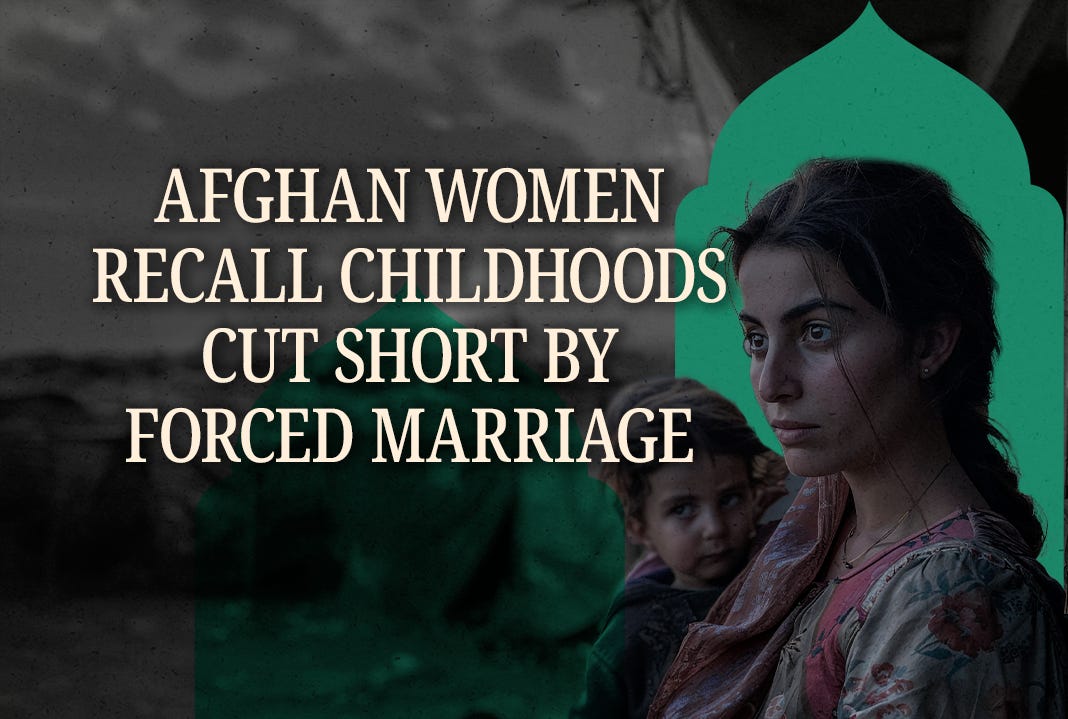
When Nadia was 14, her father told her she was getting married. A night watchman in Kandahar province, he had met a man through work—a nearly 30-year-old driver who offered 400,000 Afghanis, about $4,600, in exchange for his daughter.
“My mom was very sad; she was crying a lot,” she said. “I didn’t know what was happening, or what marriage was.”
The family had been living in crushing poverty. Nadia remembers a time when they all slept in a tent.
With this substantial lump sum, Nadia’s father was able to acquire a property through a system called qabza, in which a person pays a certain amount of money to the owner in exchange for living in the property rent-free for a set period. At the end of the term, the landlord returns the full deposit.
“My dad told me, ‘I don’t have a house or somewhere to stay. I have to marry you off.’”
Today, at 20, Nadia has two children and speaks with an ambivalence that reflects the impossible calculations many Afghan girls are forced to make.
“On the wedding day, I was afraid,” she says. “But at the same time, I was happy that my family would be better off. They would have somewhere to live.”
Afghanistan has long struggled with child marriage, forced marriage, and the practice of families selling off their daughters.
According to Girls Not Brides, 29 percent of Afghan girls marry before the age of 18 and 10 percent before the age of 15.
Since the Taliban’s takeover in 2021, poverty has worsened dramatically, pushing millions deeper into hunger and insecurity. According to Too Young To Wed, 95 percent of Afghans are not consuming enough food, which has increased the likelihood that more girls will be sold into marriage.
Meanwhile, the list of human rights violations against Afghan women and girls continues to grow.
In interviews conducted by Middle East Uncovered, three women from Kandahar described a system sustained not only by desperation but by tradition, family pressure, honor culture, misogyny, and the belief that daughters are mere assets to be transferred.
Far from a recent phenomenon, selling daughters is an old Afghan tradition. The difference now is that the Taliban has legally endorsed this practice.
Sara was sold at the age of 17 to a man twice her age to pay for her father’s medical treatment.
Her mother died when she was five, and her father had gone on to remarry a widow in her thirties. The marriage itself was transactional—her older sister, only six years old, was effectively exchanged and promised to the widow’s son.
Another custom under traditional tribal law (part of Pashtunwali) is badal, which is the exchange of pairs of blood relatives in marriages between families to resolve conflicts or to avoid paying a dowry if a family can’t afford it.
Sara’s own marriage came later, after her father became seriously ill and needed money for treatment.
“He sold me for 330,000 Afghanis ($5,600),” she says. “When they told me about it, I couldn’t eat. I was crying all the time.”
Two months after the wedding, her father died.
Her husband, 40, works shining shoes. Sara became his third wife after one wife died during childbirth, and he divorced another due to her “mental health issues.” Sara believes he married her because he wanted children and needed someone to care for his elderly mother.
“For the first few weeks, I cried every day,” she says. “My in-laws would tell me. ‘This is your destiny now.’”
Despite the beatings she gets from her husband and the abuse from her mother-in-law, Sara still thinks this is better than the life she had growing up.
“At least in my husband’s house I can eat properly,” she says. “I have some control.”
Her childhood home had been harsh, especially with the new step-mother. Sara described being sent on errands at dinnertime so food would be gone when she returned; sleeping on a cold kitchen floor in winter; and watching step-siblings receive new clothes for Eid while she wore cast-offs collected from other homes. She wasn’t even allowed to go to school, spending her days cleaning the home and looking after her step-siblings.
Her view of fathers who marry off daughters is blunt. Asked if she feels any sympathy, she replied: “This tradition treats girls as belongings of men, and that the sooner you get rid of your daughter once she hits puberty, the better off you are.”
She described intense social pressure around girls’ sexuality and family honor. If a family doesn’t get their daughter married off early, “They blame the mother or accuse the girl of having a secret relationship,” said Sara.
For Zakira, another woman from Kandahar, poverty explains only part of why this happens.
Her sister’s husband, she says, sold six of his daughters, aged around 12 and 13, to much older men in their 40s, 50s, and even 60s.
“My sister’s husband was a bricklayer, and his work was seasonal,” Zakira said. “But this was not only about money.”
Her brother-in-law regularly attended bandars—male gatherings where men disappear for days to socialize, gamble, and use drugs—and often returned having made major decisions about family life, without consulting his wife.
“When the eldest daughter was 14, he came home and told my sister he’d married her off,” Zakira said. “There were so many arguments and fights.”
While her sister opposed the decision—the couple would regularly argue and fight—she had little power to stop it.
“My dad was old. We didn’t have an older brother,” said Zakira. “No one listens to women.”
She remembers the engagement day of one of her eldest nieces, and it was horrible: “Everyone around her was crying and shouting. But she was confused. She didn’t know what a husband or marriage was.”
Another niece was married to a 45-year-old man in Karachi.
“When she came back, she cursed her father,” Zakira says. “She said, ‘He ruined my life. He married me to a grandfather.’”
Like Sara, Zakira rejects the notion that all fathers who marry off daughters are victims of circumstance.
“I’m sympathetic to fathers struggling to make ends meet,” she says. “But not my brother-in-law. He was lazy. He saw his daughters as quick cash.”
Nadia still struggles with what happened to her. Though her husband is not abusive, she wishes she had been old enough to understand what was happening.
“I should have waited until I was mature enough,” she says.
What troubles her most is how normalized the practice remains.
“Even when families aren’t poor, they still do it,” she says. “People say it is tradition or religion. They think it is shameful for girls to stay home after puberty.”
All three women describe girls too young to understand marriage being treated as though consent were irrelevant, or assumed.
Under the Taliban’s horrifying new rules, child marriage has effectively been legalized. A girl who later says she was married against her will won’t be permitted a divorce if her husband disagrees. The regulations also state that the silence of a “virgin girl” may be interpreted as consent to marriage.
It has legalized child rape.
“Silence is never consent for children who are too young to understand,” said Sara. Some mothers try to intervene quietly, the women said, hiding their daughters with relatives in desperate attempts to delay marriages. Many, however, fail.
They also described girls running away, fleeing to other provinces, and accepting permanent estrangement from families to escape forced marriages. Some, they said, resort to suicide.
According to Afghan Witness, an independent open-source investigation project, there has been a surge in female suicide rates linked to forced marriages since the Taliban takeover.
Things did improve for women and girls after the US-led invasion. In 2009, during the US occupation, Afghanistan passed the Law on the Elimination of Violence Against Women (EVAW), which guaranteed penalties for domestic violence, abuses against women, and forced child marriage. The legal age of marriage was 16 for girls and 18 for boys.
However, in places like Kandahar—the power base of the Taliban—the law wasn’t always enforced.
“If you complained to the police, the families would simply say, ‘This is a personal matter.’ At most, they would be jailed for a day or two before being bailed [out], if the police were bribed,” She explained. “Now the Taliban are 100 percent on the side of these men.”
Her fear is for the next generation of girls who have even fewer options.
“We don’t want the lives of the next generation ruined like ours,” Sara said quietly.
Nadia, meanwhile, spoke with the quiet pragmatism of someone holding two difficult truths at once—gratitude that her family escaped poverty, and grief at what it cost.
She was a child who did not understand marriage, a daughter exchanged for survival.
Now a mother herself, she simply said: “I wish I had been old enough to know what was happening.”
Middle East Uncovered is powered by Ideas Beyond Borders. The views expressed in Middle East Uncovered are those of the authors and do not necessarily reflect the views of Ideas Beyond Borders.