


February 11th marked the 47th anniversary of the Islamic Revolution in Iran, which deposed the late Shah Reza Pahlavi and replaced the monarchy with the clerical leadership system in place today. The upheaval unfolded alongside parallel developments in neighboring Afghanistan. In April 1978, Soviet-backed factions within the Afghan military toppled Afghanistan’s first democratic republic and established a so-called “people’s state” in a pro-communist coup. What many people don’t know is that it wasn’t until 1979, possibly due to the Islamic Revolution in Iran, that we saw massive uprisings against the regime in Afghanistan.
Major political upheavals rarely remain confined within national borders. The war in Syria reshaped demographics and security dynamics across neighboring states. The Rwandan genocide destabilized much of Central Africa. The Iraq War altered political calculations throughout the Middle East. Even disasters such as Chornobyl carried consequences well beyond their point of origin.
In the Middle East today, we often see revolutions, coups, and uprisings that encourage, instigate, and even incite change in countries with similar mindsets.
Afghanistan, like Iran, is governed by clerical and hardline Islamist authorities that exert broad control over political and social life. The systems differ in style and structure—Tehran presents a formal state with electoral trappings, while the Taliban rule through a more rigid emirate—but both draw legitimacy from an uncompromising interpretation of political Islam. That ideology has shaped much of the region’s turmoil over the past century and continues to influence its trajectory today.
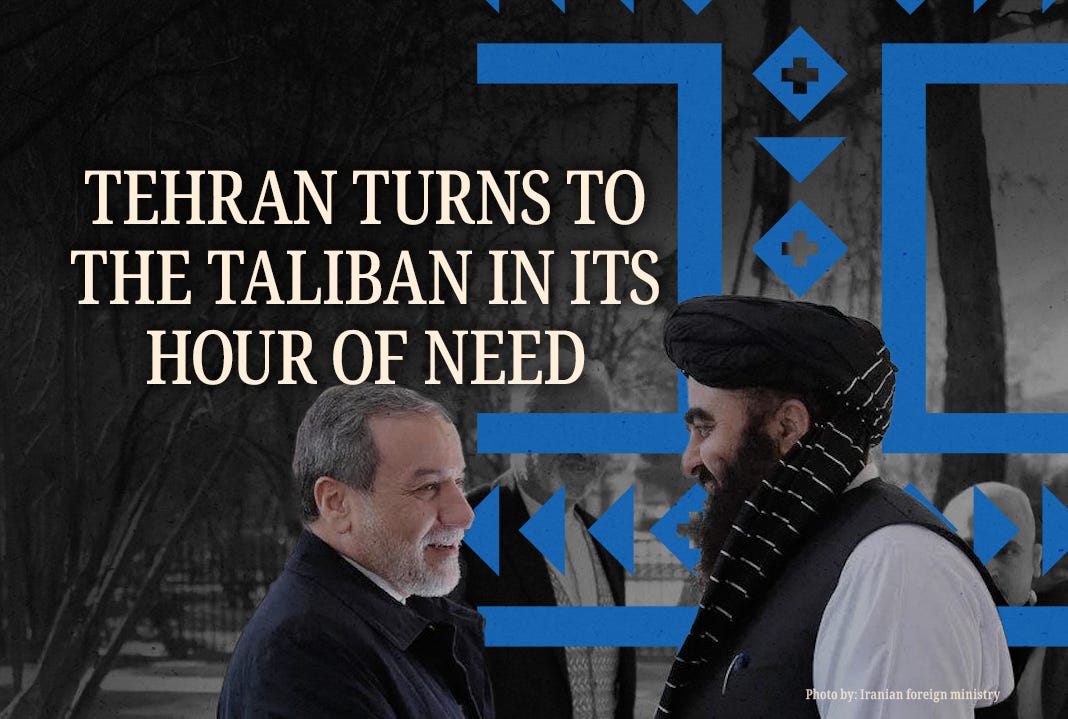
During last week’s festivities and ceremonies across Iran and its embassies, acting ambassador to Kabul Ali Reza Beikdel signaled the Islamic Republic’s interest in formally recognizing the Taliban. He said, “At the right time, we will make this legal decision and, to strengthen our ties, we will take the initiative in recognition, which all of you will admire.” Other Iranian officials also leaned toward formal recognition of the Taliban as the legitimate rulers of Afghanistan despite their clear lack of support among the people.
If these rumors are taken at face value, we may be looking at another major shift in the region’s geopolitics. Iran is now mostly isolated, and its proxies are heavily damaged. The Twelve-Day War and the prior dismantling of the Hezbollah and Hamas networks by Israel and then the United States have left the country desperately in need of strategic alliances. Who else to turn to than your next-door neighbor to the east, where, despite some prior clashes, an ongoing refugee crisis, and water disputes, you still see value in strengthening ties. Both governments are bound by a hardline ideological worldview that defines itself in opposition to the West and to Israel. That posture has been accompanied by well-documented human rights abuses, including severe restrictions on women’s rights and the suppression of political dissent.
Of course, Iran would not be the first country to recognize the value of normalizing relations with the Taliban. Russia did it first just a year ago in July. Questions of legitimacy aside, the Taliban control Afghanistan’s territory and state institutions. That reality carries strategic weight. Governing a country at the intersection of South and Central Asia—while relations with Pakistan remain strained—gives the Taliban leverage and opens the door to new regional partnerships.
Based on the recent clashes between Pakistan and the Taliban, we can assume that their longstanding relationship has come to a bitter end. After tensions peaked, including clashes and border shutdowns, the Taliban government has pivoted toward deeper engagement with Iran, especially on trade and economic cooperation. Iran has signed cooperation agreements with the Taliban on commerce, offered mediation in Afghanistan–Pakistan disputes, and hosted diplomatic contacts that signal cooperation beyond mere neighbor-to-neighbor relations. Tehran has also engaged in multilateral discussions on regional security involving the Taliban.
Public opinion inside Afghanistan increasingly favors closer economic engagement with Iran over reliance on Pakistan, particularly as tensions with Islamabad persist. Expanded trade and transit links could offer practical benefits for both sides. But deeper political alignment carries heavier implications.
Iran’s recent crackdown on protesters remains fresh in public memory, just as the Taliban’s record during their insurgency continues to shape how they are viewed internationally. Both governments face longstanding allegations of serious human rights abuses, including violence against civilians and systematic restrictions on women. Any formal alignment between them will inevitably be judged against that record.
The United States is continuing to build up its military presence around Iran while simultaneously pressing the regime to make a deal. Tehran has publicly downplayed the prospect of military escalation, but the possibility of imminent strikes hangs over the heads of the regime, and the Taliban have taken notice. Their chief spokesman, Zabiullah Mujahid, said this week that the group would be prepared to “cooperate and show sympathy” with Iran in the event of a U.S. attack—an unusual statement that signals more than routine diplomatic courtesy.
Whether that rhetoric translates into formal recognition or deeper strategic coordination remains to be seen. What is clear is that two internationally isolated governments are drawing closer at a moment of shared pressure. Iran is seeking partners as its regional network comes under strain. The Taliban, governing a landlocked state with limited recognition, are looking for economic access and political legitimacy.
An official alignment would anchor cooperation across trade routes, border security, and potentially intelligence coordination. It would also bind together two regimes widely criticized for systematic repression, particularly against women and political opponents.
The consequences of such a partnership are difficult to predict. But if Tehran moves forward with recognition, it will not read as confidence. It will look like consolidation under duress: two sanctioned governments scrambling to tighten ranks as uncertainty grows around them. In that sense, the emerging alignment suggests that the fear these regimes have long inflicted on their own people is now driving their own decisions.
Middle East Uncovered is powered by Ideas Beyond Borders. The views expressed in Middle East Uncovered are those of the authors and do not necessarily reflect the views of Ideas Beyond Borders.
The most interesting question here is not whether Tehran and the Taliban are becoming allies.
It is why two actors with such different histories, ideologies, and strategic interests can nevertheless find reasons to move closer when the regional environment changes.
This is better understood as a convergence of interests than an alliance.
For Tehran, engagement with Kabul can reduce uncertainty on its eastern frontier, protect economic and border interests, and create another channel of regional leverage. For the Taliban, relations with Iran offer access to trade, transit, energy, diplomacy, and a powerful neighbor at a time when Afghanistan remains internationally isolated.
But interests are not the same as trust.
The history between Iran and the Taliban—including serious tensions before 2001, as well as continuing disputes over water, borders, security, and Afghanistan’s internal politics—reminds us that pragmatic cooperation can coexist with deep strategic mistrust.
That distinction matters.
In regional politics, states and movements do not always choose partners because they share values. Sometimes they simply discover that, for a certain period, their interests overlap.
The real test will come when those interests stop overlapping.
— Wahidullah Noorzai
Former Afghan National Police Officer | Strategic & Security Analyst
In the high-stakes poker of Middle Eastern geopolitics, the "boom" may be the loudest card, but "containment" remains the winning hand.
Read HERE why US may not attack Iran
https://open.substack.com/pub/moderated8d2614d334ec4e16bfcc061/p/trumps-boombastic-fallacy-why-strategic?utm_source=share&utm_medium=android&r=6gfvdi