


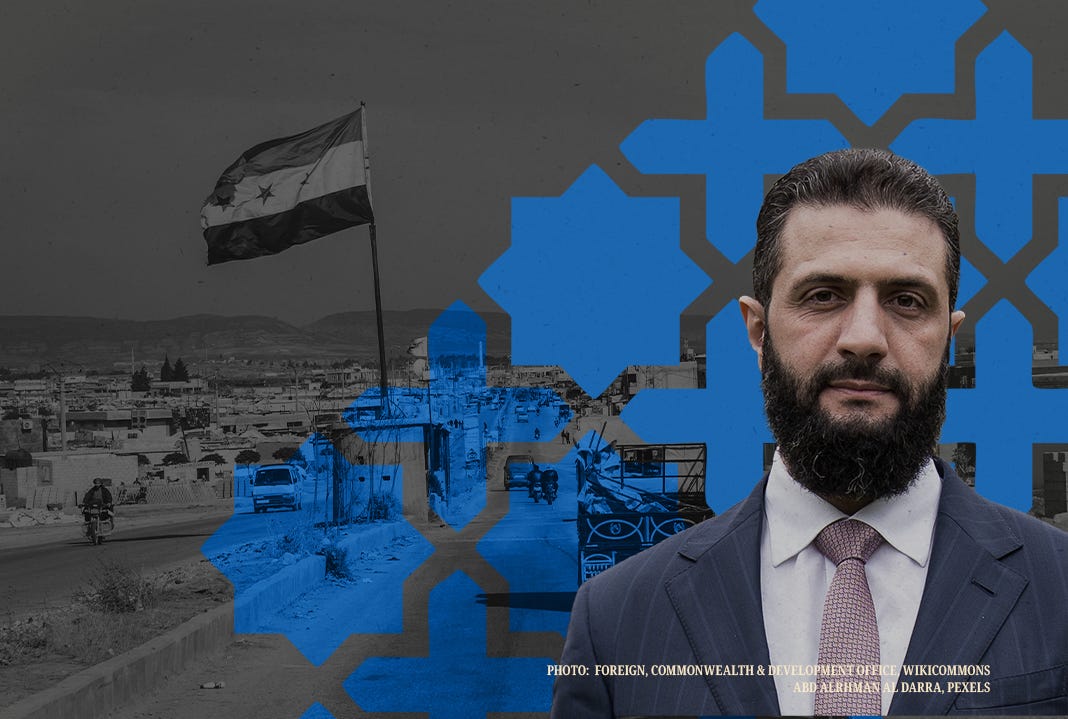
During an invitation-only meeting with Syrian-Americans in New York in September, President Ahmad al-Sharaa gave his first direct answer to a question that has hovered over Syria’s transition from the beginning: Does he intend to remain in power after the transitional period ends?
His answer was conditional. If Syria reaches Barr al-Aman—the safe shore—he suggested that he would have no reason to seek office. If he believes he is still needed to finish the task, however, he will run.
What he said at least acknowledges that a transitional presidency is supposed to end. It places succession and the transfer of power, however tentatively, in the public conversation. It also gives Syrians an opportunity to demand greater clarity.
But it also exposes the problem. The decision is being framed as a matter of al-Sharaa’s individual judgment: he will decide whether Syria has reached “safety,” whether his work is finished, and whether the country still needs him, in his opinion.
But a transitional leader does not get to decide when the transition has succeeded. The process, the institutions, and the electorate must decide. His sincerity is secondary. Even a sincere promise to leave is not a valid succession mechanism.
And what, exactly, is Barr al-Aman? How will we recognize it when we reach it? By what standards will success be measured, and who gets to apply them? Those standards need to be acceptable to Syrians from their many different communal, regional, and political backgrounds. Developing them requires a national conversation about the country’s direction and the political order we are trying to build.
That conversation is not taking place in the People’s Assembly, despite the tightly managed selection process that gave it a veneer of electoral legitimacy. Nor is it happening through political parties, because none exist. Independent newspapers, private television stations, and organized political movements, aren’t talking about it either, because space for these remains severely limited.
Syrians can speak more freely today than they could under the Assad dynasty. That is not insignificant, but it is a painfully low bar. The right to complain as an individual is not the same as the right to organize, publish, mobilize, and influence policy. Critics may not be systematically targeted by the central authorities, but some still face frivolous lawsuits or arrest under ostensibly nonpolitical pretexts, only to be released after a sufficient public uproar or the prospect of international embarrassment.
That is not yet a functioning public sphere.
Al-Sharaa’s ambiguity initially served understandable purposes. It helped hold together a coalition containing former jihadis, revolutionaries, technocrats, and local armed groups while postponing a confrontation with religious hardliners. It reassured foreign governments without requiring him to repudiate his conservative base, and allowed moderates and minorities to read hopeful signs into his behavior while the government pursued diplomatic recognition, sanctions relief, and investment.
Both camps nevertheless became anxious. Moderates, secularists and minorities feared that his silence was permitting intimidation and gradual Islamization. Hardliners watched him attend concerts, allow his wife to assume a visible public role and decline to suppress everything they considered un-Islamic. They began to worry that his making practical compromises meant abandoning the principles their project was built on.
Perhaps this balancing act helped Syria avoid an early fracture. But what buys time in the first months of a transition can become a way to avoid accountability in the years that follow.
Syria is still governed by fear, but now it is multi-vector. Fear of the authorities may have declined in some circles, yet communities now fear one another. Neighborhoods fear neighboring districts. Towns and villages fear nearby towns and villages. People fear those with different political opinions, sectarian backgrounds, or ideas about the future.
No one knows the destination, so everyone invents one. The endgame is Islamism. Or radical Islamism. Or Sunni supremacism. Or subservience to Turkey, Qatar, Saudi Arabia, the United States or Israel. Give the rumor mill enough time, and we eventually arrive at the Zionist-Masonic cabal, the Martian overlords, and the lizard people.
The absurdity of some explanations does not make the underlying anxiety imaginary. When leaders refuse to describe the future, fear fills in the blanks.
I am not arguing that al-Sharaa has issued a secret blueprint for Islamizing Syria. The reality may be both less organized and more difficult to resist: an Islamic conception of the state increasingly operates as the default presumption behind administrative decisions.
Women have been excluded from most programs at the new defense and security universities. Damascus has restricted alcohol sales largely to predominantly Christian districts, effectively territorializing a personal freedom along sectarian lines. Douma’s city council attempted to regulate whether a groom could enter a wedding celebration attended by women. The prestigious Freedom Institute, established during the French mandate, separated male and female students above the primary level, although its administration insisted that this was an independent decision rather than a government directive.
None of these decisions, taken alone, defines the character of the new state. Together, however, they reveal which impulses may proceed without constitutional explanation. Restrictions introduced in the name of religion, morality or local preference are treated as natural. Those defending personal freedom are left to prove why an exception should be made. The burden of justification has been reversed.
This is Islamization by administrative accumulation. It requires no central decree or public proclamation. A municipal order here, an admissions rule there, a licensing restriction somewhere else: gradually, the state’s character emerges from decisions no one has openly debated.
Considering the ideology of the new rulers, it is hardly surprising that Islamism should provide the default. More revealing is the “we” of official rhetoric. “Our values,” “our culture,” “our ways,” and “our country” often seem to refer primarily to Sunni Islam, with a tinge of Arabism, and to a particular interpretation of both. Yet these expressions resonate very differently among Syria’s communities.
This is precisely why the country keeps generating new crises. Every faction that captures the state attempts to present its own worldview as a glorious national restoration. No one wants to admit that there is nothing to restore in quite that fashion. The task is to build something new—drawing on Syria’s multiple traditions and identities while remaining compatible with modern citizenship and universal rights.
Modern Syria may be a modern political creation, but it is ours: in law, memory, blood and responsibility. Its people possess different historical narratives explaining their presence and attachment to the land. None of those narratives gives one community a greater claim to citizenship than another.
After more than a century of turmoil, Syria has another chance to lay the foundations of a republic. This challenge is not limited to the last fifteen years of war or the previous fifty years of Assad rule. The country has been struggling to find its footing for more than a hundred years.
Meeting that challenge requires leaders ambitious enough to imagine something new, but modest enough to understand that they cannot create it alone. As many Syrians as possible must be included in charting the way forward.
Syria is not a prize awaiting its next set of takers. It is a responsibility shared by all its citizens. When we fail to understand that, we are not transitioning into anything. We are simply marching in place to the rhythm of all our previous failures.
For this, al-Sharaa cannot afford to stay silent on the issue of where the country is heading, nor can he avoid increasing sectarian and ethnic violence. Every killing, kidnapping, and act of communal retaliation touches everyone’s sense of security and belonging.
He needs to speak out—and he needs to allow others to speak, organize, and participate. Syria needs a national campaign against sectarian and ethnic violence, accompanied by a serious process of national reconciliation. Without such an effort, every other achievement of the transition is undermined.
Al-Sharaa does not need to promise that Syria will become a Western liberal democracy. He does need to tell Syrians what principles will govern their disagreements, what rights power cannot override, and how they may eventually replace him.
Al-Sharaa’s most important legacy will not be whether he chooses to leave. It will be whether leaving ceases to depend on the ruler’s choice.
You might also like:
The Damascus Alcohol Decree Was Never Just About Drinking

A government does not need to ban something outright to make its intentions clear. Sometimes it only needs to regulate it so tightly, so selectively, and so ideologically that the message becomes unmistakable. That is what happened in Damascus last week.
Middle East Uncovered is powered by Ideas Beyond Borders. The views expressed in Middle East Uncovered are those of the authors and do not necessarily reflect the views of Ideas Beyond Borders.
he absolutely must remain in office after transition to ensure continuation of policy that is not an end game, but a balancing through development -- establishing a unitary state with sufficient but not excessive plural inputs and checks which requires deterrence of centrifugal violence, avoiding conflict with the israel enclave which may require some deterrence, learning and institutionalizing a balancing foreign policy that shifts positions as needed to avoid subordination of Syria to other countries the most threatening being israel enclave, America, and possibly west Europe. So far that balancing has required aggressive diplomacy by al Sharaa friendly in form with western countries and corporations, accepting of investment and favors, but not getting entangled in other commitments. Tricky which is why the deft hand must continue to steer.