


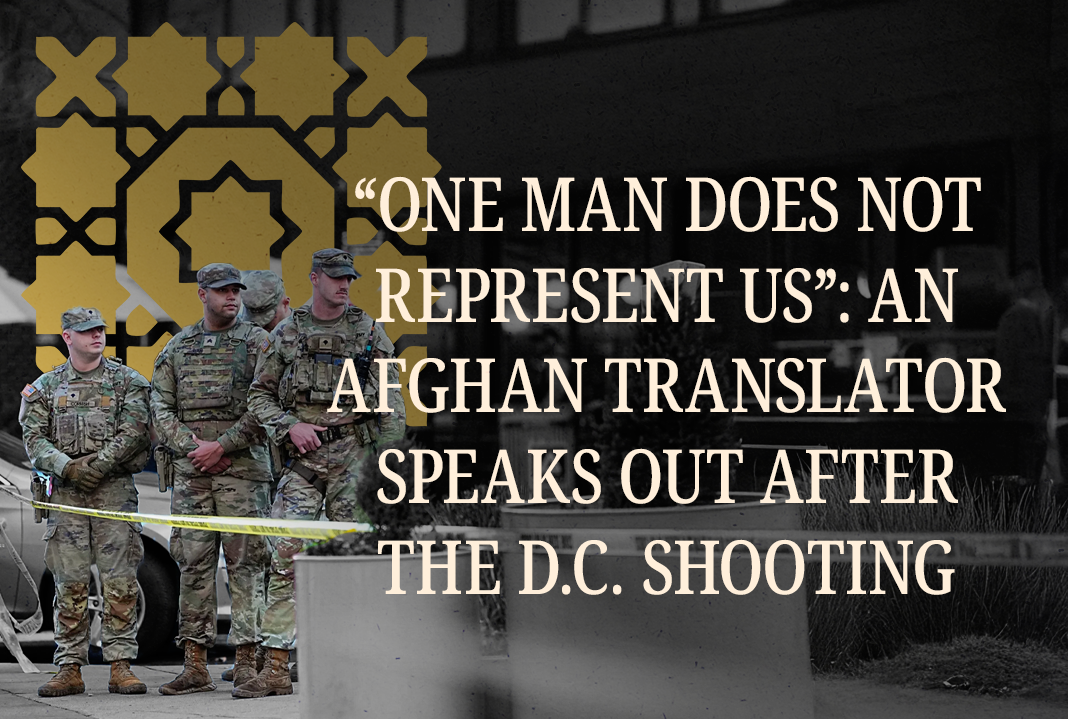
When the news broke that two members of the West Virginia National Guard had been shot near the White House—an ambush that killed 20-year-old Specialist Sarah Beckstrom and left Staff Sgt. Andrew Wolfe, 24, fighting for his life—Mohammad Sulaiman was sitting in his apartment in Ohio, scrolling through updates with growing disbelief.
The suspect, Rahmanullah Lakanwal, an Afghan man who entered the United States through a post-2021 resettlement program, was also wounded and later charged with murder. “How an Afghan who escaped to a safe place like the United States could do such a heinous action—I was shocked,” Sulaiman told Middle East Uncovered.
For Sulaiman, the news landed heavily. He and more than 200,000 other Afghans who fled the Taliban have spent years rebuilding their lives in the United States, and he worried immediately that one man’s crime would cast suspicion on an entire community.
Born in 1984, Sulaiman grew up during decades of war in Afghanistan and studied journalism at university. After graduating in 2004, he became a reporter before shifting to translation work and eventually founding a Kabul-based translation company in 2010.
By 2020, when a colleague from Ideas Beyond Borders (IBB) contacted him about translating for the nonprofit, Sulaiman had already built a successful business. But the work IBB offered felt deeply personal.
“Afghanistan didn’t have modern knowledge widely available in local languages,” he said. “If you want to reach people, you must make the knowledge accessible to them.”
The project—translating hundreds of thousands of words from Wikipedia into Pashto in an effort to revive critical thinking in the region—created jobs for dozens of Afghan translators left in precarious circumstances after the U.S. withdrawal. It also created what Sulaiman calls an “intellectual achievement” for his country: science, history, economics, and philosophy made readable for millions living under a censorious authoritarian regime.
When Kabul fell on August 15, 2021, that work suddenly put him at risk.
“Anyone who was a translator, the Taliban believed they were reporting directly to U.S. forces,” he said. “Even though I only did civil translation, I lived in fear.”
His office, located near the presidential palace, was sealed off for 15 days. Taliban intelligence contacted him. He began preparing to flee. Over the next few months, he moved from Afghanistan to Pakistan, then to Qatar, and finally to Virginia before settling in Ohio. So when Sulaiman heard that the D.C. shooting suspect was Afghan, he was filled with a deep sense of dread.
“I was thinking people would start saying all Afghans are terrorists,” he said. “Some people judge without any understanding.”
The suspect, later identified as having worked with a covert Afghan paramilitary unit under U.S. intelligence, fit a profile far removed from those of the vast majority of Afghans who arrived in the United States. Sulaiman believes that distinction matters.
“He was hired as a killer since the age of 15,” Sulaiman said. “He did that job back in Afghanistan, and he did it here.”
He also worries that regional political forces, especially Pakistan, may try to “use the incident to paint Afghans as terrorists,” reinforcing damaging narratives and making worse an already protracted conflict between the bordering nations.
But for Sulaiman, the essential point is straightforward.
“One person does not represent 200,000 Afghan refugees who came here since 2021,” he said. “We Afghans are victims of terrorism. If not for terrorism, we would not be here.”
Across Afghan communities in the United States, the mood is tense. The Trump administration has paused asylum processing for Afghan nationals in a move that many fear will leave thousands stranded, including those who aided Western forces or civil society groups.
Sulaiman sees this as a dangerous example of sweeping policy shaped by an isolated act.
“Afghans who came here are working, paying taxes, supporting the economy,” he said. “Most of us are not here to commit crimes.”
For a community already traumatized by Taliban rule, being cast under suspicion in their new home feels like adding insult to injury.
Sulaiman stays in touch with friends still in Afghanistan. Their situation, he says, is “hopeless.”
“Half of society—women and girls—are frozen in their homes,” he said. “No school, no university, no work. Young people have no job opportunities. People are tired of fighting. They feel betrayed and helpless.”
He notes that many who made it to the United States were evacuated in chaotic conditions—“loaded onto planes,” as he puts it—while many others who should have qualified for relocation were left behind.
“Those people are still waiting,” he said.
Today, Sulaiman continues to run the translation company he founded in Kabul, now remotely. The work carries even greater significance.
“When we started with IBB, Pashto Wikipedia had around 300 articles,” he said. “Now it has over 10,000.”
He doesn’t hesitate when asked why translation matters.
“It gives modern knowledge to people in their own language,” he said. “It is an intellectual asset. Even a professor at the Afghanistan Science Academy told me he had never seen such a useful project.”
In a country constrained by censorship and extremism, access to reliable information is rare and increasingly consequential.
Sulaiman hopes U.S. policymakers and the American public remember why Afghans came here in the first place. He understands that a violent attack, one that left families grieving and communities shaken, naturally prompts people to look for answers and demand safety. He is also angry that an Afghan would carry out such an act, harming not only the country that offered him refuge but the community working to rebuild its reputation.
“We fled from terrorists,” he said. “Why would we do terrorist actions in the United States when our children are living here? It makes no sense. My only message is this: do not judge all Afghans by the action of one man. One man does not represent us.”
The D.C. shooting that tragically killed Specialist Sarah Beckstrom and left Staff Sgt. Andrew Wolfe in critical condition has already reshaped the national conversation about security, migration, and who bears the cost of public safety. Sulaiman does not minimize the gravity of the attack or the grief now facing two military families. But he rejects the idea that the act of one man—whose background as a former paramilitary fighter is far removed from that of most evacuees—should be used to define an entire population.
For Afghans who arrived in the United States after fleeing the Taliban, he says, the past twelve days have been a reminder of how quickly suspicion can eclipse lived reality. And for Sulaiman, the work of correcting those assumptions is ongoing, whether in the translations he produces or in the conversations he has to explain, again and again, who Afghans in America actually are.
Middle East Uncovered is powered by Ideas Beyond Borders. The views expressed in Middle East Uncovered are those of the authors and do not necessarily reflect the views of Ideas Beyond Borders.
Thank you for this reporting. So important to hear voices standing out against the mob that might construe all Afghans as terrorists. So important to hear the voices of real Afghans who unquestionably deserve their asylum here in the United States.
I would only ask that as a premier agent of intellectual dissemination in Afghanistan, Mr Sulaiman please not take for granted the veracity of wikipedia entries on Israel, the Israel-Gaza War, and anything having to do with Zionism. These entries have been hijacked by the Group of 40, editors who deliberately enforce their narrative no matter how many times their entries are edited by others with alternative view points. These entries are NOT outcomes of open input from multiple points of view. They are agenda driven and heavily monitored by those who have an agenda to drive. They should at the very least, be asterisked as biased and problematic. Recently, a co owner of wikipedia publicly stated that the Israel-Gaza War entry would be frozen due to unauthorized activity on the account. This should be good cause to doubt the taken for granted truthfulness of any entry related to Israel, Israeli history, or Zionism. Thanks for sending this on to Mr Sulaiman. And thanks for your good work.
One man does not represent us. But Multiple Terror Attacks does little to dispel that notion.
https://www.google.com/url?sa=t&source=web&cd=&ved=2ahUKEwiEvKjA266RAxVQDjQIHbfDL3s4ChAWegQIKxAB&url=https%3A%2F%2Fwww.rcc.int%2Fswp%2Fnews%2F55%2F46-years-of-terrorist-attacks-in-europe-visualized&usg=AOvVaw11khyqD-dVJXC5P6wSO6ds&opi=89978449