


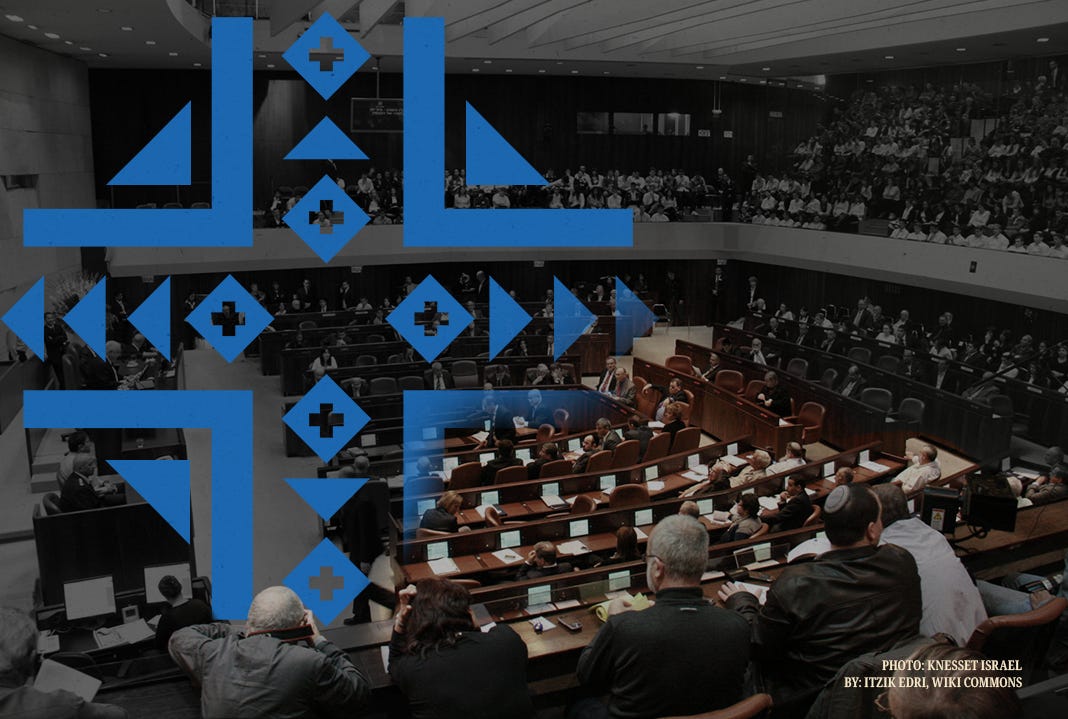
In this week’s Israeli general election, Benjamin Netanyahu’s bloc—made up of right-wing Zionist parties like Likud, the far-right parties led by Itamar Ben-Gvir and Bezalel Smotrich, and the ultra-Orthodox parties Shas and United Torah Judaism—shrank from the 68 seats they won in 2022 to just 53.
That was still the largest single bloc, and Netanyahu’s party was the single largest party. The anti-Netanyahu Zionist change bloc led by Gadi Eisenkot won just 48 seats, while Arab-led parties, the Joint List and Ra’am, together won 19.
But ultimately, this leaves no bloc with a clear majority in the Knesset, and no obvious way for any bloc to form a government.
While the Arab-led parties are also nominally anti-Netanyahu—and while Mansour Abbas’ Ra’am party previously joined the change bloc in 2021—major obstacles remain to reaching such an electoral agreement today.
In theory, the anti-Netanyahu Zionist and Arab-led parties would together make up 67 seats, which would equate to an overall majority. But large parts of the Zionist opposition are refusing to cooperate with the Arab-led parties. Eisenkot’s Yashar (“Ahead”), Naftali Bennett and Yair Lapid’s B’Yachad (“Together”), and Avigdor Lieberman’s Yisrael Beitenu (“Israel, Our Home”) have all ruled out forming a government with them.
Netanyahu now seeks to exploit these divisions. He has attempted to delegitimize the Arab parties’ electoral success by claiming the election was “stolen.” On X, Netanyahu accused Arab parties of “supporting terrorism” as well as “the elimination of the Jewish state.” He alleged that they had “committed widespread electoral fraud” via “bribery, threats, forgeries, and the use of prohibited software to mobilize voters.”
He also claimed that Likud was handing over hundreds of pieces of evidence to the police and the Shin Bet domestic intelligence service, and that the government of Qatar had funneled money to Arab organizations to boost voter turnout.
The Prime Minister’s allegations have been dismissed by the Israeli electoral authorities, as well as Israel’s police.
On Thursday, a police source told The Times of Israel that election day had passed with “very few irregular incidents” compared with previous elections, and said there was no investigative or intelligence-based evidence to substantiate his claims.
Dean Livne, acting director general of the Central Elections Committee, similarly rejected allegations of widespread fraud. He said the elections were conducted lawfully and that there was no evidence of systematic violations of electoral integrity.
What really seems to have happened is that Arab voters were spurred into action by their own pressing concerns. Turnout in Arab-majority cities in Israel rose substantially in the election.
In a Jewish People Policy Institute (JPPI) poll from 17 August 2026, the percentage of Arab respondents saying voting was important increased by 8 percentage points from August 2025 to August 2026. The number went up from 67% in 2025 to 75% this year.
In a Madad pre-election poll, 80% of Arab respondents said they would definitely vote, with another 10% fairly certain.

Does Netanyahu believe the Arab-led parties somehow managed to rig polls conducted by institutions like the JPPI, too?
More or less, Netanyahu appears to be following the Trump playbook from 2020: if you lost the election fair and square? Deny, deflect, and delegitimize.
Of course, there is a major difference between the 2020 US presidential election, which Trump lost to Joe Biden, and Israel’s current election. Under Israel’s system of proportional representation, the outcome is not simply a matter of winning or losing. Netanyahu could still form a government if he can persuade enough other parties to support him.
By alleging fraud by the Arab parties and suggesting that they support terrorism and the elimination of Israel, he seems to be trying to corner his Zionist rivals and make it much more difficult for them to team up with the Arab parties.
This leaves several possible routes out of the deadlock. One route out is to hold another election if coalition negotiations are fruitless. Another would be an Eisenkot-led minority government supported by the Arab parties. A broader unity government involving Likud and some of the Zionist Change bloc is also possible.
Likud has 27 seats. Yashar has 21. Bennett and Lapid have 12. Avigdor Lieberman’s Yisrael Beitenu has seven. Together, these parties would command 67 seats, more than enough to form a government without support from either the far-right or the ultra-Orthodox parties.
There have already been murmurings that such an effort could take place. The Jerusalem Post, for example, reported on Monday that figures in Trump’s inner circle were advocating for a unity government that would exclude Ben-Gvir and Smotrich.
On election day, Ben-Gvir accused Netanyahu of promising Americans that he would form such a government, although Netanyahu dismissed the accusation as an “electoral tactic.”
For now, Netanyahu is publicly standing by his allies. On Wednesday, the right-wing Channel 14 quoted him as telling Ben-Gvir and Smotrich: “We are together and we are staying together.”
The biggest obstacle to such a union might ultimately be Netanyahu himself, who is hated and resented by many of his Israeli opponents, and who is on trial for serious allegations of corruption.
Eisenkot, Bennett, and Lieberman have all explicitly ruled out serving under Netanyahu. They campaigned on removing him from office, and entering a government under his leadership would mean abandoning one of their central electoral promises.
There are also substantial policy differences between Netanyahu and the Zionist “change” bloc. Eisenkot has promised an independent inquiry into the failures surrounding the Hamas-led attacks of October 7, 2023, something Netanyahu has so far refused to authorize.
For now, Israel is left with a political stalemate and a flurry of accusations. The coming weeks will reveal which parties are willing to work together, whether they can reach an agreement, or whether Israelis will have to return to the polls.
Middle East Uncovered is powered by Ideas Beyond Borders. The views expressed in Middle East Uncovered are those of the authors and do not necessarily reflect the views of Ideas Beyond Borders.
Who is the person who writes this? One or 2 points are inaccurate by omission.
I think this is a broadly fair assessment, but it overlooks a significant complication.
There is, in fact, a genuine, independently authorised investigation into possible foreign interference in Israel’s election.
On 29 October, it emerged that Supreme Court Justice Noam Sohlberg, chairman of the Central Elections Committee, had instructed Shin Bet chief David Zini to investigate intelligence concerning suspected foreign funding intended to influence voter mobilisation, reportedly involving Qatar.
Crucially, this investigation originated from intelligence gathered by the Shin Bet itself, not allegations supplied by Netanyahu or Likud. Sohlberg considered the suspicions sufficiently serious to warrant investigation.
The Shin Bet has emphasised that its investigation is limited in scope, does not implicate Arab voters collectively, and does not undermine the legitimacy of the election results. Nor is there currently evidence establishing that any suspected interference altered the outcome.
That distinction matters enormously.
Netanyahu may well be exploiting these allegations politically, and his sweeping claims that the election was stolen are not supported by the available evidence. He deserves criticism for that.
But it does not follow that the underlying suspicions of foreign interference are fabricated or can simply be dismissed.
It is perfectly possible to condemn Netanyahu’s inflammatory rhetoric while recognising that an independent security investigation is both legitimate and necessary.
The article would have been considerably stronger had it acknowledged that distinction.