


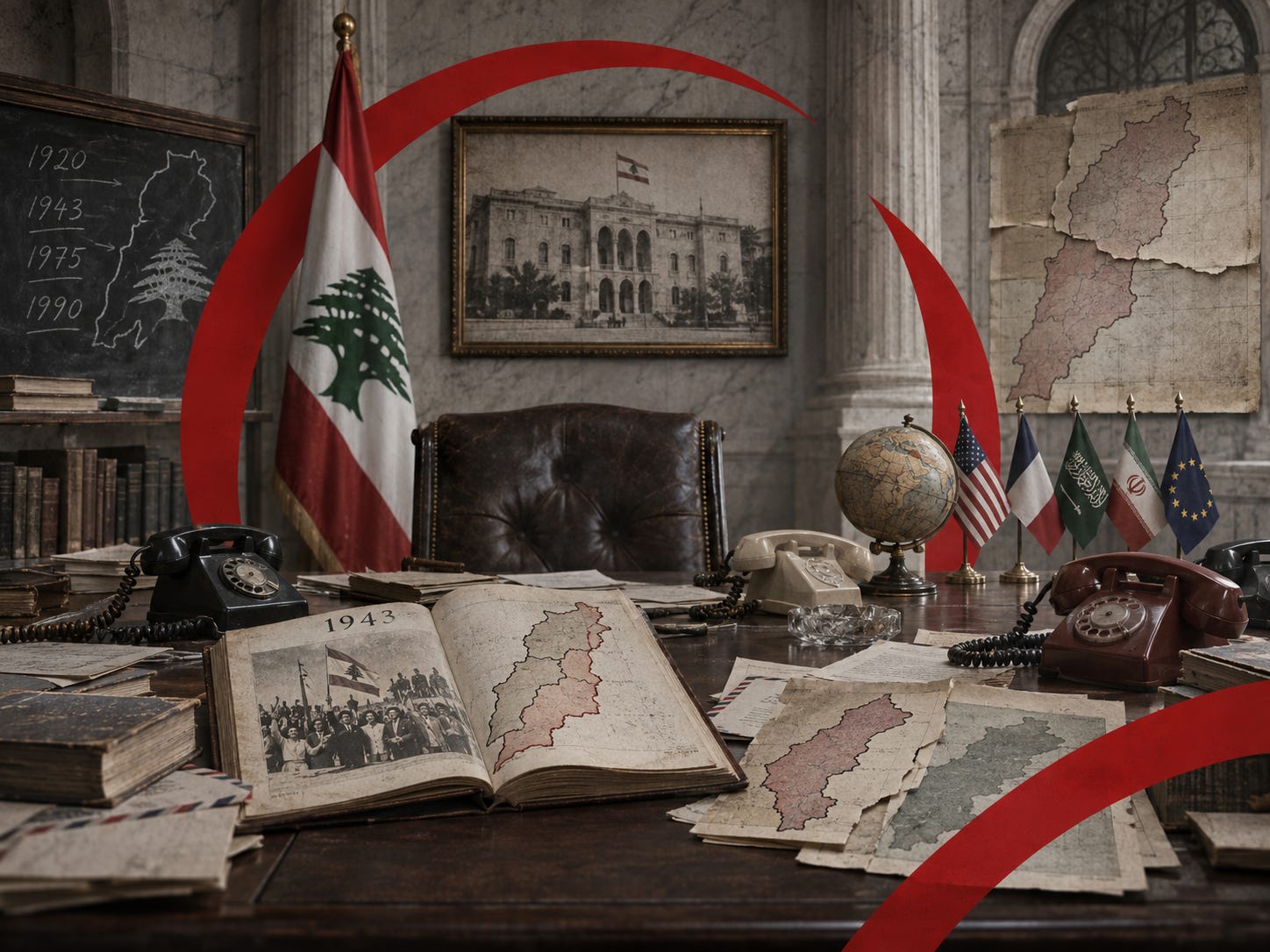
Every year on November 22, Lebanon celebrates its independence. This year marked the 83rd anniversary, with flags raised everywhere, politicians delivering speeches about sovereignty, and the same politicians who routinely seek foreign intervention lecturing everyone about the importance of national self-determination.
Lebanon’s complicated relationship with independence predates today’s republic. When the Ottomans conquered the Levant in 1516–1517, Mount Lebanon enjoyed considerable local autonomy under powerful dynasties, notably the Ma’ns and later the Shihabs. For centuries, the mountain’s religious communities lived alongside one another, sometimes cooperating and sometimes competing. But in 1860, escalating tensions between Druze and Maronite communities erupted into massacres, prompting European intervention.
The resulting settlement established the Mount Lebanon Mutasarrifate in 1861 under a Christian Ottoman governor and international guarantees.
It was then that Lebanon discovered its secret political recipe. When domestic coexistence fails, bring in foreign powers to manage the consequences.
The First World War gave the Lebanese another opportunity to disagree about their country’s future.
In 1916, Sharif Hussein launched the Arab Revolt against Ottoman rule with British backing. His son Faisal later pursued an independent Arab kingdom centered on Greater Syria, while the family had broader ambitions for Arab rule.
Some Lebanese supported the project, including Christian Arab nationalists. But influential Maronite leaders had other plans. Fearing incorporation into an Arab-majority state, the Maronite patriarchate pushed for a separate Greater Lebanon under a French mandate, seeing predominantly Catholic France as a natural religious ally.
Apparently, foreign rule was (and still is) only a problem when the foreigners belong to the wrong religion.
In September 1920, French General Henri Gouraud proclaimed the creation of Greater Lebanon. France wanted a state where its Maronite Christian allies would hold political power. But Mount Lebanon alone lacked the ports, farmland, and resources needed to support an independent country.
So the French expanded its borders to include Beirut, Tripoli, Sidon, Tyre, the Bekaa Valley, and surrounding areas, many of which had predominantly Muslim populations.
This created an awkward problem. To make Lebanon economically viable, France had brought in enough Muslims to put the Christian political dominance it wanted to preserve at risk.
Lebanon now existed as a country. Getting its people to agree on what kind of country it should be was another matter.
By 1943, Christian and Muslim leaders had reached a compromise.
Under the unwritten National Pact, Christian leaders accepted Lebanon’s Arab identity and agreed to stop seeking Western protection. Muslim leaders, in turn, accepted Lebanon as an independent country rather than pushing for it to become part of a larger Arab state.
For once, Lebanese political leaders had agreed to stop looking abroad to settle their differences.
But their commitment to independence was soon put to the test. In November 1943, French authorities arrested President Bechara El Khoury, a Christian, Prime Minister Riad Al Solh, a Muslim, and several other officials.
Public protests and British intervention helped secure their release on November 22. Winston Churchill himself supported the pressure on France, helping force the French authorities to accept Lebanese demands for independence. Lebanon would go on to celebrate November 22 as its Independence Day, although French troops would not fully withdraw until 1946.
In February 1945, Lebanon declared war on Germany and Japan, joining the Allies shortly before World War II ended. It also became a founding member of the United Nations later that year.
Lebanon had secured international recognition as an independent country. Getting its political factions to respect the authority of their own government, however, would prove much harder.
The National Pact was supposed to end Lebanon's dependence on foreign powers. That idea hasn't aged particularly well.
Maronite leaders historically looked to France for protection. During the civil war, some Christian militias allied with Israel. More recently, Christian parties have built relationships with other regional powers, including wealthy Gulf states.
Sunni political movements have also looked abroad for support, from Nasser’s Egypt and Syria to Saudi Arabia. Turkey, too, has developed ties with certain Sunni political figures and groups.
Hezbollah built close military and political ties with Iran, whose Revolutionary Guards helped establish the organization and have supported it ever since. Druze leaders have also sought allies abroad, often siding with whoever best served their interests.
These relationships are not all the same, but the political instinct behind them is familiar. When you can’t secure enough support at home, find someone abroad willing to back you. Paris, Cairo, Damascus, Riyadh, Tehran, Ankara, Tel Aviv, or Washington. The destination changes, but the habit never does.
Lebanese politicians spend a great deal of time accusing their rivals of serving foreign interests. Most of those accusations have some truth to them. What they rarely come with, however, is any sense of self-awareness.
In Lebanon, foreign interference is unacceptable when it benefits a rival party, but a welcome act of international friendship when it benefits your own. Sovereignty, it seems, is most sacred when someone else is violating it.
Perhaps the clearest example of Lebanon’s unresolved divisions can be found in its classrooms. More than 80 years after independence, the country still cannot agree on how to teach its own history.
Students learn how Lebanon was created and gained its independence. But what happened afterward is another matter. How did the country end up in a 15-year civil war? Who was responsible? And what lessons should be learned? These are questions Lebanon’s political leaders have never managed to agree on, leaving much of the country’s modern history out of a common national curriculum.
Apparently, teaching children how Lebanon gained its independence is perfectly acceptable. Explaining what the Lebanese did with it afterward is where things get politically dangerous.
The 1989 Taif Agreement, which helped end the civil war, called for a unified history curriculum. But repeated attempts to create one have failed because Lebanon’s political factions cannot agree on who should be held responsible for what happened.
As a result, Lebanese students often learn different versions of the same events depending on which school they attend. Some of the most controversial chapters of the country’s history are simply left out.
After all, acknowledging history might mean admitting responsibility. And that would be inconvenient in a country where political legitimacy so often depends on foreign support and a generous helping of selective memory.
Lebanon’s independence was a genuine historical achievement. Its people secured international recognition and the right to govern themselves.
But the decades that followed have shown how easily that independence can be weakened when political factions turn to foreign powers to gain an advantage over one another.
Lebanon’s diversity was never the problem. Its communities share centuries of history and common ancestry. The problem is that their political leaders have too often preferred foreign backing to finding common ground at home.
The agreement reached in 1943 was supposed to put an end to that dependence.
Eighty-three years later, Lebanese politicians are still celebrating the independence their predecessors fought for, while maintaining the very foreign alliances that limit their country’s ability to exercise it.
Perhaps next year’s celebrations could include something genuinely new. Lebanese politicians could try settling Lebanon’s disagreements in Lebanon, and finally be honest about the history that brought us here.
Until then, happy Independence Day.
You might also be interested in:
Lebanon’s Break with a 76-Year Taboo

I grew up in a country where there was a particular word you didn’t say. You could hint at it, gesture toward it, refer to it by titles like “the enemy,” “occupied Palestine,” or “beyond the border,” but never speak it plainly. In Lebanon, to utter “Israel” was to cross an invisible boundary everyone recognized, even if no one ever described it. It was …
Middle East Uncovered is powered by Ideas Beyond Borders. The views expressed in Middle East Uncovered are those of the authors and do not necessarily reflect the views of Ideas Beyond Borders.
