


I grew up in a country where there was a particular word you didn’t say. You could hint at it, gesture toward it, refer to it by titles like “the enemy,” “occupied Palestine,” or “beyond the border,” but never speak it plainly. In Lebanon, to utter “Israel” was to cross an invisible boundary everyone recognized, even if no one ever described it. It was a taboo woven into schoolbooks, news bulletins, political speeches, Friday sermons, Sunday Masses, dinner conversations, and the quiet pauses adults used when they didn’t want to answer tough questions.
There were no debates about peace. Not because the country had weighed it and rejected it, but because even considering dialogue—or imagining negotiations—felt treasonous. The law reinforced that feeling. Contact with Israelis was a punishable offense. Speaking of normalization made you a suspect. Universities discouraged research that touched anything related to the neighboring state. The word itself felt like a live wire: spoken in low tones, often replaced with metaphors.
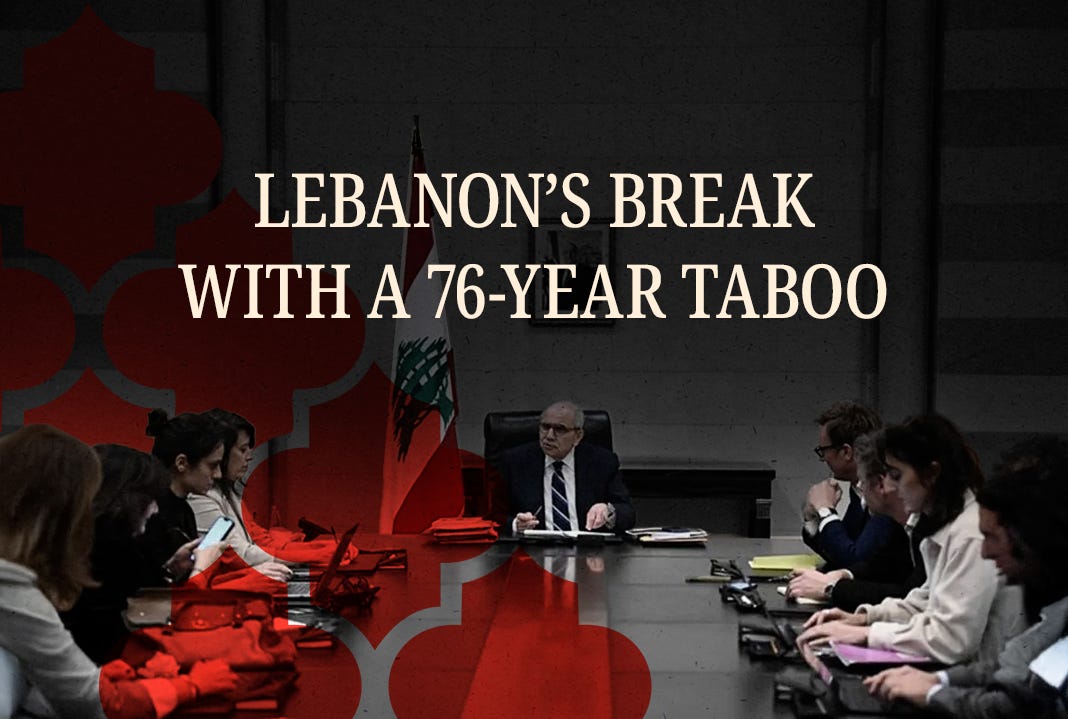
Yesterday, Lebanon crossed that boundary when a civilian Lebanese delegation sat down with Israeli officials and entered a negotiating framework with the goal of implementing a “cessation of hostilities”. Not a secret back channel, not a militia-mediated exchange, not a UN shuttle. A meeting between civilians, face to face, with names known, and a formal agenda—something we were raised to believe was impossible.
Watching the news, I felt dumbfounded. The country I grew up in, where acknowledging Israel’s existence as a state could cost someone their job or reputation, was suddenly talking to it.
Today, I find myself suspended between cautious optimism and the history that demands pessimism remain on the table. Decades of conflict with Israel have exacted a heavy toll on Lebanese lives, yet even the smallest step toward de-escalation feels like a rare and necessary opening.
I was a child when I first understood that the Lebanese state did not fully command its own authority. The realization came in bits and pieces, from people speaking in hushed tones, breaking news flashes, tense neighborhoods, and the peculiar instinct every Lebanese person develops to read political weather.
I remember the killing of Officer Samer Hanna in 2008. He was flying an army helicopter when Hezbollah fighters shot him down because he was flying too close to their bases. No consequences followed. No confrontation. No insistence from the institution sworn to defend its own. I learned then that some actors in Lebanon operate above the state, and the state knows its limits.
I remember the days of May that year, when Hezbollah’s militias invaded Beirut and the city fell under their control. I’ll never forget how the army did not confront them, nor how officials ordered journalists to abandon their posts because the army could not (or would not) protect them. Sometimes, the collapse of state authority arrives through a message delivered by someone wearing the uniform of a country that cannot enforce its sovereignty.
And then there was the recent confession by the Minister of Defense, in response to a dispute over an image of deceased Hezbollah secretary general Hassan Nasrallah projected onto the Raouché Rock. He supported the armed forces’ refusal to implement the Prime Minister’s orders, warning that confronting Hezbollah’s supporters could fracture the institution. In other words, the army’s cohesion itself could be jeopardized if it tried to enforce state authority against a powerful domestic actor.
These memories surfaced as I watched headlines report that Lebanon and Israel were speaking directly.
Because if the state fears collapse over a projected image, how does it intend to negotiate war and peace? If an officer’s killing passes without institutional response, who guarantees the outcome of any future agreement? If past confrontations ended with the army stepping aside, can the country truly stand alone in setting its borders, making decisions, and shaping its relationships?
These events shaped the air we breathed, the assumptions we internalized, and the boundaries we never should have been taught.
And still, I cannot deny that yesterday felt different.
There was something extraordinary about seeing Lebanese civilians engage directly with Israelis. For decades, the idea of dialogue was treated as a fantasy, a betrayal, or a foreign imposition. It was easier to imagine the border as nothing more than a line over which to exchange airstrikes, not a frontier between two actual states.
The meeting did not change laws, topple taboos overnight, or dissolve threats. But it changed something. It made visible that Lebanon could—under some constellation of pressures and decisions—sit down and speak. This has long been a forbidden image to even imagine.
That was what unsettled me most: not the negotiation itself, but the realization that our political imagination had shifted. The unthinkable had been spoken aloud. The forbidden had been enacted by officials of the very state that once criminalized its possibility.
A new space exists now, and it will not simply vanish, despite many trying to deny it.
I do not know what yesterday will lead to. Nobody does.
Maybe it will become a symbolic footnote that fades into obscurity. Maybe it will mark the start of a slow political recalibration. Maybe it will change nothing at all. In Lebanon, history has taught us to be cautious with hope and mercilessly honest with memory.
But I know this: a country that has labeled something impossible for seventy-six years cannot perform it without consequences. Even if Hezbollah remains armed—an unacceptable reality— even if the state remains tentative and the red lines intact, something has shifted.
For the first time in my lifetime, the taboo cracked.
Yesterday, Lebanon used a word it had avoided for generations, and it did so in the context of formal dialogue. Whether the outcome endures or evaporates, the line that was crossed is now part of the record.
Middle East Uncovered is powered by Ideas Beyond Borders. The views expressed in Middle East Uncovered are those of the authors and do not necessarily reflect the views of Ideas Beyond Borders.

Wonderful wonderful, congratulations. Every tiny bit of a different vision, every tiny step outside the many boxes that have imprisoned people, brings hope.
Let’s hope that this tiny step is but the first of many. Sending my best.