

Ending Settler Violence Is in Israel's Interest
Unchecked settler attacks are harming Palestinians, undermining Israel's security, and threatening regional stability. Stopping them is a moral obligation and strategic necessity.

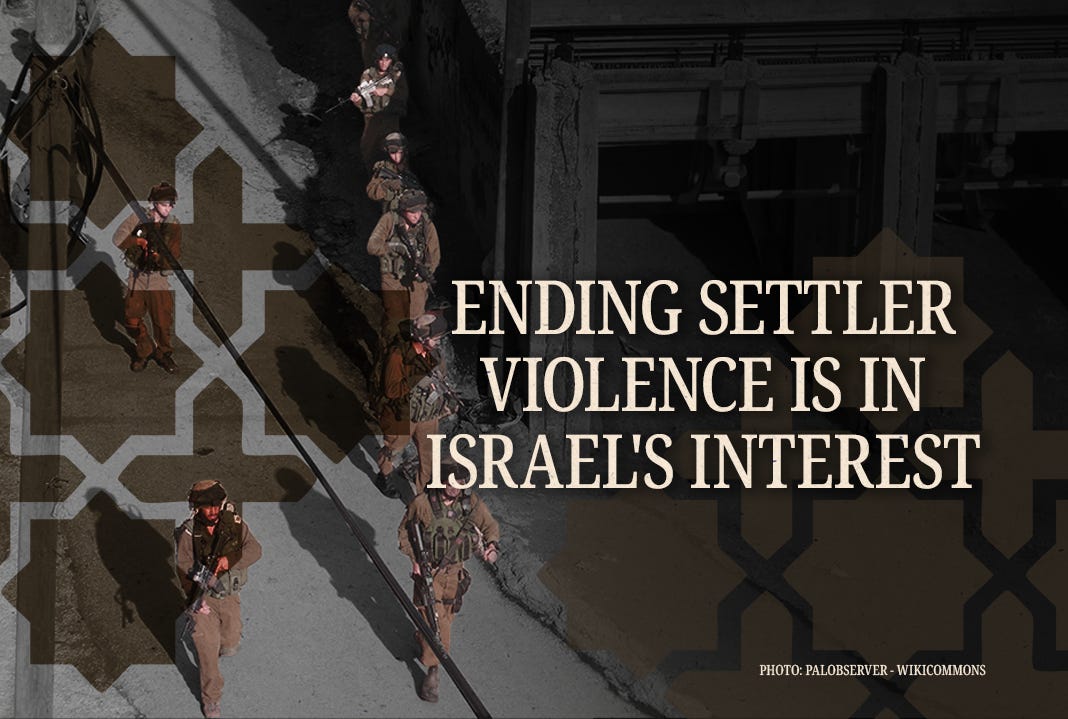
Across the West Bank, Palestinian communities are facing a steady rise in attacks by Israeli settlers. Homes have been torched, agricultural land destroyed, and residents beaten or driven from their villages. The violence has become a source of growing concern not only for those living through it, but also for neighboring states watching the consequences spread beyond Israel’s borders.
Although these attacks are illegal—and many Israelis oppose them—Israel does nothing to stop them. In fact, Israeli security forces stationed throughout the West Bank have reportedly accompanied settlers as they storm villages, assault men, women, and children, and set fire to homes, vehicles, and agricultural land.
In the past year, these events have increased in number and intensity. In the first three months of 2026, settlers attacking or blocking access to homes resulted in the displacement of nearly 1,700 Palestinians. This is 90% of the number of Palestinians displaced during the entire year of 2025.
Unlike most situations in the Middle East, this is one problem that Israel has the power to unilaterally solve. Instead, it allows an already fraught security situation to worsen. Its failure to intervene is often seen as tacit endorsement of these attacks.
One of the neighboring states paying close attention to the escalation is Jordan.
Situated on the eastern border of the West Bank, the country consistently enjoys stability even as conflict engulfs much of the surrounding region. If the attacks continue unchecked, one of only four Arab states to have normalized relations with Israel could face growing domestic pressure that tests those ties.
Jordan is home to over 2 million Palestinian refugees and their descendants, displaced since the 1948 and 1967 wars with Israel. Israel’s reluctance to stop the settler attacks could trigger a refugee crisis as more Palestinians cross the border from the West Bank into Jordan. Jordanian authorities have strongly condemned the violence, with the Ministry of Foreign Affairs recently expressing concern that the situation could fuel extremism and undermine the possibility of a two-state solution.
The presence of Israel’s Western allies, especially the United States, serves as a powerful deterrent against a wider Middle Eastern conflict. Yet settler violence has already begun to change the tone of Israel’s relationships with many of its partners. The United Nations has expressed grave concern over settler attacks. The European Union and the Vatican have issued statements of condemnation. In June, five Western allies imposed joint sanctions on individuals and networks in Israel known to support settler violence.
If these attacks continue, Western governments could face growing pressure to impose additional sanctions, reduce military or diplomatic support, or further distance themselves from Israel. A significant weakening of those alliances could encourage rival states and armed groups to take greater risks if they believe the likelihood of a coordinated Western response has diminished. Israel would remain a formidable military power, but a sustained erosion of Western backing would make a prolonged regional war more likely.
Unhindered settler violence provides extremists in the West Bank and Israel with ideological canon fodder. Settlers are shielded from consequences and protected by Israeli security forces. They are not discouraged from carrying out these attacks; instead, they are emboldened. If this continues, an increase in Palestinian retaliation would be unsurprising.
Increased Palestinian attacks alongside continued settler violence could create a never-ending cycle. As violence escalates, security in the West Bank would deteriorate further. That environment could provide more opportunities for extremist groups on both sides to recruit and expand their influence. With more people drawn into those groups, attacks would likely become more frequent, increasing the risk of further violence in both the West Bank and Israel.
If permitted to continue, Israel’s role in West Bank settler activity could shift regional and even international alliances. Added to the already volatile regional security situation, the scales could tilt so heavily against Israel that the unprecedented Abraham Accords would become obsolete.
It is not unusual for Middle Eastern alliances to be short-lived. This is because they frequently are built not on strengths, but on shared security threats and regime survival. If the Abraham Accords were scrapped, the four Arab countries that signed on to the Accords would face regional pressure to form new alliances or join existing ones. Other nations across the world would then need to adapt in order to re-secure their own interests. Such significant shifts in geopolitical alliances centered around the Middle East could recalibrate the world.
Israel has the power to end settler violence in the West Bank. Instead, it allows the attacks to continue. What happens in this disputed corner of the Middle East does not stay here. Governments across the region have condemned the attacks on Palestinians, and the combination of escalating settler violence and continued settlement expansion has created the impression that Israel is incrementally moving toward annexation of the West Bank.
Israel has both a moral responsibility and a strategic interest in changing course. Protecting Palestinians from violence means upholding the rule of law and basic human dignity. It also serves Israel’s own long-term security. Every attack that goes unchecked increases the risk of further violence, weakens Israel’s relationships with its partners abroad, and makes regional stability harder to achieve. Ending settler violence is not only the right thing to do. It is in Israel’s own interest.
Middle East Uncovered is powered by Ideas Beyond Borders. The views expressed in Middle East Uncovered are those of the authors and do not necessarily reflect the views of Ideas Beyond Borders.
 | A guest post by
|