


The United States has spent years trying to cut off the Iranian government’s access to money. We sanction Iranian banks, restrict Iranian oil exports, and target the financial networks that help Iran’s Revolutionary Guard fund its activities across the Middle East. But the underlying problem rarely gets explained to the American public.
Some of the networks accused of helping Iran circumvent those restrictions operate through Iraq, a country where the United States has spent enormous amounts of money, invested years of military effort, and maintained significant political and financial influence since 2003. Consider what the U.S. Treasury itself revealed in July 2025.
American authorities sanctioned a network run by an Iraqi businessman, Salim Ahmed Said, that allegedly helped sell Iranian oil disguised as Iraqi oil. According to Treasury, Iranian oil was delivered to facilities where it could be mixed with Iraqi oil, shipped abroad with documents concealing its Iranian origin, and sold on international markets. The Treasury also described cash being transported back into Iran through the network.
Two months later, the Treasury announced sanctions against another network accused of generating hundreds of millions of dollars through similar schemes.
This creates a serious problem for Washington. The United States is trying to stop Iran from earning money through oil exports, while networks operating through Iraq are allegedly helping Iran sell that same oil by disguising it as Iraqi.
American authorities have uncovered and sanctioned some of these networks, but the larger problem persists. Iran continues to have ways to get around U.S. sanctions through Iraq, undermining Washington’s efforts to cut off a major source of revenue.
To understand why this matters, we need to understand a strange feature of modern Iraq that most Americans have probably never heard about.
Iraq’s oil revenues are held through an arrangement involving the Federal Reserve Bank of New York.
This arrangement dates back to the American invasion of Iraq in 2003. It was originally established to safeguard Iraq’s oil revenues and facilitate reconstruction. Over time, it also became an important source of American financial leverage.
Iraq is one of the world’s major oil producers, and oil provides roughly 90 percent of its government revenue. Access to those funds, and to the American dollar system, is essential to the functioning of the Iraqi state.
In other words, Washington possesses tremendous economic influence over Baghdad. On the other hand, Iran has deeply established political, military, and economic relationships inside Iraq.
Since the fall of Saddam Hussein, Iran-aligned parties and armed groups have accumulated enormous influence across Iraq’s political and security institutions. Some armed organizations operate under the umbrella of the Popular Mobilization Forces (PMF), a state-recognized security structure originally assembled to fight ISIS. Yet individual factions have maintained their own leadership, interests, and relationships with Tehran.
The Iraqi government has strong incentives to keep Washington satisfied, because its economy depends heavily on access to the international financial system. At the same time, powerful actors within Iraq’s political and security establishment maintain relationships with Iran.
Successive Iraqi prime ministers have had to navigate these competing pressures. Some have tried harder than others to strengthen independent state institutions, but the underlying problem has persisted.
Which brings us to a small Iraqi town called Jurf al-Sakhar.
Located south of Baghdad, Jurf al-Sakhar has effectively been under the control of Kat’aib Hezbollah, one of Iraq’s most powerful Iranian-backed militias, since ISIS was expelled from the area in 2014.
For more than a decade, the Iraqi government has struggled to exercise normal authority there. Many of the town’s predominantly Sunni residents, displaced during the fighting, have been unable to return.
Enter Prime Minister Ali al-Zaidi. He says he is changing that.
His government has accused Kat’aib Hezbollah of involvement in oil smuggling and illegal fuel operations. Investigators were sent into the area, officials were dismissed, and Iraqi forces were ordered to prepare to take control.
If you were watching this from the United States, you might reasonably see it as encouraging news. An Iraqi prime minister is apparently confronting one of Iran’s most powerful allies. But the reality is far more complicated.
As the confrontation escalated, Esmail Qaani, commander of Iran’s Revolutionary Guard Quds Force, traveled to Baghdad to help resolve it. Kat’aib Hezbollah confirmed discussions involving Qaani, its own leadership, and influential Iraqi political figures.
On November 19, Reuters reported that Iraqi officials had reached a compromise under which government forces would enter Jurf al-Sakhar while Kat’aib Hezbollah fighters relocated elsewhere.
But there’s a catch. Some of the forces expected to take over Jurf al-Sakhar have ties to the same militias the government is supposedly trying to push out.
Hamdi Malik, a researcher who studies Iraq’s militias, has looked into two units of the PMF, the state-recognized umbrella organization that includes several powerful armed groups.
One of them, Brigade 72, has previously worked alongside forces linked to Kat’aib Hezbollah. Another, Brigade 79, has political ties to Faleh al-Fayyadh, the head of the government body that oversees the PMF.
To be clear, Iraq’s regular army and federal police are also expected to take part in the operation. So this isn’t necessarily a case of one militia simply replacing another. Still, the concern is that the government could end up handing control to forces with connections to the very groups it is trying to remove.
As Iraqi researcher Liqaa Makki has pointed out, sending government forces into an area controlled by a militia doesn’t automatically mean the militia has lost its power. That’s an important distinction for Americans to understand.
An Iraqi Army convoy entering a town makes for an impressive photo op. But it tells us very little about who commands the armed groups operating there, who controls their financial networks, or whether the government can enforce its decisions without negotiating with militia leaders.
The risk is that Washington mistakes a visible change in military deployment for a fundamental change in political control.
I suspect there is an element of political theater here.
President Donald Trump has placed considerable emphasis on visible demonstrations of success in foreign policy. Iraqi political leaders have reasons to show his administration that they are taking action against Iranian-backed armed groups, particularly given America’s financial leverage over Baghdad.
Iran-aligned actors, meanwhile, have reasons to avoid a direct confrontation that could threaten their wider political and economic interests.
A negotiated arrangement might satisfy both sides in the short term. The Iraqi government could announce a victory for sovereignty, and Washington could point to progress against Iranian-backed militias. And the factions involved might still retain much of their influence through other positions and institutions.
It is also possible that al-Zaidi is genuinely attempting to expand state authority through the channels available to him.
But the possibility of political theater deserves scrutiny, particularly because the economic questions are much bigger than one town.
The United States has repeatedly documented sanctions-evasion schemes involving Iraq. American authorities have accused Iraqi banks, businessmen, and shipping networks of helping Iran access dollars or market petroleum products despite restrictions.
These cases do not mean the entire Iraqi state participates in such activity. Nor do they demonstrate that sanctions are useless. In fact, the Treasury’s investigations and designations show active efforts to disrupt these networks.
They do, however, reveal why focusing exclusively on military deployments can produce a misleading picture of Iranian influence.
Iran’s influence in Iraq is not simply a collection of armed men with Iranian-supplied weapons. It also involves political relationships, commercial interests, and economic networks that cannot be dismantled by changing the uniforms at a checkpoint.
So what is the United States actually trying to accomplish?
If the goal is to reduce attacks on American interests, pressure particular militias into concessions, and contain Iranian influence, a negotiated withdrawal from Jurf al-Sakhar might represent useful progress.
But if the goal is to fundamentally dismantle Iran’s ability to exercise influence through Iraqi institutions and financial networks, the standard for success has to be much higher.
And Washington should be clear about which objective it is pursuing.
Americans have spent more than two decades hearing about the importance of building a sovereign, stable Iraq. They have also heard successive administrations promise to contain Iran, enforce sanctions, and prevent Iran from financing armed groups.
Yet American authorities continue to uncover networks operating through Iraq that allegedly help Iran evade those restrictions.
Meanwhile, the Iraqi government must navigate American economic pressure and the influence of Iranian-aligned actors within its own political system.
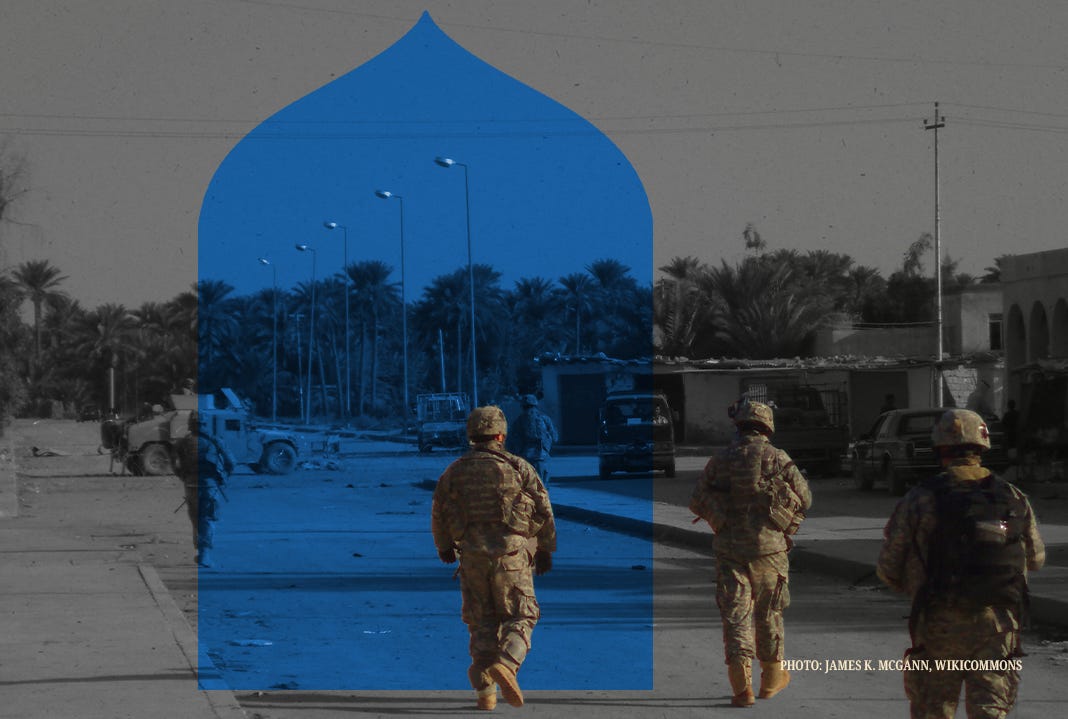
Yesterday, Iraqi forces finally entered Jurf al-Sakhar. But moving troops into a town is the easy part. The real test is what happens after the cameras leave.
Will the government be able to investigate oil smuggling, control the armed groups operating there, and allow displaced families to return home? Or will the same people continue to pull the strings, operating through different units and political connections?
Iraq has seen plenty of announcements about restoring state authority and fighting corruption. This time, there is an opportunity to show that something has actually changed. But there is also a very real possibility that corruption will simply find new ways to operate, while officials take credit for a victory that exists mostly on paper.
The soldiers have entered Jurf al-Sakhar. We should all wonder if whether the Iraqi state entered with them.
You might also be interested in:
A U.S. Withdrawal Risks Handing Iraq to Militias

After a rocky start to January and a wave of escalations across the region, the Middle East once again finds itself on the brink of a wider conflict. U.S. threats against Iran, combined with the continued deployment of heavy military hardware and rising tensions in Syria and Lebanon, have signaled a long and volatile winter ahead.
Middle East Uncovered is powered by Ideas Beyond Borders. The views expressed in Middle East Uncovered are those of the authors and do not necessarily reflect the views of Ideas Beyond Borders.