


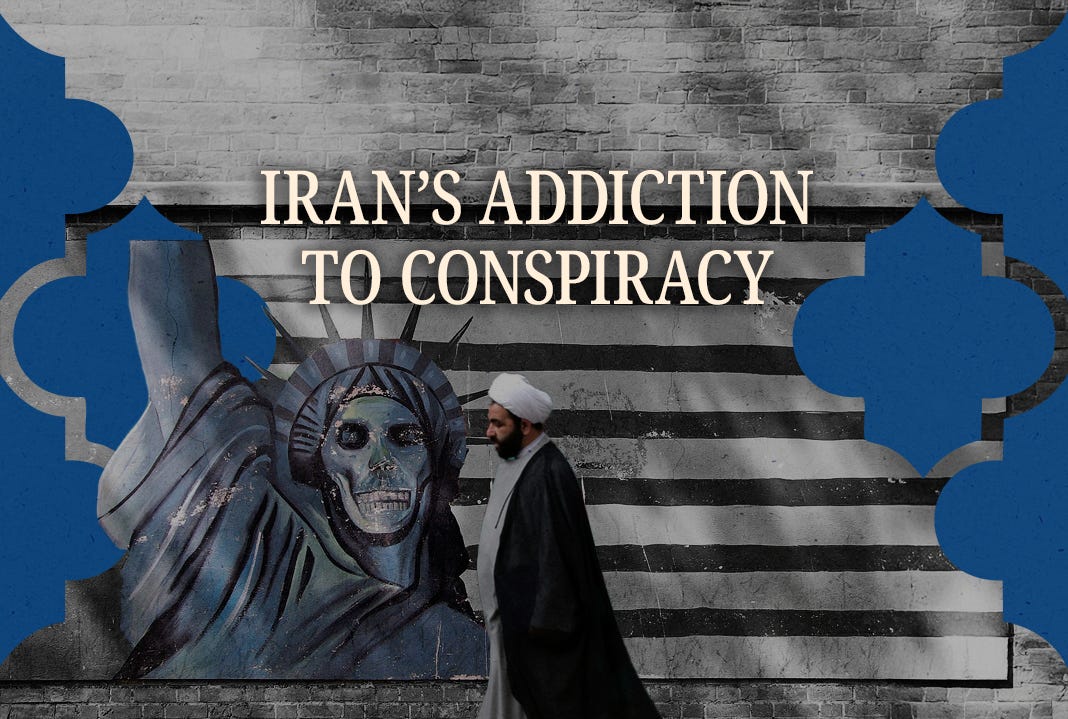
When Iran’s Supreme Leader, Ayatollah Ali Khamenei, recently claimed that “the USA is responsible for the death of the protesters,” most Iranians rolled our eyes. A regime that kills thousands, imprisons many more, and then blames America for the funerals has perfected this reflex. An estimated 30,000 people have been killed so far, and according to the Islamic Republic, none of that responsibility lies at home. There is no self-reflection, no accountability—only an ever-present foreign hand, an ever-expanding conspiracy.
This habit of blaming outsiders for the crimes of corrupt officials predates the Islamic Republic itself. And it is not confined to those in power. It has seeped into how many Iranians, inside and outside the country, talk about themselves.
Recently, some Iranian and non-Iranian “progressive” activists on social media have taken to scolding the diaspora by insisting that “Iranians are not white.” In their framework, the West already views Iranians as inferior. We are cast, in progressive parlance, as an oppressed victim group crushed under “white capitalism.”
As a result, when an Iranian in Europe or North America carries themselves with ordinary self-confidence, these activists mock them for “thinking they are white” and rush to correct them: you must see yourself as a racialized, inferior victim—or else you are naïve, deluded, or a traitor.
Beyond how racist and infantilizing this framing is, it injects a sense of inferiority into a community already shaped by discrimination, exile, and political trauma. It reduces complex social realities to skin color and simplistic binaries of oppressor and oppressed. It also provides a convenient escape hatch: if every problem originates in “white America,” then there is no need to confront internal failures or personal responsibility.
Inside Iran, the narrative is even more extreme. Students, journalists, workers, women’s rights activists, and religious minorities are all accused of “working for foreign countries.” Ask for clean water, and you are a Zionist. Defend labor rights, and you are CIA. Be a Bahá’í, like me, and you are automatically an agent of Israel.
After I was expelled from university for being a Bahá’í, a university staff member told me—kindly, and with genuine concern—that I should “escape to Israel, because it must be good for us there.” She meant well. The problem was not malice, but the conspiracy lodged in her mind. She did not know that the Bahá’í Faith originated in Iran, not Israel. She knew only the propaganda, and that was enough.
This mindset is not limited to regime supporters. Over the years, I have watched anti-regime activists cancel one another using the same language: “He is paid by America,” “They are a British operation,” “She works for the Zionist lobby.” Apparently, everyone is a foreign agent. Only the alleged sponsor changes.
This reflex long predates 1979. In 1963, the Shah announced his “White Revolution” reforms—yes, that was their actual name. The reforms expanded women’s rights, introduced land redistribution, and established profit-sharing for workers: modest but real steps toward modernization.
Ayatollah Khomeini denounced these reforms as a Western conspiracy, and many believed him. Mosque and bazaar networks mobilized, protests erupted, Khomeini was arrested, and many historians identify this moment as the opening chapter of the 1979 Revolution.
For my generation—those who grew up after 1979 and now look at romanticized images of pre-revolutionary Iran—the “what if” questions are unavoidable. What if being “white,” in the sense of having women’s rights, labor protections, and modern institutions, had actually been possible? What if we could have been “white” without being white?
Setting irony aside, the idea that equal rights for women are a foreign conspiracy is historically incoherent. One of the central teachings of Bahá’u’lláh in the nineteenth century—articulated inside Iran—was the equality of men and women. No CIA involvement, no Zionist plot, no American universities required.
For decades, Iran’s oil nationalization in the early 1950s has been taught as a simple morality tale: a patriotic prime minister, Mohammad Mossadegh, reclaimed national wealth from colonial powers, only to be overthrown by the British and Americans in 1953. Foreign villains, an Iranian hero, and a clear message—the outside world stole our future.
There is some truth in that story. But the reality was far more complex and considerably less flattering, as my co-contributor Faisal Saeed Al Mutar recently articulated.
The nationalization movement did not emerge in a vacuum. Throughout the 1940s, politicians across Iran’s political spectrum debated how to regain leverage over the British-controlled Anglo-Iranian Oil Company. When Prime Minister Haj Ali Razmara proposed a compromise—renegotiating the contract to achieve a 50/50 profit split, similar to arrangements later adopted by Saudi Arabia—he became the primary obstacle to full nationalization.
On March 7, 1951, Razmara was assassinated by members of Fadā’iyān-e Islam, a radical Islamist group. With his removal, the path to nationalization cleared. Within weeks, parliament passed the law, and Mossadegh emerged as its political champion.
From the outset, nationalization was not only an economic project. It was also a political tool—one used to mobilize public sentiment and reshape internal power balances. Mossadegh framed the crisis as a struggle for dignity against foreign exploitation, rallying support against the Shah.
Britain responded with legal action, diplomatic pressure, and a global boycott of Iranian oil. The resulting Abadan Crisis crippled Iran’s economy. Tankers refused to load, refineries shut down, and state revenues collapsed. Iranian leaders believed buyers would line up to purchase nationalized oil. Instead, they vanished.
Another uncomfortable fact is that what occurred in 1951 was not nationalization in the strict legal sense. It was closer to expropriation: foreign-owned assets—refineries, pipelines, equipment—were seized without compensation. Under international law, that distinction matters.
Countries such as Saudi Arabia later nationalized their oil industries through gradual buyouts and negotiated settlements, preserving investor confidence. Iran chose the opposite route, sending a clear message to global markets: contracts here can be nullified overnight if politics demand it.
The crisis deepened in 1953 when Mossadegh dissolved parliament through a controversial referendum, triggering a constitutional confrontation with the Shah. When the Shah dismissed him by royal decree, Mossadegh refused to comply, arguing that the monarch lacked authority.
The events of August 1953 ended with Mossadegh’s removal and the Shah’s consolidation of power. The United States and the United Kingdom undeniably interfered. But Iran’s own legal gambles, institutional breakdowns, and factional rivalries also played a decisive role.
The true tragedy followed. With oil fully state-owned, the sector became an opaque government monopoly rather than a public-private partnership. For the first time, the Iranian state could fund itself without taxing citizens, weakening accountability and strengthening authoritarianism.
The message to investors was equally unmistakable: Iran was unpredictable and hostile to legal continuity. When the Islamic Republic began expropriating private Iranian companies after 1979, the pattern was already established.
None of this erases British domination or American interference. Those events occurred. But reducing the 1950s to a single foreign conspiracy ignores the role Iranians themselves played in dismantling the constitutional order, destroying cooperative institutions, and teaching the world not to trust their commitments.
Blaming MI6 and the CIA is easy. Acknowledging self-inflicted wounds is harder.
So what should be learned?
Countries that have achieved stability and prosperity did not do so by isolating themselves or by shouting conspiracy theories at the world. They negotiated, protected property, welcomed expertise, learned from others, and stayed connected.
Iran has done the opposite—tearing up agreements when they clash with ideology, seizing assets under the banner of “foreign plots,” and blaming America, Israel, or “white capitalism” when things fail. Then comes the surprise that trust evaporates. Unsurprisingly, this approach has produced poor results.
A healthier path requires something deceptively simple: trust, cooperation, and responsibility.
Trust is not naïveté; it is the assumption that not everyone wakes up plotting Iran’s destruction. Responsibility means admitting that not every failure was engineered in Washington or Tel Aviv—sometimes the mistakes were our own.
This does not require choosing sides, but accepting that the modern world functions through cooperation, not paranoia.
If Iran expects equal treatment internationally, it must act like an equal: honor agreements, protect investments, respect minorities, and allow open inquiry rather than policing thought. It also means confronting history honestly, without myths—especially when the truth is uncomfortable.
Iranians are exhausted by conspiracies. Exhausted by being told that distant enemies are responsible for every setback. Exhausted by watching real potential collapse under suspicion and manufactured inferiority.
At some point, the story must be reclaimed. The world is not waiting to destroy Iran; most of it is busy building. Iran could join that construction if it chose to.
There is nothing shameful about shaking hands, making deals, and contributing to a Middle East that moves forward through cooperation rather than fear.
The CIA Didn’t Create the Islamic Republic

In much of the popular telling, modern Iranian history follows a simple arc. Iran had a democracy. In 1953, the CIA and British intelligence overthrew it by removing Prime Minister Mohammad Mosaddeq. The Shah returned, ruled as a Western-backed autocrat, and a quarter-century later the Islamic Republic emerged as the delayed consequence of that original…
Middle East Uncovered is powered by Ideas Beyond Borders. The views expressed in Middle East Uncovered are those of the authors and do not necessarily reflect the views of Ideas Beyond Borders.

Thank you for this article. News without context is not helpful to this reader. Context is needed to gain an understanding of current events. Your narrative of Iran's path to today, it's paranoia resonates, clears up much that I didn't know/understand of Iran's journey.
Thank you for this contribution. The right words at the right time. The truth is like a small amount of leaven that leavens 50 pounds of flour.