

Inside Iran’s Intensifying Crackdown on Dissent
Bita Shafiei's arrest exposes the Islamic Republic’s widening campaign against voices it cannot control. Her fate remains unknown as activists warn of an escalating pattern of forced disappearances.

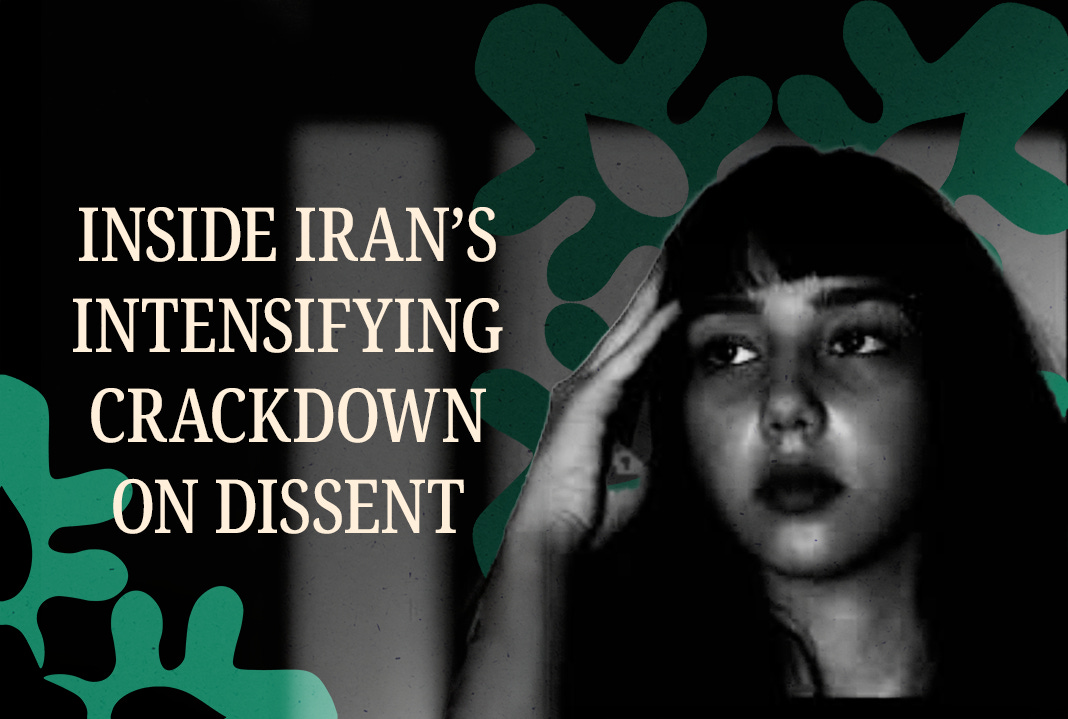
In a black-and-white video, Bita Shafiei comes across as confident and determined. Her bangs fall across one side of her face, veiling her eye like a soft curtain—her gaze half-hidden with haunting intensity.
“Dad, it’s time to say goodbye. But don’t tell mom anything,” she sings softly in Farsi. “Dad, I can’t take it anymore. My throat is choked with sorrow and pain. Dad, if I’m gone, know that it was all for the future. Know that my only wish is to see Iran free one day.”
In hindsight, the lyrics aren’t merely abstract or hypothetical, but a premonition of Shafiei’s fate.
According to activists, the 19-year-old was arrested by security forces of the Islamic Republic of Iran on November 13, just three days after her mother, Maryam Abbasi Nikoo, was also arrested.
When her mother was taken, Shafiei took to her Instagram to post: “Intelligence agents stormed our home, abducted my mother, transferred her to an unknown location, and have refused to provide any answers.”
A video shared by the teenager’s father following the raid shows substantial damage inside their home, highlighting the force used by the authorities.
Shafiei was already on their radar. She had previously been arrested during the “Woman, Life, Freedom” (Zan Zendegi Azadi) protests. During her detainment, she was tortured and had a finger broken during interrogation.
In this latest arrest, Bita Shafiei—a resident of Shahin Shahr in Isfahan Province—was transferred to an undisclosed location.
Currently, there is no information available on the teenager's or her mother's whereabouts or condition. This week in Junqan, southwestern Iran, a group of citizens gathered to demand their release.
Following this latest disappearance, many activists are convinced that the theocratic regime is turning its ire particularly on those who are openly supporting Iran’s former royal family.
In Bita’s video, a poster of Mohammad Reza Pahlavi, the Shah who was overthrown in the 1979 Islamic Revolution, is visible behind her.
“Every day, there are new names. It’s so sad,” says Ellie Borhan, an Iranian exile and activist who set up the Stage of Freedom group following Mahsa Amini’s murder in 2022. “There’s more pressure on those activists who are supporting Reza Pahlavi.”
Reza Pahlavi, son of the former shah, has condemned the abductions and the broader crackdown by the Iranian regime. “Bita has asked us to be her voice. We will not let her down,” he said in a statement, saluting her courage.
The self-styled crown prince has been advocating for a secular, democratic Iran, positioning himself as a facilitator of the transition rather than a monarch seeking power.
Shafiei’s fate follows a long list of political detainees who have been abducted over the years. Some of them have subsequently died in custody.
Earlier this month, 31-year-old Farzad Khoshboresh, from Mazandaran province, died while imprisoned at the Intelligence Detention Center in northern Sari.
According to reports, officials claimed Khoshboresh’s health deteriorated in detention and that he died after being transferred to a hospital.
But activists insist that the bruises and signs of torture on his body tell a different story. Khoshboresh had previously been detained in August for “posting and sharing political criticism on social media” and was released on bail.
He was also a supporter of the monarchy. As was Milan Khajeh’i, a 30-year-old history student who was detained by security forces in Shiraz. She has since been held incommunicado.
If anyone knows all too well about the lengths to which the Islamic Republic will go, it’s Ellie Borhan. Now based in the UK, Borhan was physically attacked outside a center in Wembley, north west London, allegedly by supporters of the regime. She was hospitalized after they beat her.
Her activism also made her family back in Iran collateral damage. In mid-June, as Israel and Iran launched airstrikes on one another during a 12-day war, Ellie’s 30-year-old brother was kidnapped and tortured by the fearsome Islamic Revolutionary Guard Corps (IRGC). He was eventually released, but only after agreeing to spy on his sister and lure her to a neighboring country, where the regime could kidnap her across the border.
Borhan’s mother and brother were forced to sign a loyalty pledge and were scheduled to appear in court. Instead, they fled the country, carrying just two suitcases.
Since June 13, over 20,000 people have been arrested in Iran for crossing the regime: journalists, activists, relatives of protest victims, and religious or ethnic minorities, including Baháʼís, Kurds, and Afghans.
“We now say that prisons are like universities, because they are full of teachers, doctors, lawyers, and professors,” says Borhan. “Their only crime was asking for democracy.”
This summer, Reza Pahlavi issued a blunt message calling on Iranian military and security forces to abandon the Islamic Republic and “join the people” against the regime.
Perhaps it is this which has further provoked the mullahs’ wrath. Yet the regime remains careful about the image it wishes to project abroad.
Lately, a cohort of Western journalists was invited to Iran to report on the country. Mainstream British outlets, for example, gushed over how free and even westernized it appeared, marvelling at the women flouting the mandatory hijab laws.
But there is no such thing as a free journalist in Iran. Visiting reporters are shuffled around by regime handlers and reduced to mouthpieces for state propaganda, unable—or unwilling—to report the country as Iranians experience it.
The journalists were effectively “whitewashing the regime,” says Borhan. “When I read those articles, I felt so disappointed.”
As I wrote recently for Middle East Uncovered, the Islamic Republic is making tactical choices, not ideological shifts.
“Many people are challenging the government,” says Borhan. “Bita’s character was different to others. She was always encouraging people to get united. She said, ‘When I get arrested, be my voice. If not, they can do what they want.’”
Still, people speak out—because silence has become another kind of death. Some are driven to the ultimate act of protest: setting themselves on fire in sheer desperation, as 20-year-old Ahmad Baledi did when officials moved to demolish his family’s only source of livelihood: a modest food kiosk.
“They’ve had enough,” says Borhan. “When you have no hope for the future, you do what’s possible.”
Once just a young woman’s plea for freedom, Bita Shafiei’s voice now reverberates as a warning of what dissenters face. Her disappearance is not an isolated tragedy but part of a broader, brutal pattern: a regime so insecure (and vulnerable, perhaps) that even a teenager’s song can unsettle it.
Middle East Uncovered is powered by Ideas Beyond Borders. The views expressed in Middle East Uncovered are those of the authors and do not necessarily reflect the views of Ideas Beyond Borders.
Grateful for your attention to the plight of prisoners in Iran. Thank you for giving them a voice ❤️