


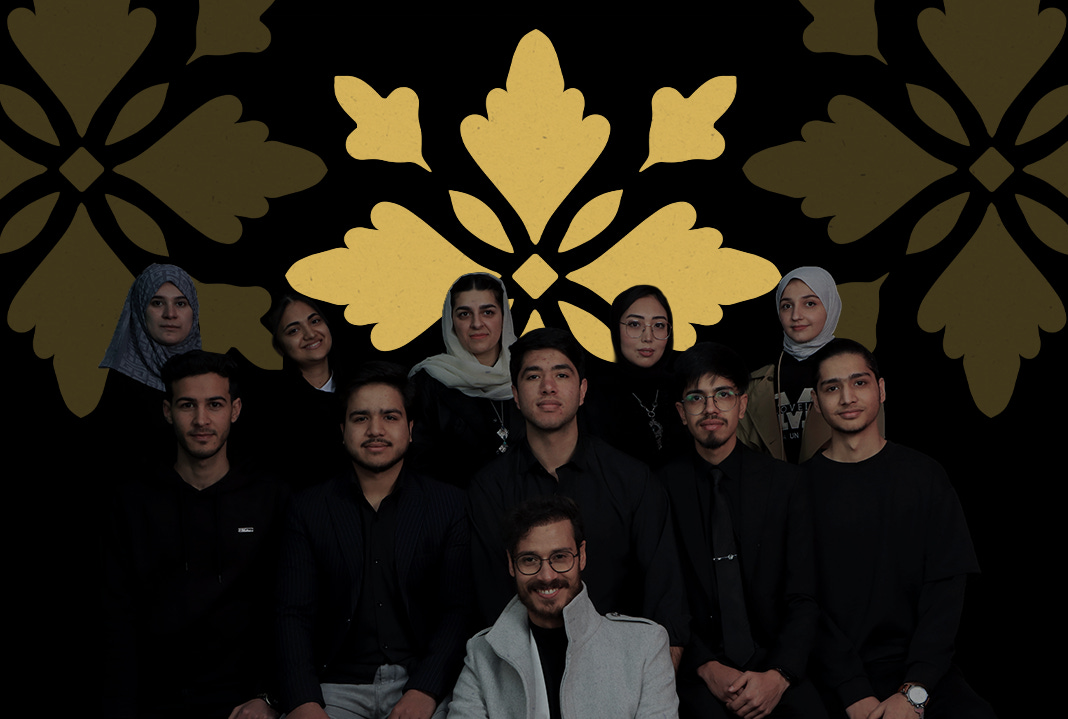
No money, no network, and a café instead of an office. Soon, the four teenagers would lose that too, evicted only for ordering energy drinks from morning till closing time. Undeterred, they moved to another café in Kart-e Char, a neighborhood in western Kabul, and put their heads together over business plans, dreaming their start-up empire into existence.
“We had just finished school, and we didn’t have a clue,” says Suhail Yadgari, whose entrepreneurial experience came from tips in YouTube videos. Three years later, he is the CEO of Veyaarh Holding Group, which he co-founded with Abdul Basit Amarkhail and now runs seven ventures across technology, media, and education. They include Ayen, a design company with an international client base, alongside Startup Grind Kabul and TEDxShar e Naw, where he is creating the network entrepreneurs lack in Afghanistan.
But the rapid realization of Yadgari’s dreams came at a price. Afghanistan’s start-up scene is sparse, without coworking spaces to swap ideas, incubators where early-stage business models are tested and developed, or accelerators that offer mentorship and access to crucial seed funding. “We’re a third-world country, and startups are not the focus. We have a lot of limitations,” he says.
For his ideas to succeed, Yadgari would have to create his own environment to nurture startups. “That’s the ultimate goal: a stable ecosystem in Afghanistan with successful companies inside it,” he says.
Laying the foundations for an entire sector meant long hours at his desk and little time for rest. “It has cost me time with my family and friends, a lot of sleep, and some of my health,” says Yadgari, who suffered multiple bouts of acute pancreatitis from overdosing on caffeine and stress.
Looking back on that period now, he believes he found a formula for startup success. His new book, The Bootstrapped Brand, charts the route from idea to launch, showing how founders like him can start with nothing and build from the ground up. “I wrote it for founders in emerging markets because almost every brand book assumes you have a budget, a market that works, and infrastructure you can rely on. I had none of those,” he says.
What he had instead was a growing set of skills and a first-hand insight into navigating a market with untapped potential. For Yadgari, the upside of a system that doesn’t support start-ups is the scope it offers to industrious entrepreneurs. “There are a lot of opportunities in Afghanistan that don’t exist anywhere else in the world,” he says, pointing in particular to the huge gap in online services.
Daily life in Afghanistan, even now, is distinctly analog. People visit the bazaar rather than order groceries online, while shops still use notebooks to record transactions. Buying a car or renting a house relies mostly on word of mouth, and cash is frequently the only payment option.
This poses a challenge for digital-first startups that depend on overseas clients to bolster their revenue streams. But it’s also an opportunity. “In a mature market you fight for space in a crowded category. Here the category often doesn’t exist yet,” Yadgari says.
Five years after the Taliban’s return, Afghanistan’s economy is showing signs of growth as it continues to stabilize after the sharp contraction that followed the takeover. The World Bank points to a “modest” expansion in 2025, with real GDP up by an estimated 4.8 percent. However, the recent return of millions of Afghans from neighboring countries has prompted a rapid population spike, straining the country’s fragile economic recovery. Many Afghans feel poorer amid job shortages, rising food prices, climate shocks, and declining humanitarian support.
When Yadgari was brainstorming business ideas with his friends at cafes in Kart-e Char in 2023, the picture was bleak. Government support for aspiring entrepreneurs was non-existent, and many of his classmates left to pursue their ambitions overseas.
Friends in Europe and America urged him to join them, but Yadgari felt compelled to stay and build the infrastructure Afghanistan lacked. He knew he would be starting with nothing. “In most countries, a young founder can find an accelerator, a mentor, an investor, or at least a community of people building the same way. Here that layer barely exists.”
In his book, Yadgari shows how he built businesses with no money or network using free tools and self-marketing. “My advice is to build channels you own first and never make paid ads the foundation, because paid reach stops the moment the money does.”
Start-up capital, he believes, needs to be self-generated in Afghanistan, hence the title of his book The Bootstrapped Brand. “In Silicon Valley, it’s a choice to go bootstrap, but in Afghanistan it’s a must,” says Yadgari, who funded the launch of Ayen Creative Agency through freelance design projects.
Now profitable, the company draws on its international client base to generate revenue from development and design services, some of which it can channel into the group’s other ventures. Each adds another layer to the entrepreneurial landscape that Yadgari is cultivating.
Foundr OS, intended to be Afghanistan’s first start-up operating system, offers a 12-week training program for 50 to 80 founders, at least half of whom will be women. This is produced in partnership with two other Veyaarh ventures, Zdakara, an e-learning platform, and TEDxShar e Naw, which hosts inspirational talks and networking events.
Yadgari remembers the moment he secured the license to run TED talks in Afghanistan. “I applied on the off-chance. I didn’t think I would get it.” He was in the shower when the email came through. Initial excitement gave way to trepidation as he confronted familiar problems. There was no network to make up the guest list, no money, and sponsors were in short supply.
Once again, he drew on bootstrapping principles, paying $2,000 out of pocket and relying on word of mouth to put on the first event. “There were a lot of hiccups, but once I saw people talking and networking, I realized what a big thing this was for Afghanistan.”
Women in particular, denied the chance to study and work in most sectors under Taliban rule, have found a rare space to participate in the start-up community. A tenfold increase in the number of Afghan women holding official business licenses over the past five years shows that many are turning to entrepreneurship when they are barred from work elsewhere. Others are working remotely, finding ways to continue their careers from home.
Five years after the Taliban seized power, women make up just five percent of workers in the country, down from 16.5 percent in 2020. A recent report by the International Labor Organization described it as the second-lowest female labor force participation rate in the world, after Yemen, warning that losing women from the workforce risks undermining the country’s economic resilience by limiting its productive capacity.
Yadgari worries about the long-term impact if women continue to be excluded. His female employees work from home, but many private companies avoid hiring women altogether. “Afghanistan is losing a lot of its best talent,” he says.
The ecosystem Yadgari is building could also create more routes for Afghan women to participate in the economy and create sustainable sources of income across sectors, including technology.
However, the rise in female entrepreneurship is not necessarily a sign of opportunities opening up. A recent UNDP report described many of these businesses as a last resort. “It’s what’s left after the other doors closed. Women who wanted to be engineers or lawyers are weaving carpets and making soap because that’s the path still permitted,” said Doel Mukerjee, Deputy Resident Representative, UNDP Afghanistan.
Entrepreneurs like Yadgari are seeking to change this by creating pathways for Afghan women to participate in the wider economy. Not just in arts and crafts, but tech, online education, and other rapidly evolving spaces where the potential for innovation is huge. “People assume that because we are a developing country under the Taliban, we must live and work like cavemen. The reality is very different. Afghanistan has gone through a real digital shift in the past few years, and it is speeding up,” he says.
Just three years ago, Yadgari was moving from café to café, dreaming up businesses that hardly had a place in Afghanistan’s economy. Now he is showing other entrepreneurs how to build from scratch in a country where venture capital and co-working spaces are scarce. “What it has given me back is a set of skills no course could have taught me,” he says. “I learned them by building, failing, and fixing things in real time, in a place where there is no playbook to follow.”


Middle East Uncovered is powered by Ideas Beyond Borders. The views expressed in Middle East Uncovered are those of the authors and do not necessarily reflect the views of Ideas Beyond Borders.
thank you olivia for writing this the way you did. most coverage of afghanistan stops at the politics and never reaches the people quietly building things here.