


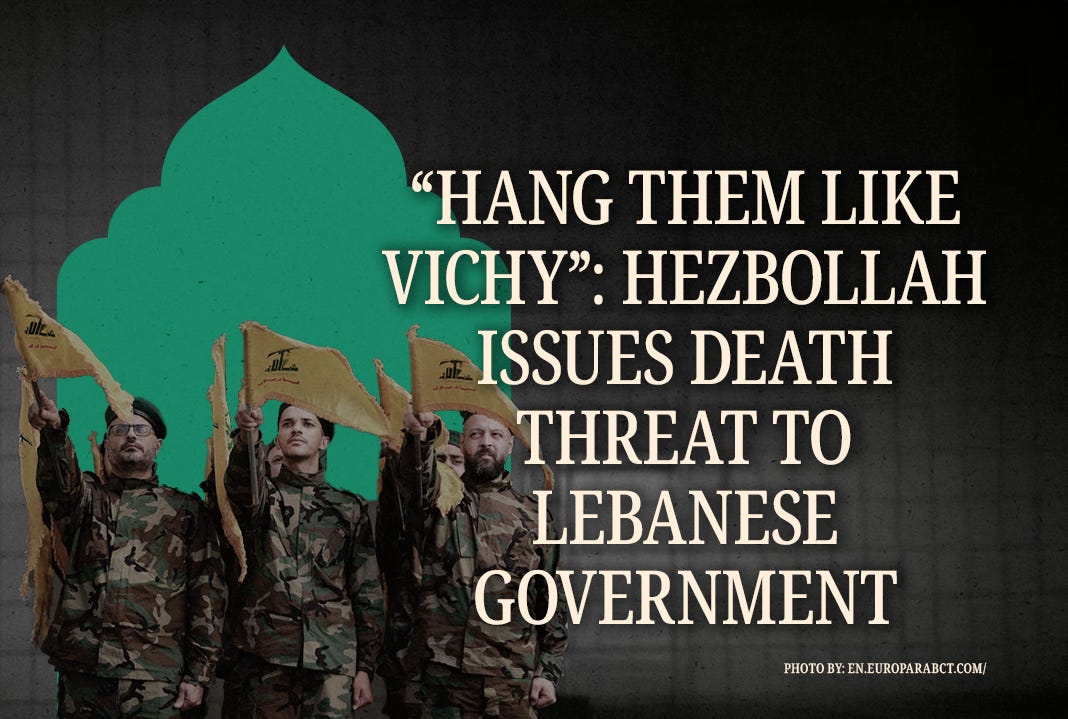
Lebanon is at war, and the most dangerous front isn’t at the border—it’s inside the state itself, where threats are now turning inward.
Since the start of the war in Iran, Hezbollah’s senior political rhetoric has moved from contempt to something far more explicit. Mahmoud Qamati, deputy head of Hezbollah’s political council, invoked the fate of the infamous Vichy government.
The Vichy regime (July 1940–August 1944) was an authoritarian state based in southern France, headed by Marshal Philippe Pétain, that cooperated with Nazi Germany during World War II. Formed after France’s military defeat, it replaced the Third Republic and implemented an anti-Semitic agenda under the banner of the “Révolution nationale,” while formally maintaining a stance of neutrality.
He said Vichy “arrested the resistance and executed them,” was later overthrown, and “the traitors in it were executed,” adding: “God willing we don’t get there.” He followed it with a promise that “Based on the current facts and positions, it appears that a direct confrontation with this political authority is inevitable after the war ends, regardless of its outcome. The government in Lebanon is no longer fit to run the country, and its positions only serve the Israeli enemy. Therefore, confrontation is coming, and the traitors will pay the price for their betrayal.”
This is a blatant death threat, delivered through historical analogy, so it can be denied later with a smirk. It places an elected government in the category of traitors and elevates Hezbollah to the role of judge and executioner. And it suggests—without even bothering to hide it—that Lebanon’s leadership may be forcibly executed if it attempts to behave like a state.
If Lebanon still had any illusion that Hezbollah can be treated as a normal Lebanese political actor, it should die here.
Hezbollah’s Vichy rhetoric is a weapon designed to justify violence.
“Vichy” is not shorthand for “weak” or “corrupt.” It means collaboration with an occupying enemy. It is one of the most morally loaded accusations in modern political memory because it turns opponents into legitimate targets. By placing the government in the “Vichy” category and speaking about how “traitors were executed,” Hezbollah is doing three things at once:
delegitimizing the state as a treasonous instrument,
sanctifying itself as the only authentic national actor, and
preparing the public for physical punishment against anyone who challenges its war decision.
It’s also a grotesque inversion.
A collaborator regime is one that enforces an external occupier’s will against its own people. Hezbollah is the actor in Lebanon that has long operated as a parallel sovereignty: deciding war and peace outside the state’s control, maintaining its own security apparatus, and aligning its strategic priorities with Iran. The Vichy analogy does not describe the Lebanese government. It describes the relationship Hezbollah wants Lebanon to accept: a country that exists to serve an external project, while anyone who resists that project is branded a traitor.
Lebanon’s postwar era has been stained by political assassinations. Some were solved; many were not; most have been swallowed by impunity. The most consequential example was the 2005 assassination of former Prime Minister Rafik Hariri. A UN-backed tribunal later convicted a Hezbollah member, Salim Ayyash, for his role in that assassination. Hezbollah rejected the tribunal and refused to hand him over.
Around the same period, Lebanon witnessed a wave of assassinations targeting prominent critics of Hezbollah’s terror axis. (Samir Kassir, Walid Eido, Gebran Tueini, and Pierre Gemayel among them.) These murders deepened the country’s belief that politics is enforced by bullets, not ballots. In many cases, the perpetrators were not brought to justice. That impunity becomes part of the threat ecosystem: when killers are not punished, threats become credible by default.
So when Hezbollah’s official rhetoric flirts with “executions,” it does not matter that the sentence ends with “God willing we don’t get there.” The message is already delivered: we can get there, and you should behave accordingly.
The threats have expanded from political discourse into direct intimidation of media and public speech.
A Lebanese TV station reported “death threats and intimidation messages” targeting officials and staff, describing it as an attempt to “silence the media by force” and subject free speech to “the logic of weapons.” The accusation attached to these threats was familiar and poisonous: claims that the station’s reporting on Hezbollah’s illegal activities “gave coordinates” to Israel.
Then came the digital enforcement arm. The station’s website was hit by a cyberattack that took it offline. A group calling itself the “Fatimiyoun Electronic Squad” claimed responsibility and described the outlet as “Zionist,” adding that the attacks would not be limited to denial-of-service and that the station’s databases would be exposed “successively.”
Speech in Lebanon has become a frontier of the ongoing war, and it carries penalties. If you report, you may be branded a traitor. If you are branded a traitor, threats become “patriotism,” and Lebanon knows very well that those threats are often realized.
This is how a militia governs when it cannot persuade: it makes fear a public utility.
There is a deeper scandal here than Hezbollah’s threats. The scandal is the state’s slow, cautious, and evasive response.
A state is not a state if it cannot defend the basic right to disagree without being threatened with death. When officials are publicly compared to Vichy traitors who deserve “execution,” and the state does not respond with firm action, it sends a message to every Lebanese citizen that the militia has more authority than the republic.
When journalists receive death threats, and the response is not immediate prosecution, it teaches every newsroom that survival requires self-censorship.
And when cyberattacks are claimed publicly with escalation promises, and the state still behaves as if this is a “media dispute” rather than a political intimidation operation, it signals institutional surrender.
This is how Lebanon is trained into submission. Not with one coup, but with a thousand small retreats.
For years, Lebanese officials and foreign diplomats hid behind timid vocabulary: Hezbollah’s actions were “uncoordinated,” “unregulated,” “outside the state.” Even when the results were catastrophic, the language stayed polite, as if Hezbollah’s problem were administrative rather than existential.
That framing has expired.
When a movement declares war without the state’s consent, threatens an elected government with the language of execution, and cultivates an ecosystem that threatens journalists with death and enforces fear through cyberattacks, this is no longer merely “illegal.” It is terror politics.
And that is why the next conclusion is unavoidable.
A political party does not threaten to “execute traitors.” A political party does not wrap an elected government in the language of treason and imply it may deserve the fate of collaborators. A political party does not tolerate an ecosystem where journalists receive death threats for reporting. A political party does not cultivate punishment through cyberattacks and threats of database exposure.
This is the behavior of a terrorist organization.
Hezbollah has benefited from Lebanon’s greatest national delusion that it could be treated as both a militia and a party for decades. That hybrid model is what trained the state to hesitate and society to accept intimidation as “normal politics.”
If Lebanon wants to survive this war with anything resembling sovereignty, it has to stop entertaining the fantasy of coexistence with a movement that treats disagreement as treason and treason as a pretext for death.
Hezbollah’s threats are not only about today’s government or today’s newsroom. They are about tomorrow’s Lebanon.
They are training a population to believe that citizenship has conditions: don’t speak too loudly, don’t question the war, don’t investigate the militia, and don’t oppose the chain of command.
The most frightening line in Qamati’s speech is not the reference to Vichy, but the calm assurance that the confrontation with the state is “inevitable.” That is a militia announcing it intends to discipline the republic after the war, and informs how the citizenry and its leaders will behave in the interim.
Lebanon’s answer to the current moment cannot be another season of silence. We have had enough. If the state remains inert now, then Lebanon is not heading toward a crisis. It is already living inside one and is now heading towards the end of Lebanon’s existence.
To put it plainly: Lebanon is being held hostage, and the state is suffering from Stockholm syndrome.
Middle East Uncovered is powered by Ideas Beyond Borders. The views expressed in Middle East Uncovered are those of the authors and do not necessarily reflect the views of Ideas Beyond Borders.

Thank you for this article. It is an eye-opener. The Middle East Uncovered fills in a huge gap in American media coverage in an area that is extremely important in the world. It behooves all of us to understand this part of the world better.
Hezbollah boasts of "resistence" and defending Lebanon from Israel, but the only reason Israel attacks Lebanon is because Hezbollah attacked them. Israel has 0 interest in Lebanon.