


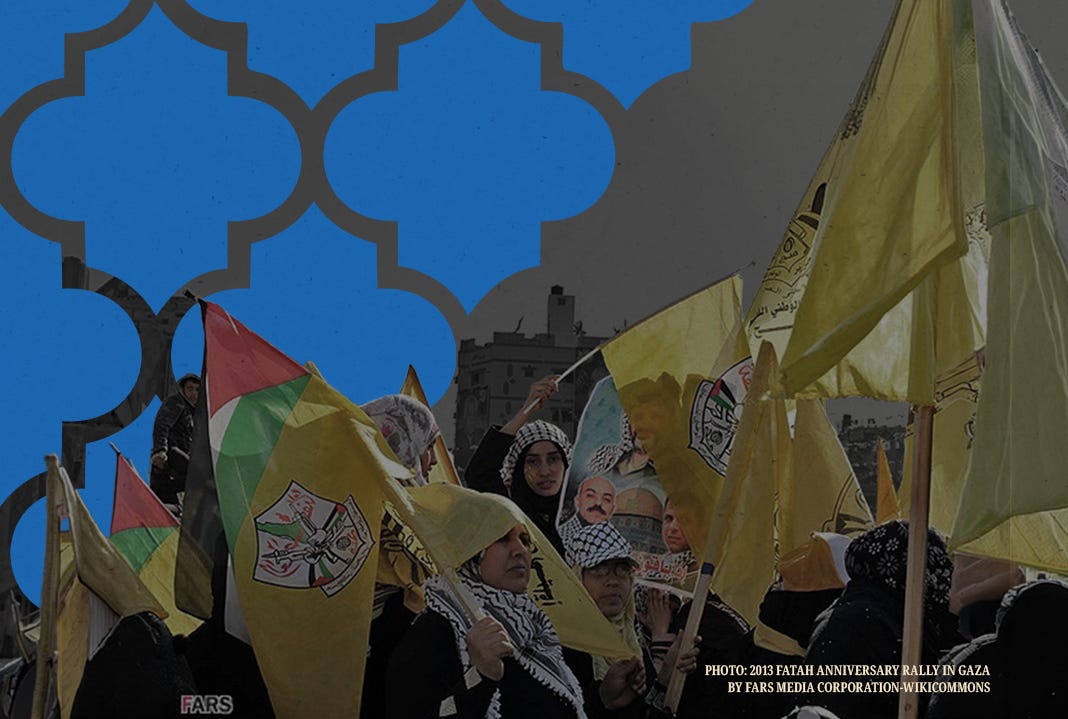
Last week, Palestinians received news that the upcoming legislative election previously scheduled for November of this year would be postponed once more.
Jibril Rajoub, the newly elected secretary-general of Fatah, announced the move. Speaking in Ramallah, he told journalists: “There will be no elections... We will proceed to elections after holding a comprehensive Palestinian national dialogue to reach consensus on the mechanisms for conducting them.”
He then suggested that a presidential election could be held first on the basis that “they are easier” and “less costly.”
The last Palestinian legislative election took place in 2006, and the one before that in 1996.
Right now, there is no functioning Palestinian parliament. After Hamas seized control of Gaza in 2007, the parliament ceased meeting and has not resumed.
Since then, many attempts have been made to revive the democratic process. This is not the first time in recent years that elections have been postponed.
Most recently, elections were scheduled for May 2021, to be followed by a presidential election in July. However, Mahmoud Abbas postponed the process just weeks before the vote was set to take place. The official reason given at the time was Israel’s failure to guarantee that Palestinians in East Jerusalem would be permitted to participate in the election. But many thought that this was a highly dubious explanation. Hamas was in a position to win. Fatah had fractured into three competing factions, while Hamas remained comparatively unified.
But today, we do not see a similar situation. And still, elections have been canceled. In the most recent electoral poll of Palestinians from the Jerusalem Center for Media and Communications, Fatah led with 27.4 percent of those polled. Meanwhile, Hamas was at 7.6 percent. 40.2 percent of those polled said that they would not vote at all.
So Fatah is ahead. Unlike in 2021, fear of losing to Hamas cannot explain why the vote was called off.
Of course, Hamas’s participation is itself controversial. Hamas does not recognize Israel and has never accepted the political framework of the Palestinian Authority which was adopted via the Oslo process during the 1990s. In other words, Hamas is seeking power through institutions created by agreements it does not accept.
This is a fundamental contradiction, and we have seen how badly it has played out in the past.
Allowing an armed group that rejects the peace process and coexistence with Israel to participate in a democratic system has given it the power to derail that very process.
In July of this year, Hamas formally dissolved its de facto government, while agreeing to hand over civilian governance to the new National Committee for the Administration of Gaza. But it has yet to disarm. At the end of July, Hamas and the other armed factions agreed to a Board of Peace roadmap under which power would ultimately be transferred to the new administration and Hamas’ weapons decommissioned. More than a month later, however, that process remains incomplete, and Hamas continues to possess its arsenal.
Palestinians who want to make peace with Israel need to be tougher and more resolute. For the Palestinian Authority to continue canceling elections is unacceptable and is a national shame for Palestinians.
The demise of the Hamas government in Gaza is an opportunity to revive the peace process and rejuvenate Palestinians’ national aspirations on the basis of coexistence alongside Israel.
While achieving a peaceful solution may have become much more difficult in recent years, there is still hope for a negotiated solution.
That same poll from the Jerusalem Center for Media and Communications revealed strong support for a two-state solution, with 47.9 percent of those polled backing it. Meanwhile, 21.7 percent favored a binational Palestinian-Israeli state, while only 18.1 percent favored a single Palestinian state “from the river to the sea.”
Peaceful negotiations with Israel were the preferred path, backed by 55.8 percent of respondents. Another 17.8 percent favored nonviolent resistance, while just 13.3 percent supported an armed intifada.
Any negotiated solution needs a Palestinian government with the democratic legitimacy to speak for its people and the credibility to negotiate peace. Mahmoud Abbas was last elected more than twenty years ago. Palestinians deserve the chance to choose who represents them now.
That means holding elections, without another postponement.
The PA has its own crisis of legitimacy after years without national elections, and public distrust runs high. In an August poll, 83 percent of Palestinians said they believed corruption existed within PA institutions. They should have the opportunity to judge Fatah’s record for themselves at the ballot box.
But elections alone are not enough. Candidates seeking to lead institutions created through the Oslo process should accept the framework those institutions are built on, including recognition of Israel. We have already seen what happens when armed groups exploit democratic institutions while rejecting the agreements underpinning them.
Palestinians have waited twenty years for this election. They should not be asked to wait any longer.
Hamas Won Gaza’s Last Election. Twenty Years Later, Palestinians May Finally Get the Chance to Choose Differently.

In January 2006, Palestinians went to the polls to elect a new parliament. This was the first legislative election since 1996, and none have happened since.
Middle East Uncovered is powered by Ideas Beyond Borders. The views expressed in Middle East Uncovered are those of the authors and do not necessarily reflect the views of Ideas Beyond Borders.

As I understand it, the elections are being postponed because otherwise neither Hamas nor Fatah would win. Marwan Barghouti’s alternative list would. Some people call him the Palestinian Mandela.
Moreover, there is a very good chance he would win the presidential election next year too.
If it takes place, of course.
And will Palestinians accept being deprived of the franchise?