


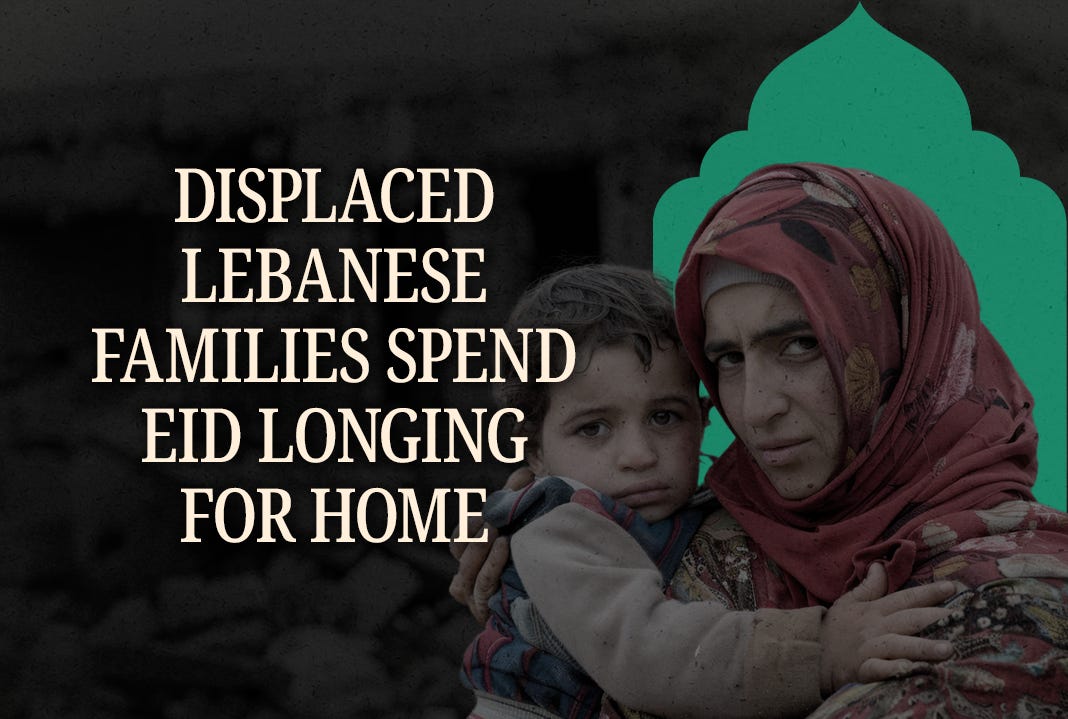
The ongoing war between Hezbollah and Israel has deepened despair across Lebanon, worsening an already dire economic crisis and forcing many families from their homes. As Muslims around the world celebrate Eid al-Adha, many in Lebanon are struggling to experience the joy and sense of togetherness that usually define the holiday.
Eid al-Adha, or the “Festival of Sacrifice,” commemorates Prophet Ibrahim’s willingness to sacrifice his son, Ismael, as an act of obedience to God, according to the Quran and Hadith. Observed on the 10th day of Dhul Hijjah, the final month of the Islamic lunar calendar, the holiday is traditionally centered on the sacrifice of a lamb and gatherings with family and friends. While animal sacrifice is not one of the five pillars of Islam, it remains a widely observed Sunnah rooted in the traditions of the Prophet Muhammad.
Many Muslims in Lebanon, however, are finding it difficult to uphold the practice this year. For some who have been forced to flee their homes, displacement and financial uncertainty have pushed long-held traditions out of reach, shifting the focus from celebration to meeting basic daily needs.
“Eid is not [about] joy and celebrations this year,” said Abir Fakih, a displaced woman who evacuated her home from the southern Lebanese city of Nabatieh. “Eid this year is about nostalgia and silent longing.”
Fakih is one of more than a million Lebanese who have been internally displaced in recent months. Much of the South has become uninhabitable, rendering many without access to their homes. Fakih lived north of the Litani River, a militarized frontier, where Israeli soldiers have created a buffer zone. Hezbollah attacks are launched from north of the river toward Israeli soldiers, who swiftly return fire. The back-and-forth between the two parties has created a dangerous situation for locals in the surrounding areas, including Fakih and her family.
“I evacuated my home with my family around 3 am on March 2nd,” said Fakih. “My village was bombed heavily since it was just north of the Litani River, and almost all villages behind it are fully demolished.”
She is currently renting a small studio with her family in northern Lebanon, but the uncertainty has dampened their Eid celebrations.
“We are trying to make the most out of Eid,” Fakih said. “Maybe we will go out and have a special meal, but at the end of the day, we need to create hope with the resources available.” She and her family eventually spent Eid at their studio, enjoying a home-cooked meal and calling some of their friends in the process.
Others expressed that they have yet to experience the Eid spirit at all this year. A resident from Tripoli, a Sunni-majority city in northern Lebanon, has lost her sense of joy that typically accompanies the holiday. She spoke to Middle East Uncovered on the condition of anonymity.
“One thing I noticed is the lack of Takbir [religious chants] over the speakers by many mosques,” one resident said. “I remember them being more prominent in previous Eid seasons, but maybe they [imams] are not in the mindset.”
Tripoli is far from the conflict in southern Lebanon, but it is still impacted by it. In order to avoid Israeli bombardment, thousands of families have fled southern Lebanon and Beirut’s Dahieh region toward Tripoli and other regions in the north. The city has become a hotspot for the internally displaced, but lacks sufficient resources and proper shelters. A number of those families currently occupy public schools that have been converted into shelters. Others are experiencing difficulty finding housing, especially given the heightened sectarian divide many described as escalating.
“The overall climate is that people are a bit too occupied with lots of worries to even be thinking about Eid,” said another resident. “I have overheard that many citizens might not be able to afford sacrificial lambs, and I think that some [people] are promoting a kind of presumably cheaper alternative to the practice.”
He ultimately visited a few of his relatives during Eid, but said the occasion felt casual and far from special.
Many who celebrate Eid typically buy date-stuffed pastries and sweets in addition to sacrificial lambs. According to local reports, the price of lamb now ranges from $350 to $570, depending on the breed and weight of the sheep. Some prices can be even steeper, making it difficult to purchase in a country where the average monthly income is often estimated to be below $500.
Many families traditionally buy new clothes for Eid. This year, however, soaring costs and limited availability of imported goods have put the tradition out of reach for many.
Another resident who works closely with displaced families described a similar mood. People in the shelters, she said, are consumed by uncertainty and longing for the homes they left behind—few are thinking about Eid. She, too, said she feels none of the usual Eid spirit.
“It honestly doesn’t feel like Eid, and I think that the work I do is impacting my feelings about the occasion and my psychological well-being.” She said. “I really like celebrating Eid and buying new clothes for the occasion. However, it doesn’t feel like Eid this year, and I’m not planning on buying new clothes because things are becoming more and more expensive.”
Lebanon is not the only country in the region where economic hardship has overshadowed Eid celebrations. Similar reports have emerged from Syria and Tunisia. But in Lebanon, the crisis is compounded by the war.
For some, Eid this year has become an exercise in remembrance—a longing for the homes and traditions they once knew. Others say they will only celebrate once they are able to return to homes now destroyed, abandoned, or occupied.
In the meantime, a shared meal in a shelter, a phone call to relatives, or a visit with loved ones is all that they have to preserve a sense of the holiday while they wait for more stable days ahead.
Read more of Abdullah’s reporting on Eid below:
“The People Are Hungry and the Prisons Are Full”: Tunisia on the Eve of Eid

On May 16, just days before the Islamic holiday of Eid al-Adha, hundreds of Tunisians took to the streets of the capital to protest deteriorating economic conditions and what demonstrators describe as democratic backsliding. The demonstrations were the second major wave of protests in less than six months, following
Middle East Uncovered is powered by Ideas Beyond Borders. The views expressed in Middle East Uncovered are those of the authors and do not necessarily reflect the views of Ideas Beyond Borders.
They start wars and live by the sword.